THE ADVENTURE COLLECTIVE® · Independent discovery and booking for outdoor travel

Pair Iceland’s essential day sights with a night chase for the aurora on this 11-hour combo tour from Reykjavík. Visit Þingvellir, Gullfoss, Geysir, and Kerið by day, then head into dark countryside for a guided northern lights hunt.
Pair Iceland’s essential day sights with a night chase for the aurora on this 11-hour combo tour from Reykjavík. Visit Þingvellir, Gullfoss, Geysir, and Kerið by day, then head into dark countryside for a guided northern lights hunt.
The minibus pulls out of Reykjavík under a low, iron sky and the city’s hum slides away. In an hour the asphalt gives up to gravel, and the land begins to speak in tectonic lines — the rift valley at Þingvellir yawning open like a seam in the earth. Guides move with practiced economy, directing attention to rock faces, parliament ruins, and the lake that catches the pale Icelandic light.
Verified experiences and guided adventures in the surrounding area.
Operated by Arctic Adventures · Reykjavík, Capital Region
The minibus pulls out of Reykjavík under a low, iron sky and the city’s hum slides away. In an hour the asphalt gives up to gravel, and the land begins to speak in tectonic lines — the rift valley at Þingvellir yawning open like a seam in the earth. Guides move with practiced economy, directing attention to rock faces, parliament ruins, and the lake that catches the pale Icelandic light.
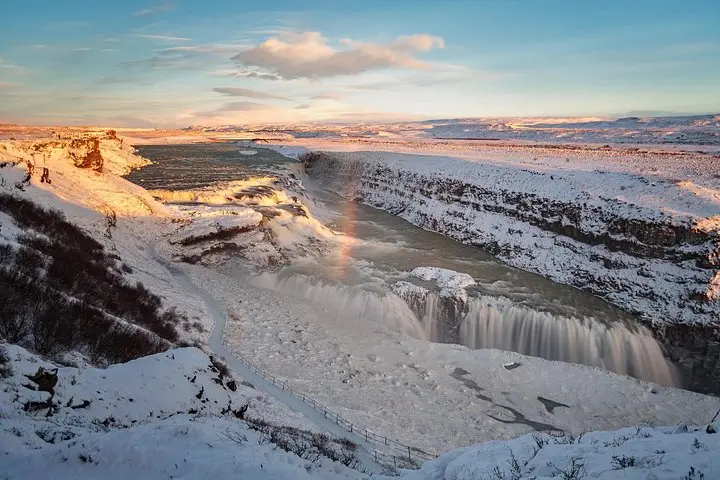
Þingvellir is where geology and history share a stage. The Eurasian and North American plates separate visibly here, cleaving cliffs and filling fissures with clear, cold water. It is also the original site of Alþingi, Iceland’s national assembly, founded in 930. From there the day flows to Gullfoss, a two-tiered fall that plunges roughly 32 meters into the Hvíta River canyon. The water has the blunt authority of glacial melt — Langjökull’s runoff pushing the falls’ roar downstream.
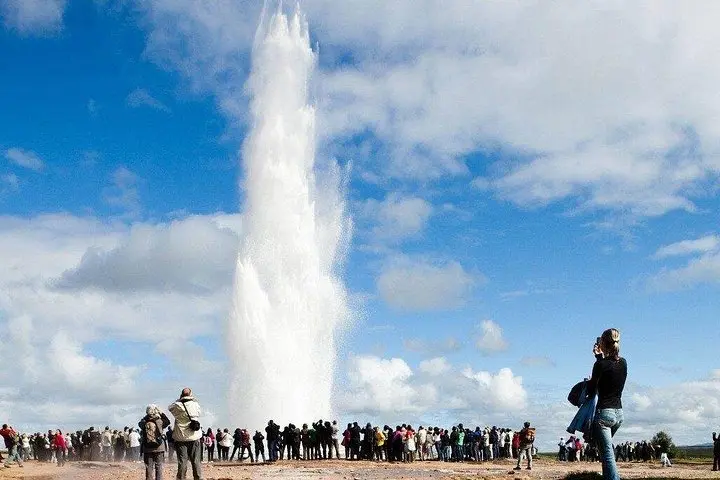
The Geysir geothermal field offers a different kind of drama. Bubbling pools and vents perfume the air with sulphur while Strokkur times its eruptions every 4 to 10 minutes, sending a plume of boiling water skyward with mechanical regularity. Kerið volcanic crater, with its blood-red slopes and crater lake, provides a quieter counterpoint — a compact, walkable reminder of volcanic forces that shaped the region.
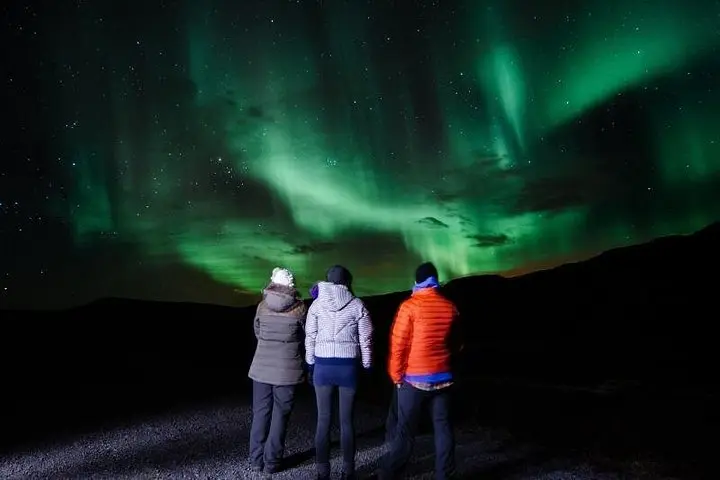
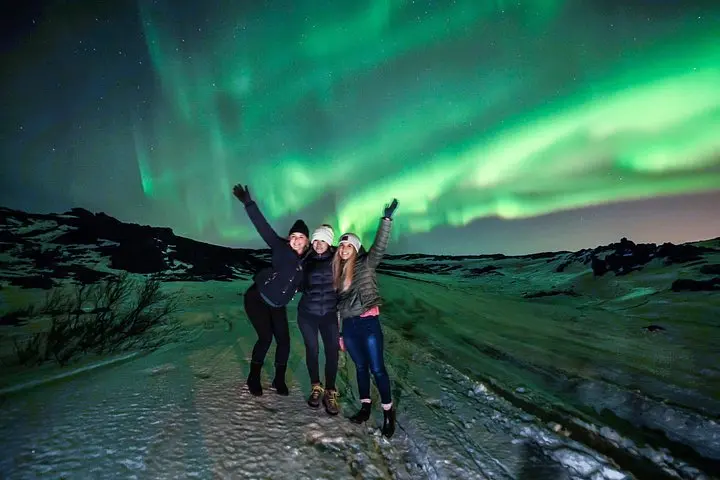
After roughly six hours on the road and multiple photo stops you return to Reykjavík for a pause: dinner on your own, a chance to warm up before the night’s work begins. The second act is a hunt for aurora: guides use KP indices and weather models to chase clear skies, ferrying small groups to remote, dark fields where the lights stand the best chance of appearing. If they do, expect green and yellow ribbons, sometimes edged in violet; guides supply blankets, hot chocolate, and help with long-exposure photos.
Practical edge: the full experience spans about 11 hours, with pickup beginning around noon and a late-evening pickup for the aurora (times change seasonally). Minimum age is 6. The tour operates in most weather, so dressing for cold, wind, and geothermal steam is essential. Bring traction for icy paths in winter and a tripod plus spare batteries for aurora shots — long exposures drain power fast.
This combo is best for travelers who want to compress Iceland’s textbook landscapes into a single, logistics-light day. It trades deep exploration for a curated sweep of geology, history, and skycraft — and if the aurora answers, the payoff is the kind of natural theater that makes the long day feel instant and unforgettable.
Pickup begins around 12:00 PM from authorized points across Reykjavík — pickup list is provided by the operator. Evening pickup for the aurora departs from your original pickup point; times vary seasonally (generally 20:30–21:30).
The full combo runs about 11 hours, returning to Reykjavík around midnight depending on where the aurora is seen.
No; aurora is a natural phenomenon and cannot be guaranteed. Guides monitor KP index and weather to maximize the chances and will relocate to find clearer skies when possible.
Yes, minimum age is 6 and children must be accompanied by an adult.
No. The operator notes the tour is not wheelchair accessible due to vehicle and terrain limitations.
Dinner in Reykjavík is on your own during the break between the Golden Circle and aurora portions; bring snacks and water for the day portion and expect hot chocolate during the aurora stop.
Arctic Adventures operates guided outdoor trips and adventures with an emphasis on safety, stewardship, and memorable experiences.
The minibus pulls out of Reykjavík under a low, iron sky and the city’s hum slides away. In an hour the asphalt gives up to gravel, and the land begins to speak in tectonic lines — the rift valley at Þingvellir yawning open like a seam in the earth. Guides move with practiced economy, directing attention to rock faces, parliament ruins, and the lake that catches the pale Icelandic light.
The minibus pulls out of Reykjavík under a low, iron sky and the city’s hum slides away. In an hour the asphalt gives up to gravel, and the land begins to speak in tectonic lines — the rift valley at Þingvellir yawning open like a seam in the earth. Guides move with practiced economy, directing attention to rock faces, parliament ruins, and the lake that catches the pale Icelandic light.
Þingvellir is where geology and history share a stage. The Eurasian and North American plates separate visibly here, cleaving cliffs and filling fissures with clear, cold water. It is also the original site of Alþingi, Iceland’s national assembly, founded in 930. From there the day flows to Gullfoss, a two-tiered fall that plunges roughly 32 meters into the Hvíta River canyon. The water has the blunt authority of glacial melt — Langjökull’s runoff pushing the falls’ roar downstream.
The Geysir geothermal field offers a different kind of drama. Bubbling pools and vents perfume the air with sulphur while Strokkur times its eruptions every 4 to 10 minutes, sending a plume of boiling water skyward with mechanical regularity. Kerið volcanic crater, with its blood-red slopes and crater lake, provides a quieter counterpoint — a compact, walkable reminder of volcanic forces that shaped the region.
After roughly six hours on the road and multiple photo stops you return to Reykjavík for a pause: dinner on your own, a chance to warm up before the night’s work begins. The second act is a hunt for aurora: guides use KP indices and weather models to chase clear skies, ferrying small groups to remote, dark fields where the lights stand the best chance of appearing. If they do, expect green and yellow ribbons, sometimes edged in violet; guides supply blankets, hot chocolate, and help with long-exposure photos.
Practical edge: the full experience spans about 11 hours, with pickup beginning around noon and a late-evening pickup for the aurora (times change seasonally). Minimum age is 6. The tour operates in most weather, so dressing for cold, wind, and geothermal steam is essential. Bring traction for icy paths in winter and a tripod plus spare batteries for aurora shots — long exposures drain power fast.
This combo is best for travelers who want to compress Iceland’s textbook landscapes into a single, logistics-light day. It trades deep exploration for a curated sweep of geology, history, and skycraft — and if the aurora answers, the payoff is the kind of natural theater that makes the long day feel instant and unforgettable.