THE ADVENTURE COLLECTIVE® · Independent discovery and booking for outdoor travel

Landscapes that change by mile and myths that stand for centuries—this small‑group Golden Circle tour is designed for cruise arrivals. Expect thundering falls, erupting geysers, a family dairy stop, and the rift valley where Iceland’s parliament began.
Landscapes that change by mile and myths that stand for centuries—this small‑group Golden Circle tour is designed for cruise arrivals. Expect thundering falls, erupting geysers, a family dairy stop, and the rift valley where Iceland’s parliament began.
The Sprinter idles in the bus lot as passengers stream off the docked ship; a cold wind from the North Atlantic washes through the harbor and the guide checks names, maps, and the itinerary. This is not a timed coach‑line excursion but an arrival‑sensitive Golden Circle: the group waits until the ship has cleared customs, then pushes out into the low volcanic hills that cradle Reykjavík. Within an hour and a half the open landscape changes—steam vents hiss in the distance, a river begins to shout—and the day becomes a string of spectacles.
Verified experiences and guided adventures in the surrounding area.
Operated by EastWest · Reykjavik, Capital Region
The Sprinter idles in the bus lot as passengers stream off the docked ship; a cold wind from the North Atlantic washes through the harbor and the guide checks names, maps, and the itinerary. This is not a timed coach‑line excursion but an arrival‑sensitive Golden Circle: the group waits until the ship has cleared customs, then pushes out into the low volcanic hills that cradle Reykjavík. Within an hour and a half the open landscape changes—steam vents hiss in the distance, a river begins to shout—and the day becomes a string of spectacles.
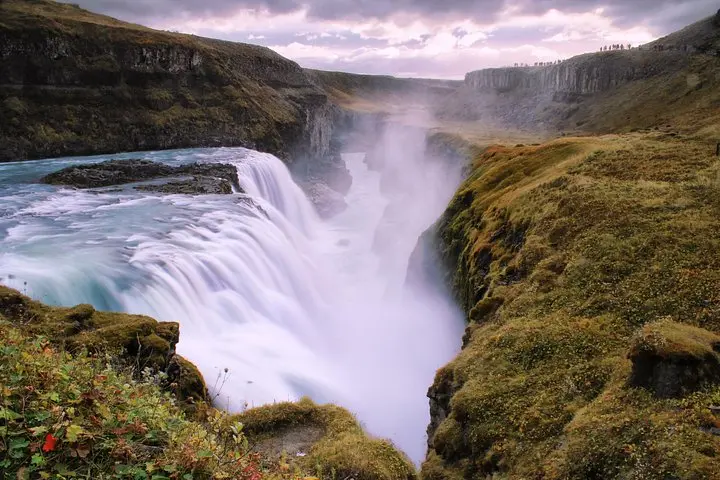
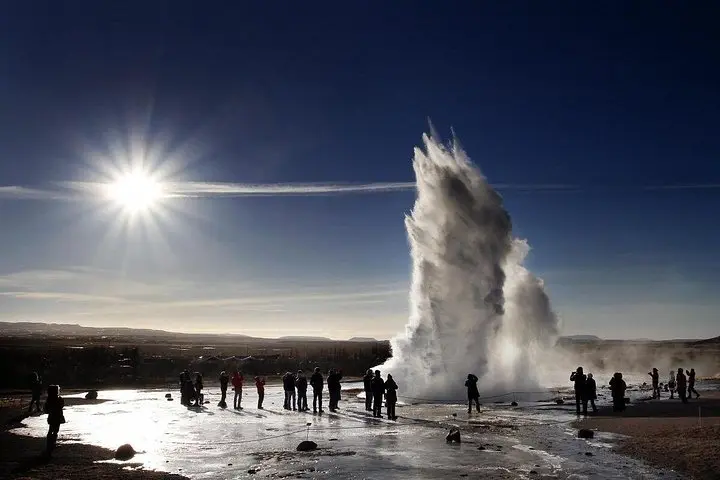
Gullfoss is the first real punctuation: the river Hvítá narrows and then breaks over a two-step curtain that together drops about 32 meters, throwing spray that dares your camera lens closer. The Geysir geothermal field makes a different kind of noise—Strokkur bulges, then shoots water 20–30 meters skyward every few minutes, an impatient giant practicing its routine. Between these bookends, Efstidalur dairy farm provides a human rhythm: handcrafted ice cream, grazing Icelandic cows, and a view of Mount Hekla that keeps watch in the distance.
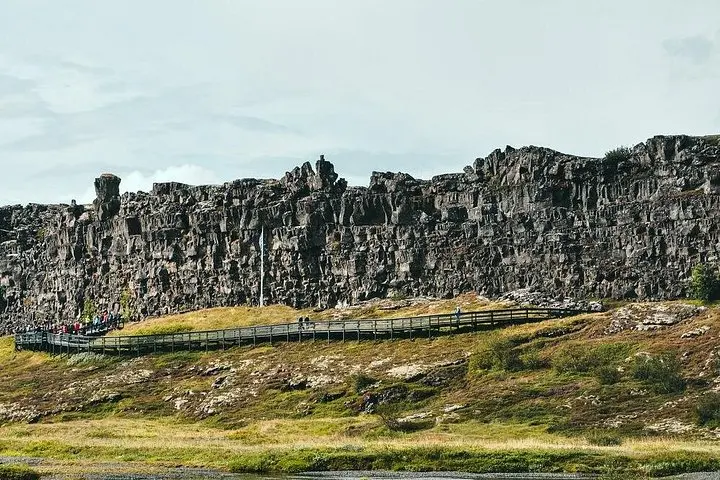
Thingvellir brings the trip into history and geology at once. The plain where the Alþingi met in 930 A.D. still holds the lines of the North American and Eurasian plates; walking the rift is the rare sensation of striding between continents. Öxarárfoss, whose flow was redirected in the settlement era to supply the assembly, is low and bright—one of the few falls shaped by human hands in Icelandic history.
Practical context: this small‑group tour runs about 6–7 hours and covers roughly 230 km round trip from Reykjavík, with about 3½ hours of driving total and numerous short walks. Most stops require only easy walking on gravel paths and boardwalks; expect a 10–20 minute walk at Gullfoss viewpoints and a roughly 1 km round trip to Öxarárfoss with minimal elevation gain. The operator waits up to two hours after your cruise docks—still, factor in customs delays and bring a daypack with snacks and a charged phone.
What to prepare: layers and waterproofs are essential—weather shifts quickly, and spray from waterfalls demands a good shell. Sturdy, treaded footwear keeps traction on wet boardwalks and muddy trail edges. Pack a power bank, a small tripod or sturdy grip for long exposures, and cash or card for farm cafés. Guides in small groups have time to answer questions about geology, settlement law, and contemporary Icelandic farming practices, so use that access to dig deeper into the landscape you’re passing through.
The Golden Circle remains a concentrated lesson in Iceland: rivers that carve drama, geothermal systems that rearrange the ground, and human stories that kept law and livelihood together under a wide northern sky.
Exit through the security gate at Skarfabakki port, turn right to the "Pick up for tours" sign and look for the Mercedes‑Benz Sprinter with the EastWest logo in the bus parking lot.
Expect about 6–7 hours total with roughly 3½ hours of driving and around 230 km round trip; stops include short walks at each site.
The operator advises that infants (0–3 years) should not attend due to tour length and fixed schedule; older children are welcome but must be supervised at viewpoints.
Entry to national parks and geothermal areas is generally free; food is not included—there are cafés at some stops like Gullfoss and Geysir and a farm café at Efstidalur where you can buy ice cream and lunch.
Tours may be canceled for severe weather; you’ll receive a full refund if canceled at least 24 hours before departure, and the operator reserves the right to cancel for safety reasons.
Coaches may have onboard Wi‑Fi; restrooms are available at major stops but not continuously on the coach—use facilities during scheduled breaks.
EastWest operates guided outdoor trips and adventures with an emphasis on safety, stewardship, and memorable experiences.
The Sprinter idles in the bus lot as passengers stream off the docked ship; a cold wind from the North Atlantic washes through the harbor and the guide checks names, maps, and the itinerary. This is not a timed coach‑line excursion but an arrival‑sensitive Golden Circle: the group waits until the ship has cleared customs, then pushes out into the low volcanic hills that cradle Reykjavík. Within an hour and a half the open landscape changes—steam vents hiss in the distance, a river begins to shout—and the day becomes a string of spectacles.
The Sprinter idles in the bus lot as passengers stream off the docked ship; a cold wind from the North Atlantic washes through the harbor and the guide checks names, maps, and the itinerary. This is not a timed coach‑line excursion but an arrival‑sensitive Golden Circle: the group waits until the ship has cleared customs, then pushes out into the low volcanic hills that cradle Reykjavík. Within an hour and a half the open landscape changes—steam vents hiss in the distance, a river begins to shout—and the day becomes a string of spectacles.
Gullfoss is the first real punctuation: the river Hvítá narrows and then breaks over a two-step curtain that together drops about 32 meters, throwing spray that dares your camera lens closer. The Geysir geothermal field makes a different kind of noise—Strokkur bulges, then shoots water 20–30 meters skyward every few minutes, an impatient giant practicing its routine. Between these bookends, Efstidalur dairy farm provides a human rhythm: handcrafted ice cream, grazing Icelandic cows, and a view of Mount Hekla that keeps watch in the distance.
Thingvellir brings the trip into history and geology at once. The plain where the Alþingi met in 930 A.D. still holds the lines of the North American and Eurasian plates; walking the rift is the rare sensation of striding between continents. Öxarárfoss, whose flow was redirected in the settlement era to supply the assembly, is low and bright—one of the few falls shaped by human hands in Icelandic history.
Practical context: this small‑group tour runs about 6–7 hours and covers roughly 230 km round trip from Reykjavík, with about 3½ hours of driving total and numerous short walks. Most stops require only easy walking on gravel paths and boardwalks; expect a 10–20 minute walk at Gullfoss viewpoints and a roughly 1 km round trip to Öxarárfoss with minimal elevation gain. The operator waits up to two hours after your cruise docks—still, factor in customs delays and bring a daypack with snacks and a charged phone.
What to prepare: layers and waterproofs are essential—weather shifts quickly, and spray from waterfalls demands a good shell. Sturdy, treaded footwear keeps traction on wet boardwalks and muddy trail edges. Pack a power bank, a small tripod or sturdy grip for long exposures, and cash or card for farm cafés. Guides in small groups have time to answer questions about geology, settlement law, and contemporary Icelandic farming practices, so use that access to dig deeper into the landscape you’re passing through.
The Golden Circle remains a concentrated lesson in Iceland: rivers that carve drama, geothermal systems that rearrange the ground, and human stories that kept law and livelihood together under a wide northern sky.