THE ADVENTURE COLLECTIVE® · Independent discovery and booking for outdoor travel

Spend a full day from Flagstaff across three dramatic sites—the Grand Canyon rim, ancient Wupatki Pueblo, and the basalt fields of Sunset Crater—on a guided tour that combines geology, history, and faith-based interpretation. Expect short hikes, big views, and a compact, interpretive itinerary.
Spend a full day from Flagstaff across three dramatic sites—the Grand Canyon rim, ancient Wupatki Pueblo, and the basalt fields of Sunset Crater—on a guided tour that combines geology, history, and faith-based interpretation. Expect short hikes, big views, and a compact, interpretive itinerary.
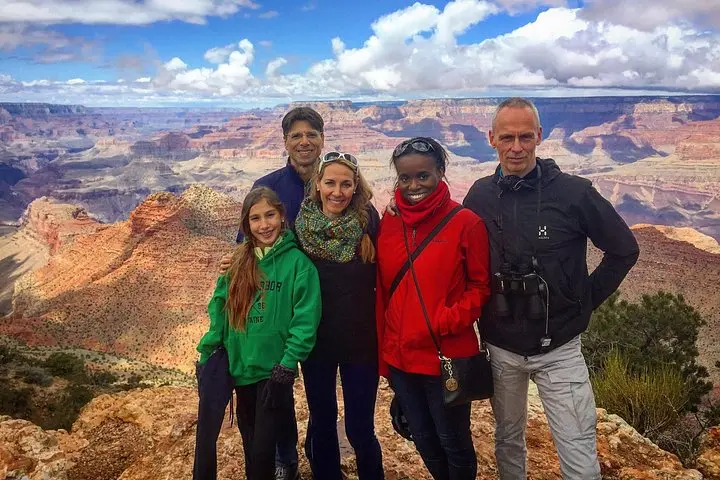
The bus eases out of Flagstaff as the Ponderosas thin and the land opens into a high desert quilt of cinder cones and sage. Windows frame Humphreys Peak to the north—a snow-capped cheek against Arizona sky—while the San Francisco Volcanic Field strings the horizon with black humps. By midmorning the rim appears: a break in the earth that stops conversation and invites people to lean forward.
Verified experiences and guided adventures in the surrounding area.
Operated by Canyon Ministries Christian Tours · Flagstaff, Arizona
The bus eases out of Flagstaff as the Ponderosas thin and the land opens into a high desert quilt of cinder cones and sage. Windows frame Humphreys Peak to the north—a snow-capped cheek against Arizona sky—while the San Francisco Volcanic Field strings the horizon with black humps. By midmorning the rim appears: a break in the earth that stops conversation and invites people to lean forward.
This ten-hour loop ties three distinct landscapes into a single day: the high, wind-scoured rim of the Grand Canyon; the low, sun-baked plaza of Wupatki, where masonry from nearly a millennium ago still holds; and the jagged, basalt scars of Sunset Crater. The itinerary is guided through a Christian interpretive lens—geology and archaeology are read alongside scriptural narratives about Creation and the Flood—so expect commentary that blends natural science with faith-based perspectives.
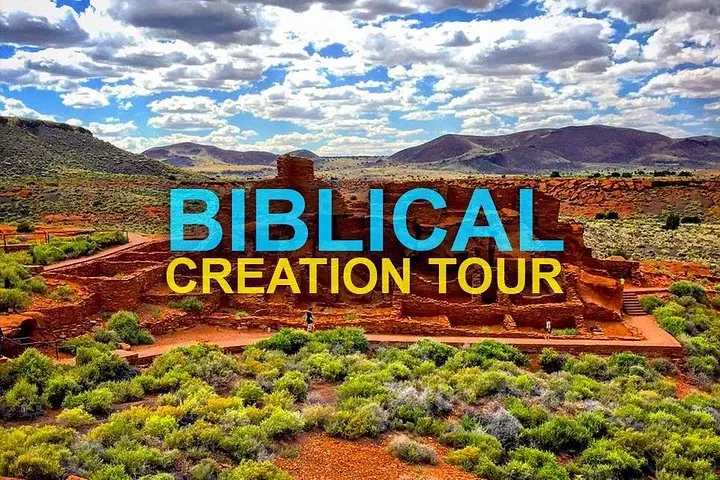
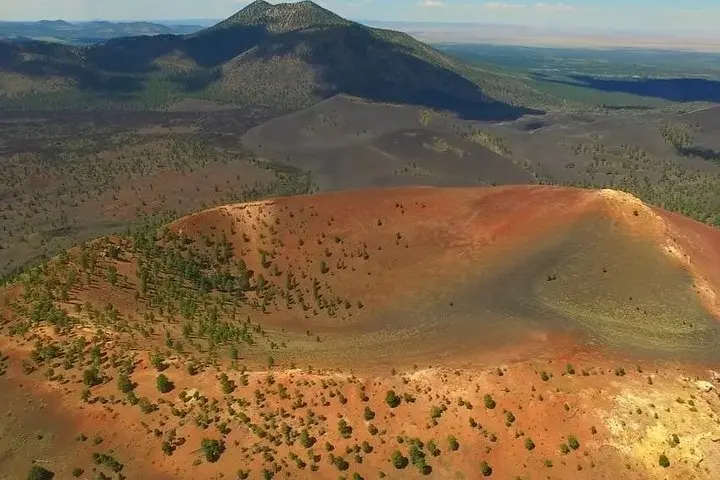
Geologically the region reads like a field guide to plateaus and fire: layered sedimentary cliffs at the South Rim expose nearly two billion years of rock, while the volcanic field north of Flagstaff is a much younger story of lava flows, cinder cones, and spatter horns. Wupatki sits on a limestone shelf where Sinagua peoples built pueblo structures using local sandstone and mud mortar; the ruins are compact but revealing, with kivas and entryways that orient to wind and sun.
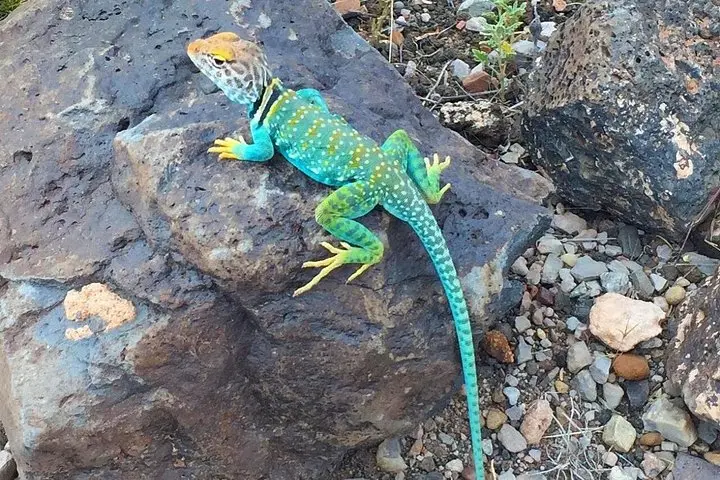
Culturally the tour moves through landscapes still lived in by the Hopi and Navajo nations—guides often point to Hopi mesas in the distance and speak to the deep human timelines of the Colorado Plateau. Wildlife is subtle but present: look for pronghorn or elk at dawn and hawks riding thermals over the canyon.
Practicalities matter on a compact day like this. The tour begins and ends at the DoubleTree in Flagstaff, runs roughly 10 hours, and includes park entry fees and bottled water; lunch is self-pay at Desert View or bring a compact lunch. Expect short, mostly paved walks at rim overlooks, a ~0.5–1 mile loop at Wupatki on uneven packed dirt, and an optional 1–1.5 mile walk around Sunset Crater over loose cinders—good traction matters. The roadwork involves elevation swings: Flagstaff sits near 7,000 ft, you’ll descend roughly 3,000 ft toward the Little Colorado Gorge and climb about 2,000 ft en route to Sunset Crater.
Who it’s for: families and travelers comfortable with a full day of driving and short walks, curious about geology and regional history, and open to faith-based interpretation. Tips: pack sun protection, bring layers for elevation change, and charge your camera—these landscapes reward attention.
Leave no trace: stay on designated trails through Wupatki, don’t remove artifacts or volcanic rock, and follow ranger guidance at all monuments.
The tour runs about 10 hours and begins/ends at the DoubleTree by Hilton in Flagstaff; round-trip transport and park entry fees are included.
Yes—walks are short and the tour is described as suitable for all fitness levels, though participants should be able to step on and off the vehicle and walk uneven surfaces briefly.
Lunch is not included; there are food options at Desert View Market and Deli, or you may bring your own compact lunch (large coolers may not fit on the vehicle).
Some Grand Canyon overlooks (e.g., Yavapai Point) have paved viewpoints accessible to wheelchairs, but Wupatki and Sunset Crater include uneven surfaces that limit accessibility—check with the operator for specifics.
Expect dry conditions with strong sun in summer and potential snow or chill at higher elevations in winter; the tour cancels for severe weather per policy.
Yes—binoculars are provided, and photography is encouraged; drones are prohibited in national parks.
Canyon Ministries Christian Tours operates guided outdoor trips and adventures with an emphasis on safety, stewardship, and memorable experiences.
The bus eases out of Flagstaff as the Ponderosas thin and the land opens into a high desert quilt of cinder cones and sage. Windows frame Humphreys Peak to the north—a snow-capped cheek against Arizona sky—while the San Francisco Volcanic Field strings the horizon with black humps. By midmorning the rim appears: a break in the earth that stops conversation and invites people to lean forward.
The bus eases out of Flagstaff as the Ponderosas thin and the land opens into a high desert quilt of cinder cones and sage. Windows frame Humphreys Peak to the north—a snow-capped cheek against Arizona sky—while the San Francisco Volcanic Field strings the horizon with black humps. By midmorning the rim appears: a break in the earth that stops conversation and invites people to lean forward.
This ten-hour loop ties three distinct landscapes into a single day: the high, wind-scoured rim of the Grand Canyon; the low, sun-baked plaza of Wupatki, where masonry from nearly a millennium ago still holds; and the jagged, basalt scars of Sunset Crater. The itinerary is guided through a Christian interpretive lens—geology and archaeology are read alongside scriptural narratives about Creation and the Flood—so expect commentary that blends natural science with faith-based perspectives.
Geologically the region reads like a field guide to plateaus and fire: layered sedimentary cliffs at the South Rim expose nearly two billion years of rock, while the volcanic field north of Flagstaff is a much younger story of lava flows, cinder cones, and spatter horns. Wupatki sits on a limestone shelf where Sinagua peoples built pueblo structures using local sandstone and mud mortar; the ruins are compact but revealing, with kivas and entryways that orient to wind and sun.
Culturally the tour moves through landscapes still lived in by the Hopi and Navajo nations—guides often point to Hopi mesas in the distance and speak to the deep human timelines of the Colorado Plateau. Wildlife is subtle but present: look for pronghorn or elk at dawn and hawks riding thermals over the canyon.
Practicalities matter on a compact day like this. The tour begins and ends at the DoubleTree in Flagstaff, runs roughly 10 hours, and includes park entry fees and bottled water; lunch is self-pay at Desert View or bring a compact lunch. Expect short, mostly paved walks at rim overlooks, a ~0.5–1 mile loop at Wupatki on uneven packed dirt, and an optional 1–1.5 mile walk around Sunset Crater over loose cinders—good traction matters. The roadwork involves elevation swings: Flagstaff sits near 7,000 ft, you’ll descend roughly 3,000 ft toward the Little Colorado Gorge and climb about 2,000 ft en route to Sunset Crater.
Who it’s for: families and travelers comfortable with a full day of driving and short walks, curious about geology and regional history, and open to faith-based interpretation. Tips: pack sun protection, bring layers for elevation change, and charge your camera—these landscapes reward attention.
Leave no trace: stay on designated trails through Wupatki, don’t remove artifacts or volcanic rock, and follow ranger guidance at all monuments.