THE ADVENTURE COLLECTIVE® · Independent discovery and booking for outdoor travel

Walk the pale cliffs that built Arequipa: a four-hour guided tour across Añashuayco quarries and the Culebrillas ravine where Wari engravings and 30‑meter sillar walls tell the city’s geological and cultural story. Expect dramatic photo ops, uneven terrain, and local stonemasons at work.
Walk the pale cliffs that built Arequipa: a four-hour guided tour across Añashuayco quarries and the Culebrillas ravine where Wari engravings and 30‑meter sillar walls tell the city’s geological and cultural story. Expect dramatic photo ops, uneven terrain, and local stonemasons at work.
You step off the air-conditioned minivan and the city’s white facades fall away, replaced by sheer pale walls cut from the same volcanic stone that built Arequipa’s cathedral. Sunlight washes the ashlar faces and the quarry breathes heat; the stone seems to hold the city’s memory in its grain.
Verified experiences and guided adventures in the surrounding area.
Operated by Abelardo Garrafa Quispe · Arequipa, Arequipa
You step off the air-conditioned minivan and the city’s white facades fall away, replaced by sheer pale walls cut from the same volcanic stone that built Arequipa’s cathedral. Sunlight washes the ashlar faces and the quarry breathes heat; the stone seems to hold the city’s memory in its grain.
The Sillar route follows paths where colonial masons and pre-Inca hands quarried ignimbrite — a compacted volcanic tuff locally called sillar. On the trail you’ll pass Añashuayco’s 30‑meter cliffs and the unworked Culebrillas ravine, where wind and rain have carved dramatic channels. Guides point out petroglyphs and Wari-era engravings, then explain how sillar’s insulating and aesthetic properties shaped Arequipa’s urban identity as the “White City.”
Geology is tactile here: the stone is light, workable, and frost-resistant, a reason it became the region’s dominant building material. The cultural layer is present in small workshops where stonemasons still shape blocks by hand and in colonial façades downtown made from the same quarries you visit.
Practical guidance: aim for morning or late afternoon light for photos and cooler walking; wear closed shoes with good traction — quarry floors can be uneven and dusty. Carry sun protection and at least 1 liter of water; altitude around 2,300–2,400 m can make exertion feel harder. The tour is shared, roughly four hours with short canyon walks and photo stops. Respect marked paths, avoid touching fragile engravings, and let local guides explain the sites — they translate geology into history and keep the route sustainable.
The tour is approximately four hours total with around 30–60 minutes of walking spread across short canyon and quarry paths; pacing is relaxed with photo stops.
Yes — the tour is family-friendly; infants must sit on an adult’s lap and some areas have uneven terrain, so supervise children closely.
Yes — the listed tour includes tickets to the quarry sites and an official bilingual guide who explains geology and history.
Arequipa sits near 2,300–2,400 m; light breathlessness is possible for unacclimated visitors—move at a steady pace and hydrate.
Abelardo Garrafa Quispe operates guided outdoor trips and adventures with an emphasis on safety, stewardship, and memorable experiences.
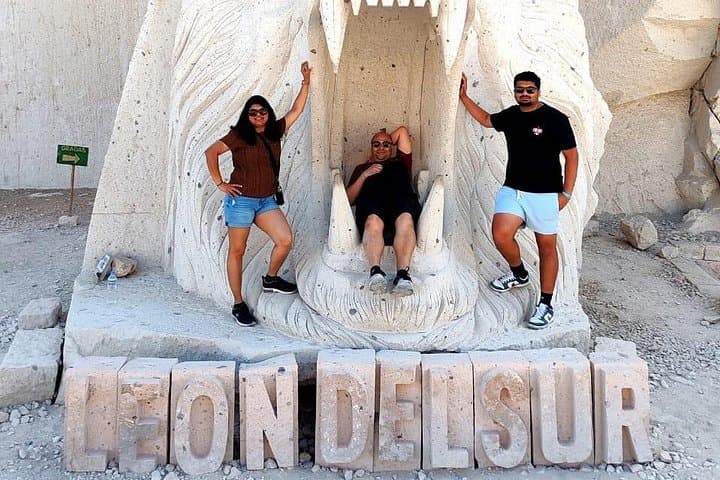


You step off the air-conditioned minivan and the city’s white facades fall away, replaced by sheer pale walls cut from the same volcanic stone that built Arequipa’s cathedral. Sunlight washes the ashlar faces and the quarry breathes heat; the stone seems to hold the city’s memory in its grain.
You step off the air-conditioned minivan and the city’s white facades fall away, replaced by sheer pale walls cut from the same volcanic stone that built Arequipa’s cathedral. Sunlight washes the ashlar faces and the quarry breathes heat; the stone seems to hold the city’s memory in its grain.
The Sillar route follows paths where colonial masons and pre-Inca hands quarried ignimbrite — a compacted volcanic tuff locally called sillar. On the trail you’ll pass Añashuayco’s 30‑meter cliffs and the unworked Culebrillas ravine, where wind and rain have carved dramatic channels. Guides point out petroglyphs and Wari-era engravings, then explain how sillar’s insulating and aesthetic properties shaped Arequipa’s urban identity as the “White City.”
Geology is tactile here: the stone is light, workable, and frost-resistant, a reason it became the region’s dominant building material. The cultural layer is present in small workshops where stonemasons still shape blocks by hand and in colonial façades downtown made from the same quarries you visit.
Practical guidance: aim for morning or late afternoon light for photos and cooler walking; wear closed shoes with good traction — quarry floors can be uneven and dusty. Carry sun protection and at least 1 liter of water; altitude around 2,300–2,400 m can make exertion feel harder. The tour is shared, roughly four hours with short canyon walks and photo stops. Respect marked paths, avoid touching fragile engravings, and let local guides explain the sites — they translate geology into history and keep the route sustainable.