THE ADVENTURE COLLECTIVE® · Independent discovery and booking for outdoor travel

Walk the streets of Italica with an official guide and unlock mosaics, amphitheater tiers, and everyday Roman life lost to time. This focused tour combines archaeological insight with practical tips for visiting Seville’s nearest ancient city.
Walk the streets of Italica with an official guide and unlock mosaics, amphitheater tiers, and everyday Roman life lost to time. This focused tour combines archaeological insight with practical tips for visiting Seville’s nearest ancient city.
You step through the main gate and the city opens like a plan laid flat in stone: arcaded streets, low house foundations, and a broad amphitheater that still holds the echo of a crowd.
Verified experiences and guided adventures in the surrounding area.
Operated by GUIDE ME IN SEVILLE · Santiponce, Andalusia
You step through the main gate and the city opens like a plan laid flat in stone: arcaded streets, low house foundations, and a broad amphitheater that still holds the echo of a crowd.
Italica, in the modern municipality of Santiponce just north of Seville, was founded in the 2nd century BCE and grew into an early imperial Roman town — the birthplace of emperors Trajan and Hadrian. The site sits on a gentle plain carved by the Guadalquivir’s historic floodplain; layers of Roman brick and marble rise from compacted sediment and olive-orchard soil, offering a readable cross-section of daily life and imperial display.
A licensed guide points out details that a casual walk misses: original mosaic panels inside domestic houses, the engineering of the amphitheater’s drainage, and inscriptions that name free citizens and veterans. You’ll pass through shaded alleys where stone thresholds bear centuries of footsteps and stand on amphitheater terraces with a wide view of the surrounding plains and low Sierra de Córdoba on the horizon.
Practical guidance: tours typically last 2–3 hours and include site admission; expect uneven Roman paving and short climbs. Go early in summer to avoid heat, wear sturdy shoes, sun protection, and bring at least 1 liter of water. Public transport reaches Santiponce but private pick-up is sometimes offered — confirm meeting details when you book. Photography is allowed, but respect cordoned areas and fragile mosaics; your guide will point out the best angles and the conservation-sensitive zones to avoid.
Yes — the itinerary indicates site admission is included as part of the tour booking.
Santiponce is about 9–10 km north of central Seville; options include local buses, taxi, or private transfer depending on your booking.
Much of Italica has uneven stone and stepped areas; accessibility is limited — contact the operator in advance for specific accommodations.
Photography for personal use is generally permitted, but avoid flash on vulnerable mosaics and respect any restricted zones your guide indicates.
GUIDE ME IN SEVILLE operates guided outdoor trips and adventures with an emphasis on safety, stewardship, and memorable experiences.
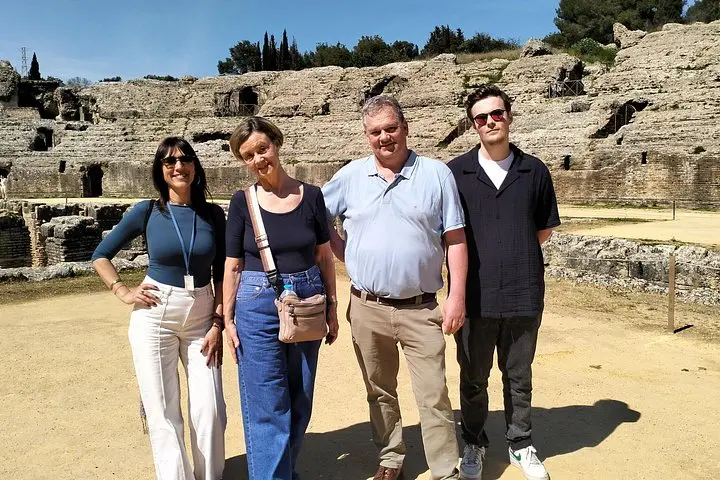
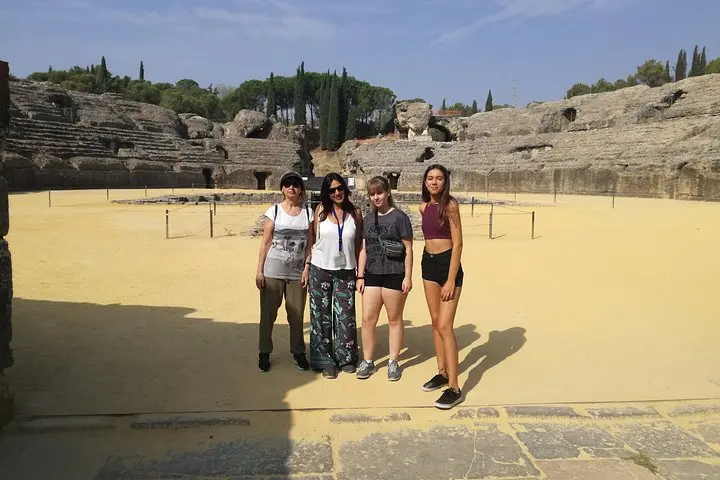
You step through the main gate and the city opens like a plan laid flat in stone: arcaded streets, low house foundations, and a broad amphitheater that still holds the echo of a crowd.
You step through the main gate and the city opens like a plan laid flat in stone: arcaded streets, low house foundations, and a broad amphitheater that still holds the echo of a crowd.
Italica, in the modern municipality of Santiponce just north of Seville, was founded in the 2nd century BCE and grew into an early imperial Roman town — the birthplace of emperors Trajan and Hadrian. The site sits on a gentle plain carved by the Guadalquivir’s historic floodplain; layers of Roman brick and marble rise from compacted sediment and olive-orchard soil, offering a readable cross-section of daily life and imperial display.
A licensed guide points out details that a casual walk misses: original mosaic panels inside domestic houses, the engineering of the amphitheater’s drainage, and inscriptions that name free citizens and veterans. You’ll pass through shaded alleys where stone thresholds bear centuries of footsteps and stand on amphitheater terraces with a wide view of the surrounding plains and low Sierra de Córdoba on the horizon.
Practical guidance: tours typically last 2–3 hours and include site admission; expect uneven Roman paving and short climbs. Go early in summer to avoid heat, wear sturdy shoes, sun protection, and bring at least 1 liter of water. Public transport reaches Santiponce but private pick-up is sometimes offered — confirm meeting details when you book. Photography is allowed, but respect cordoned areas and fragile mosaics; your guide will point out the best angles and the conservation-sensitive zones to avoid.