THE ADVENTURE COLLECTIVE® · Independent discovery and booking for outdoor travel

A two-hour guided walk that starts in St. Mark’s Square and threads through the Castello district to Campo Santa Maria Formosa, Marco Polo’s house and the Malibran Theatre. Perfect for first-time visitors who want history, architecture and local stories delivered by a professional guide.
A two-hour guided walk that starts in St. Mark’s Square and threads through the Castello district to Campo Santa Maria Formosa, Marco Polo’s house and the Malibran Theatre. Perfect for first-time visitors who want history, architecture and local stories delivered by a professional guide.
You step out of the shadow of St. Mark’s Basilica and the square opens like a stage — pigeons wheel, gondoliers call from the waterways, and the city’s stonework glows under the low sun. For the next two hours a local guide leads the group away from the tourist thrum into a quieter Venice: narrow calli that funnel light onto polished stone, small bridges that incline like old bows, and campos where everyday life still plays out between ancient facades.
Verified experiences and guided adventures in the surrounding area.
Operated by Venice Events srl · Venice, Veneto
You step out of the shadow of St. Mark’s Basilica and the square opens like a stage — pigeons wheel, gondoliers call from the waterways, and the city’s stonework glows under the low sun. For the next two hours a local guide leads the group away from the tourist thrum into a quieter Venice: narrow calli that funnel light onto polished stone, small bridges that incline like old bows, and campos where everyday life still plays out between ancient facades.
The route reads like a condensed history of the Serenissima. Beginning with the majesty of St. Mark’s Square — its basilica, Doge’s Palace and the Renaissance clock tower — the tour explains how trade, salt and naval power molded Venice’s political structures and public architecture. As you move into Castello, the guide shifts from grand narratives to the local grammar of the city: how wooden piles driven into lagoon silt became the invisible foundation for palazzi, why façades face alleys rather than streets, and how canals act as both streets and sewage systems through centuries of adaptation.
Campo Santa Maria Formosa offers one of the tour’s clearest moments: a sweeping, human-scaled square ringed with Renaissance and medieval buildings where the guide points out the church’s layered reconstructions and local legends. At Campo SS. Giovanni e Paolo you’ll stand before the tombs of Doges and the equestrian monument to Bartolomeo Colleoni, reminders that Venice’s public art is also its political memory.
The walk pauses at Corte Seconda del Milion — historically linked to Marco Polo — and takes in the Malibran Theatre’s ornate exterior, a compact lesson in Venice’s cultural life from mercantile power to opera houses. Throughout, headphones provide clear commentary in multiple languages without losing the intimacy of the streets.
Practicalities are straightforward: the tour is two hours, suited to all fitness levels, and capped at small groups for easy movement through alleys. Meet 15 minutes early in Calle larga de l’Ascension, behind the Correr Museum; the operator provides audio headsets and a professional guide. Note that the city may apply a daily access fee on certain dates for day visitors — check local rules in advance — and the route is not wheelchair accessible.
For planning: wear comfortable, water-resistant shoes (stone can be slick), carry a refillable water bottle, and bring a light rain jacket for sudden showers or acqua alta. Early morning or late afternoon departures make for the best light and fewer crowds. This tour is ideal as a first-day orientation — it gives the geography, history and the small, human stories that turn Venice from a postcard into a living, walking city.
Meet 15 minutes before departure at Calle larga de l’Ascension behind the Correr Museum, next to the San Marco post office; look for the TURIVE assistant.
The tour lasts approximately two hours and covers roughly 1.5–3 kilometers on mostly flat ground through narrow alleys and small squares.
No; the route includes bridges, steps and narrow calli that are not suitable for wheelchairs.
Guided commentary is provided in English, French, German and Spanish with personal audio headsets included.
On certain dates the city charges a daily access fee for day visitors; check the official Venice site for exemptions and the current schedule before your visit.
Late arrivals may not be admitted and are not refundable — being 15 minutes early is required to collect audio equipment and register.
Venice Events srl operates guided outdoor trips and adventures with an emphasis on safety, stewardship, and memorable experiences.


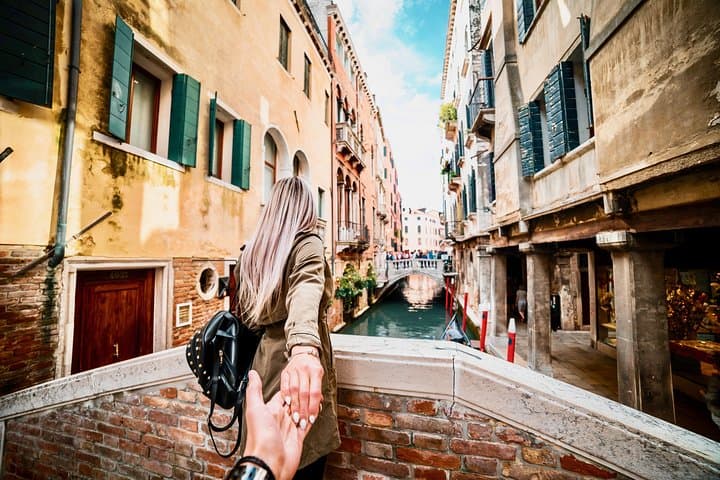
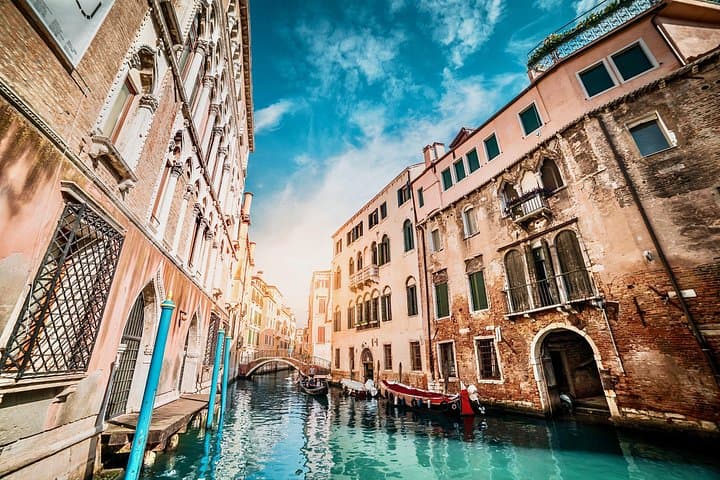
You step out of the shadow of St. Mark’s Basilica and the square opens like a stage — pigeons wheel, gondoliers call from the waterways, and the city’s stonework glows under the low sun. For the next two hours a local guide leads the group away from the tourist thrum into a quieter Venice: narrow calli that funnel light onto polished stone, small bridges that incline like old bows, and campos where everyday life still plays out between ancient facades.
You step out of the shadow of St. Mark’s Basilica and the square opens like a stage — pigeons wheel, gondoliers call from the waterways, and the city’s stonework glows under the low sun. For the next two hours a local guide leads the group away from the tourist thrum into a quieter Venice: narrow calli that funnel light onto polished stone, small bridges that incline like old bows, and campos where everyday life still plays out between ancient facades.
The route reads like a condensed history of the Serenissima. Beginning with the majesty of St. Mark’s Square — its basilica, Doge’s Palace and the Renaissance clock tower — the tour explains how trade, salt and naval power molded Venice’s political structures and public architecture. As you move into Castello, the guide shifts from grand narratives to the local grammar of the city: how wooden piles driven into lagoon silt became the invisible foundation for palazzi, why façades face alleys rather than streets, and how canals act as both streets and sewage systems through centuries of adaptation.
Campo Santa Maria Formosa offers one of the tour’s clearest moments: a sweeping, human-scaled square ringed with Renaissance and medieval buildings where the guide points out the church’s layered reconstructions and local legends. At Campo SS. Giovanni e Paolo you’ll stand before the tombs of Doges and the equestrian monument to Bartolomeo Colleoni, reminders that Venice’s public art is also its political memory.
The walk pauses at Corte Seconda del Milion — historically linked to Marco Polo — and takes in the Malibran Theatre’s ornate exterior, a compact lesson in Venice’s cultural life from mercantile power to opera houses. Throughout, headphones provide clear commentary in multiple languages without losing the intimacy of the streets.
Practicalities are straightforward: the tour is two hours, suited to all fitness levels, and capped at small groups for easy movement through alleys. Meet 15 minutes early in Calle larga de l’Ascension, behind the Correr Museum; the operator provides audio headsets and a professional guide. Note that the city may apply a daily access fee on certain dates for day visitors — check local rules in advance — and the route is not wheelchair accessible.
For planning: wear comfortable, water-resistant shoes (stone can be slick), carry a refillable water bottle, and bring a light rain jacket for sudden showers or acqua alta. Early morning or late afternoon departures make for the best light and fewer crowds. This tour is ideal as a first-day orientation — it gives the geography, history and the small, human stories that turn Venice from a postcard into a living, walking city.