THE ADVENTURE COLLECTIVE® · Independent discovery and booking for outdoor travel

Ride the Ha Giang Loop over three days to reach Ma Pi Leng, Dong Van and Lung Cu—steep passes, karst peaks, and homestays combine into a compact highland adventure. Learn the route, conditions, and what to pack before you go.
Ride the Ha Giang Loop over three days to reach Ma Pi Leng, Dong Van and Lung Cu—steep passes, karst peaks, and homestays combine into a compact highland adventure. Learn the route, conditions, and what to pack before you go.
The engine’s pulse settles into the rhythm of the mountain road as the tour leaves the lowlands and climbs toward stony ridgelines. Cold air at Quan Ba Heaven Gate opens the view: steep terraces, Twin Mountains rising like old guardians, and the road unspooling toward Dong Van. Riders trade city lights for star-pocked sky, sleep on a sleeper bus, then swap the bus’s hum for the rattle and lean of motorbikes through the karst plateau.
Verified experiences and guided adventures in the surrounding area.
Operated by Authentic Travel in Vietnam · Ha Giang, Ha Giang Province
The engine’s pulse settles into the rhythm of the mountain road as the tour leaves the lowlands and climbs toward stony ridgelines. Cold air at Quan Ba Heaven Gate opens the view: steep terraces, Twin Mountains rising like old guardians, and the road unspooling toward Dong Van. Riders trade city lights for star-pocked sky, sleep on a sleeper bus, then swap the bus’s hum for the rattle and lean of motorbikes through the karst plateau.
This three-day loop threads Ha Giang Province’s cultural and geological highlights—Quan Ba (1,500 m), the dizzying Ma Pi Leng Pass (≈2,000 m), the Dong Van karst plateau, and the Lung Cu Flag Tower marking Vietnam’s northern edge. The route crosses ancient Hmong and Dao villages; the Meo King Palace reveals early 20th-century local power; Lung Cam village preserves brocade weaving traditions. Geologically, the Dong Van area is an eroded carbonate plateau cut into sharp limestone towers, narrow valleys, and deep river gorges carved by the Nho Que.
Practicalities: the itinerary covers roughly 300–350 km of mixed tarmac and rough shoulder, with frequent steep switchbacks and short gravel segments—expect long riding days (several hours between stops), simple homestays one night and a hotel another, and included meals and entrance fees listed by the operator. Wear a good helmet, layered clothing for 1,500–2,000 m temperatures, and pack drinking water and a basic repair kit. Start early to avoid afternoon clouds on high passes and allow time at viewpoints for photos and short walks. The loop rewards riders who respect the road and local customs with raw scenery and close encounters with highland life.
Yes—the tour assumes riders can operate their own motorbike safely on winding, sometimes steep roads; some operators offer guided pillion options.
Typical inclusions are sleeper bus transfers, accommodation (1 hotel night, 1 homestay), most meals listed, an English-speaking guide, and certain entrance fees (e.g., Meo King Palace, Lung Cu).
Most of the route is paved but includes narrow switchbacks, steep grades, and occasional gravel shoulders—careful riding is required, especially on Ma Pi Leng and during rain.
Yes—many travelers join shared groups; the tour supports solo bookings but expect group riding etiquette and possible shared rooms at homestays.
Authentic Travel in Vietnam operates guided outdoor trips and adventures with an emphasis on safety, stewardship, and memorable experiences.
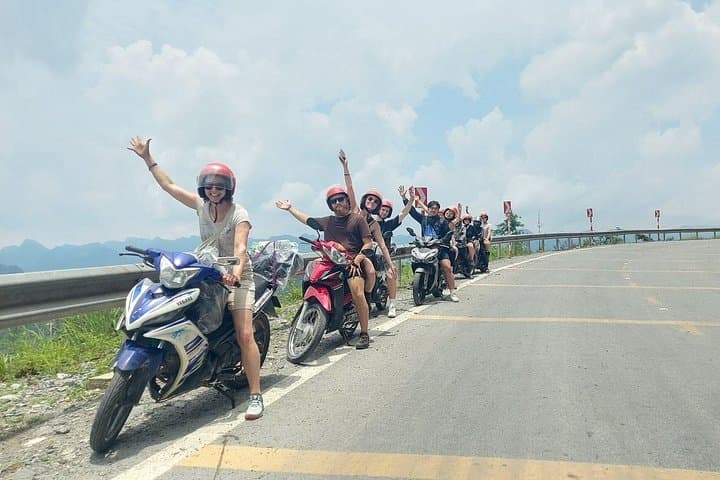


The engine’s pulse settles into the rhythm of the mountain road as the tour leaves the lowlands and climbs toward stony ridgelines. Cold air at Quan Ba Heaven Gate opens the view: steep terraces, Twin Mountains rising like old guardians, and the road unspooling toward Dong Van. Riders trade city lights for star-pocked sky, sleep on a sleeper bus, then swap the bus’s hum for the rattle and lean of motorbikes through the karst plateau.
The engine’s pulse settles into the rhythm of the mountain road as the tour leaves the lowlands and climbs toward stony ridgelines. Cold air at Quan Ba Heaven Gate opens the view: steep terraces, Twin Mountains rising like old guardians, and the road unspooling toward Dong Van. Riders trade city lights for star-pocked sky, sleep on a sleeper bus, then swap the bus’s hum for the rattle and lean of motorbikes through the karst plateau.
This three-day loop threads Ha Giang Province’s cultural and geological highlights—Quan Ba (1,500 m), the dizzying Ma Pi Leng Pass (≈2,000 m), the Dong Van karst plateau, and the Lung Cu Flag Tower marking Vietnam’s northern edge. The route crosses ancient Hmong and Dao villages; the Meo King Palace reveals early 20th-century local power; Lung Cam village preserves brocade weaving traditions. Geologically, the Dong Van area is an eroded carbonate plateau cut into sharp limestone towers, narrow valleys, and deep river gorges carved by the Nho Que.
Practicalities: the itinerary covers roughly 300–350 km of mixed tarmac and rough shoulder, with frequent steep switchbacks and short gravel segments—expect long riding days (several hours between stops), simple homestays one night and a hotel another, and included meals and entrance fees listed by the operator. Wear a good helmet, layered clothing for 1,500–2,000 m temperatures, and pack drinking water and a basic repair kit. Start early to avoid afternoon clouds on high passes and allow time at viewpoints for photos and short walks. The loop rewards riders who respect the road and local customs with raw scenery and close encounters with highland life.