THE ADVENTURE COLLECTIVE® · Independent discovery and booking for outdoor travel

Spend three hours tracing Astana’s rapid reinvention—Bayterek’s viewpoint, the National Museum’s steppe history and the city’s central mosque. This concise, private tour blends architecture, culture and brief tastings for a practical introduction to Kazakhstan’s capital.
Spend three hours tracing Astana’s rapid reinvention—Bayterek’s viewpoint, the National Museum’s steppe history and the city’s central mosque. This concise, private tour blends architecture, culture and brief tastings for a practical introduction to Kazakhstan’s capital.
You step out of an air-conditioned vehicle onto broad boulevards where glass and concrete rise like geometric claims on the steppe. The Bayterek tower looms ahead — a viewing capsule that gives a quick, high-altitude read on the city’s bold, post-Soviet ambitions. Streets here alternately feel planned and theatrical: sweepingly modern facades, public squares, and the slow curl of the Ishim River cutting across the flat landscape.
Verified experiences and guided adventures in the surrounding area.
Operated by Astana Guide Tours · Astana, Akmola Region
You step out of an air-conditioned vehicle onto broad boulevards where glass and concrete rise like geometric claims on the steppe. The Bayterek tower looms ahead — a viewing capsule that gives a quick, high-altitude read on the city’s bold, post-Soviet ambitions. Streets here alternately feel planned and theatrical: sweepingly modern facades, public squares, and the slow curl of the Ishim River cutting across the flat landscape.
Astana (Nur-Sultan) became Kazakhstan’s capital in 1997, a deliberate move to the geographic center of the country that set off an era of rapid architectural experimentation. The National Museum collects artifacts from the Kazakh steppe — Bronze Age relics, nomadic horse gear — that explain how a mobile culture shaped present-day identity. Geologically the region is flat alluvium of the Eurasian steppe; the city’s skyline is an overlay on that wide-open plain.
Culturally, a city tour moves between public ritual and contemporary consumption: prayer at the central mosque, a look at Nazarbayev University’s campus, and a stop for regional wines from southern Kazakhstan. Local guides translate civic pride into anecdote and context, pointing out why certain buildings were commissioned and what they mean to a young capital.
Practical guidance: expect 3–4 hours of mostly flat walking with short museum and mosque stops. Dress conservatively for the mosque (a wrap is provided if needed), carry water, and plan for brisk winds on the riverfront. The itinerary is compact — an efficient primer on a city that’s still inventing itself.
Yes; non-Muslim visitors are welcome. Modest dress is required and a mantle is provided at the entrance if needed.
The tour description indicates admissions are included for designated stops like the National Museum and selected sites in the itinerary.
The tour notes wheelchair accessibility and stroller access, but confirm specific pickup/drop-off locations and any museum accessibility details when booking.
Yes; this private tour allows advance notice of dietary needs for the included wine tasting and local cuisine sampling—provide details at booking.
Astana Guide Tours operates guided outdoor trips and adventures with an emphasis on safety, stewardship, and memorable experiences.
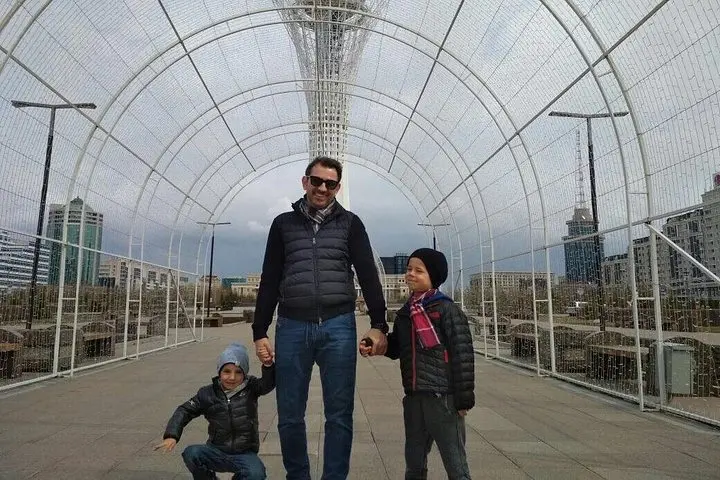
You step out of an air-conditioned vehicle onto broad boulevards where glass and concrete rise like geometric claims on the steppe. The Bayterek tower looms ahead — a viewing capsule that gives a quick, high-altitude read on the city’s bold, post-Soviet ambitions. Streets here alternately feel planned and theatrical: sweepingly modern facades, public squares, and the slow curl of the Ishim River cutting across the flat landscape.
You step out of an air-conditioned vehicle onto broad boulevards where glass and concrete rise like geometric claims on the steppe. The Bayterek tower looms ahead — a viewing capsule that gives a quick, high-altitude read on the city’s bold, post-Soviet ambitions. Streets here alternately feel planned and theatrical: sweepingly modern facades, public squares, and the slow curl of the Ishim River cutting across the flat landscape.
Astana (Nur-Sultan) became Kazakhstan’s capital in 1997, a deliberate move to the geographic center of the country that set off an era of rapid architectural experimentation. The National Museum collects artifacts from the Kazakh steppe — Bronze Age relics, nomadic horse gear — that explain how a mobile culture shaped present-day identity. Geologically the region is flat alluvium of the Eurasian steppe; the city’s skyline is an overlay on that wide-open plain.
Culturally, a city tour moves between public ritual and contemporary consumption: prayer at the central mosque, a look at Nazarbayev University’s campus, and a stop for regional wines from southern Kazakhstan. Local guides translate civic pride into anecdote and context, pointing out why certain buildings were commissioned and what they mean to a young capital.
Practical guidance: expect 3–4 hours of mostly flat walking with short museum and mosque stops. Dress conservatively for the mosque (a wrap is provided if needed), carry water, and plan for brisk winds on the riverfront. The itinerary is compact — an efficient primer on a city that’s still inventing itself.