THE ADVENTURE COLLECTIVE® · Independent discovery and booking for outdoor travel

Explore the Great Pyramids of Giza and the Sphinx on a focused half-day guided tour. Learn practical tips for timing, entry options and what to bring to navigate the plateau efficiently.
Explore the Great Pyramids of Giza and the Sphinx on a focused half-day guided tour. Learn practical tips for timing, entry options and what to bring to navigate the plateau efficiently.
You step from the air-conditioned vehicle onto a wind-scoured limestone plain; the pyramids rise ahead like giant, weathered machines, their edges catching the low sun while the Sphinx keeps quiet watch. The air smells faintly of dust and street food from nearby Cairo, and a local guide folds ancient timelines into the present, pointing out quarry scars and burial causeways.
Verified experiences and guided adventures in the surrounding area.
Operated by Egypt Tours Online · Giza, Giza Governorate
You step from the air-conditioned vehicle onto a wind-scoured limestone plain; the pyramids rise ahead like giant, weathered machines, their edges catching the low sun while the Sphinx keeps quiet watch. The air smells faintly of dust and street food from nearby Cairo, and a local guide folds ancient timelines into the present, pointing out quarry scars and burial causeways.
The Giza Plateau is the product of Fourth Dynasty ambition: Khufu, Khafre and Menkaure set massive stone statements into the desert that still read as instruction manuals for ancient Egyptian kingship. Geology matters here — the pyramids sit on a stable limestone bedrock quarried nearby, and the surrounding sands once acted as both cloak and conserver for buried structures like the workers’ village and boat pits.
Culturally, the site is as much a living market and photography stage as it is an archaeological complex; expect vendors, camel handlers and modern Cairo traffic on the horizon. Practicalities: most half-day guided excursions include hotel pickup, a walking loop past the three main pyramids, a closer view of the Sphinx and a stop at the Valley Temple; entry to go inside a pyramid and camel rides are usually extra.
Plan for strong sun, uneven terrain and crowds. Wear sturdy closed shoes for rocky footing, bring at least one liter of water, and carry local cash for tips and optional extras. Morning departures avoid heat and give better light for photos. Respect barriers — climbing and touching sensitive masonry accelerates erosion — and follow your guide’s route to make the most of this compact, intense slice of ancient Egypt.
Some tour options include basic entry to the plateau; specific tickets like entry inside a pyramid are typically extra — confirm when booking.
Access inside the Great Pyramid or other chambers is limited and often costs an extra fee; it may also be restricted for conservation or crowd-control reasons.
Camel rides around the plateau are usually optional and charged on-site; negotiate price beforehand and confirm with your guide.
The plateau involves uneven ground and steps; families with young children can participate but travelers with serious mobility constraints should inquire about vehicle access and shorter routes.
Egypt Tours Online operates guided outdoor trips and adventures with an emphasis on safety, stewardship, and memorable experiences.


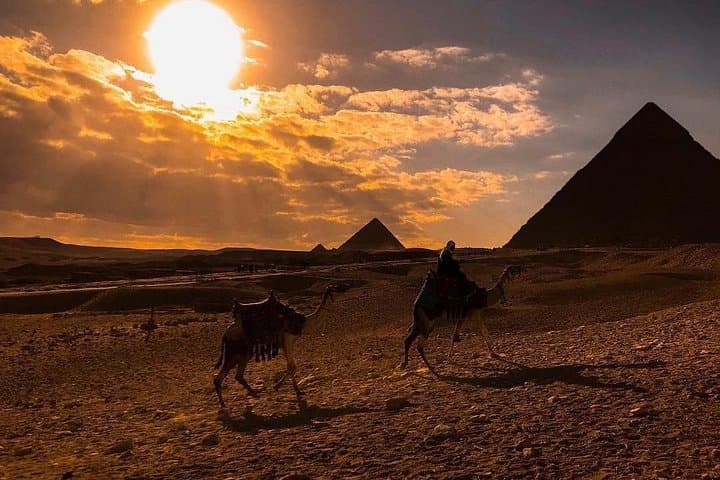
You step from the air-conditioned vehicle onto a wind-scoured limestone plain; the pyramids rise ahead like giant, weathered machines, their edges catching the low sun while the Sphinx keeps quiet watch. The air smells faintly of dust and street food from nearby Cairo, and a local guide folds ancient timelines into the present, pointing out quarry scars and burial causeways.
You step from the air-conditioned vehicle onto a wind-scoured limestone plain; the pyramids rise ahead like giant, weathered machines, their edges catching the low sun while the Sphinx keeps quiet watch. The air smells faintly of dust and street food from nearby Cairo, and a local guide folds ancient timelines into the present, pointing out quarry scars and burial causeways.
The Giza Plateau is the product of Fourth Dynasty ambition: Khufu, Khafre and Menkaure set massive stone statements into the desert that still read as instruction manuals for ancient Egyptian kingship. Geology matters here — the pyramids sit on a stable limestone bedrock quarried nearby, and the surrounding sands once acted as both cloak and conserver for buried structures like the workers’ village and boat pits.
Culturally, the site is as much a living market and photography stage as it is an archaeological complex; expect vendors, camel handlers and modern Cairo traffic on the horizon. Practicalities: most half-day guided excursions include hotel pickup, a walking loop past the three main pyramids, a closer view of the Sphinx and a stop at the Valley Temple; entry to go inside a pyramid and camel rides are usually extra.
Plan for strong sun, uneven terrain and crowds. Wear sturdy closed shoes for rocky footing, bring at least one liter of water, and carry local cash for tips and optional extras. Morning departures avoid heat and give better light for photos. Respect barriers — climbing and touching sensitive masonry accelerates erosion — and follow your guide’s route to make the most of this compact, intense slice of ancient Egypt.