THE ADVENTURE COLLECTIVE® · Independent discovery and booking for outdoor travel

In three to four hours this half-day car tour threads Hon Chong’s wind-sculpted boulders, centuries-old Cham towers, a hilltop Buddha and the bustle of Dam Market—an efficient cultural primer on Nha Trang’s coastal character.
In three to four hours this half-day car tour threads Hon Chong’s wind-sculpted boulders, centuries-old Cham towers, a hilltop Buddha and the bustle of Dam Market—an efficient cultural primer on Nha Trang’s coastal character.
You step out of a low-slung minivan and immediately the sea takes over—salt on the wind, waves insisting against a spine of black boulders. Hon Chong Promontory is the first stop: an unlikely skyline of stacked granite where a square rock bears a weathered five-finger handprint that points toward the open water. It’s the kind of place that reorients you from the grid of the city to the raw geometry of coast and stone.
Verified experiences and guided adventures in the surrounding area.
Operated by Insight Vietnam · Nha Trang, Khanh Hoa
You step out of a low-slung minivan and immediately the sea takes over—salt on the wind, waves insisting against a spine of black boulders. Hon Chong Promontory is the first stop: an unlikely skyline of stacked granite where a square rock bears a weathered five-finger handprint that points toward the open water. It’s the kind of place that reorients you from the grid of the city to the raw geometry of coast and stone.
From wind-carved granite the tour slips into centuries. Po Nagar Cham Towers rise on a small hill above the Cai River, their tiered brickwork a surviving fragment of the Champa kingdom that ruled central Vietnam before the 10th century. The guide’s voice modulates between architectural detail and myth—how stone lintels and sculpted reliefs celebrate fertility, kingship and long trade routes to Java and India.
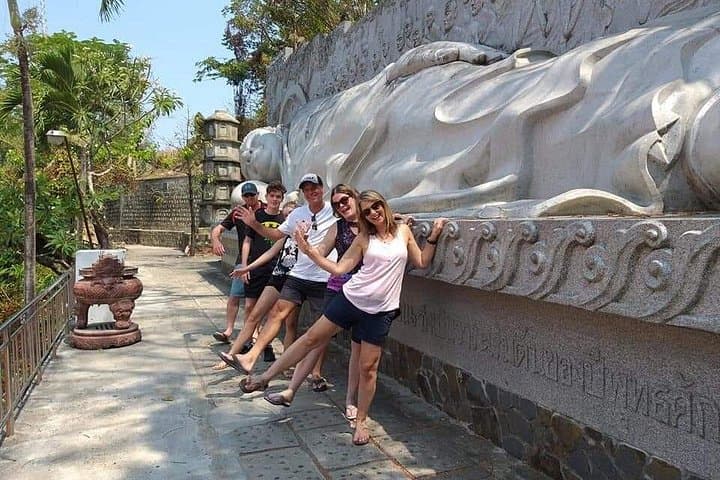
Long Son Pagoda shifts the mood again. Ascend a broad stairwell and the town opens beneath you; the pagoda’s white Buddha, seated on a lotus pedestal, watches over Nha Trang like an old friend. The tour threads through incense-scented interiors, lacquered altars and the small, deliberate rituals of local Buddhism.
A short drive away, Nha Trang Cathedral—known locally as the Stone Church—anchors a neighborhood of French colonial-era villas and lanes that still hum with daily life. Its stained glass and pointed arches are quieter reminders of a different foreign presence and the layered religious landscape of the city.
The final stop is Dam Market, which is simultaneously practical and theatrical: stacked piles of dried squid, mounds of dragonfruit, stalls selling silk, coffee and lacquerware. Here you can gauge local prices, practice a little bargaining and taste the coastal food culture that defines Nha Trang.
Practical edge: the half-day format (3–4 hours) is compact—expect quick visits rather than long temple immersions. The tour includes hotel pickup within roughly 1.5 km of Bai Tam Hon Chong, bottled water, entrance fees and lunch, making it a low-hassle introduction to the city’s highlights.
Plan for sun and stepped walks—light, breathable clothing that covers shoulders and knees is needed for sacred sites, and comfortable shoes for uneven stone and staircases. Bring a hat, sunscreen and a small camera; sacred spaces will often limit flash photography, and market vendors appreciate firm but polite negotiation.
This itinerary is ideal for travelers who want a rapid cultural orientation: geology, Cham history, Buddhist practice and a slice of modern Vietnamese market life all in a morning or afternoon. It’s not a deep-dive, but it’s a reliable primer—one that positions you to return later to the places that capture your imagination.
The tour runs approximately 3 to 4 hours, depending on traffic and the size of the group.
Yes—pickup is provided from many hotels in the Nha Trang area, generally within 1.5 km of Bai Tam Hon Chong; confirm your pickup point at booking.
Yes—entrance fees for Po Nagar Cham Towers, Long Son Pagoda, Nha Trang Cathedral and Bãi Tắm Hòn Chồng are included in the price.
Infants must sit on laps; the tour is family-friendly though there are stairs and short walks that may be challenging for very young children.
The tour includes an English-speaking guide; check availability if you require another language.
This is a short city tour—large luggage is not advisable; leave large items at your hotel or the port.
Insight Vietnam operates guided outdoor trips and adventures with an emphasis on safety, stewardship, and memorable experiences.


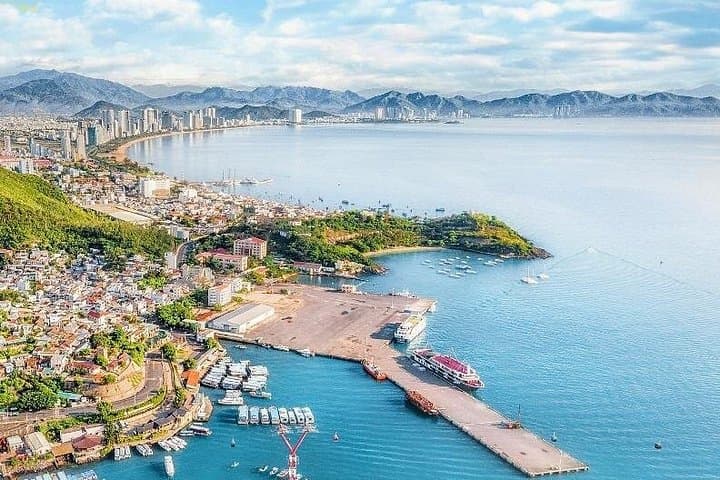
You step out of a low-slung minivan and immediately the sea takes over—salt on the wind, waves insisting against a spine of black boulders. Hon Chong Promontory is the first stop: an unlikely skyline of stacked granite where a square rock bears a weathered five-finger handprint that points toward the open water. It’s the kind of place that reorients you from the grid of the city to the raw geometry of coast and stone.
You step out of a low-slung minivan and immediately the sea takes over—salt on the wind, waves insisting against a spine of black boulders. Hon Chong Promontory is the first stop: an unlikely skyline of stacked granite where a square rock bears a weathered five-finger handprint that points toward the open water. It’s the kind of place that reorients you from the grid of the city to the raw geometry of coast and stone.
From wind-carved granite the tour slips into centuries. Po Nagar Cham Towers rise on a small hill above the Cai River, their tiered brickwork a surviving fragment of the Champa kingdom that ruled central Vietnam before the 10th century. The guide’s voice modulates between architectural detail and myth—how stone lintels and sculpted reliefs celebrate fertility, kingship and long trade routes to Java and India.
Long Son Pagoda shifts the mood again. Ascend a broad stairwell and the town opens beneath you; the pagoda’s white Buddha, seated on a lotus pedestal, watches over Nha Trang like an old friend. The tour threads through incense-scented interiors, lacquered altars and the small, deliberate rituals of local Buddhism.
A short drive away, Nha Trang Cathedral—known locally as the Stone Church—anchors a neighborhood of French colonial-era villas and lanes that still hum with daily life. Its stained glass and pointed arches are quieter reminders of a different foreign presence and the layered religious landscape of the city.
The final stop is Dam Market, which is simultaneously practical and theatrical: stacked piles of dried squid, mounds of dragonfruit, stalls selling silk, coffee and lacquerware. Here you can gauge local prices, practice a little bargaining and taste the coastal food culture that defines Nha Trang.
Practical edge: the half-day format (3–4 hours) is compact—expect quick visits rather than long temple immersions. The tour includes hotel pickup within roughly 1.5 km of Bai Tam Hon Chong, bottled water, entrance fees and lunch, making it a low-hassle introduction to the city’s highlights.
Plan for sun and stepped walks—light, breathable clothing that covers shoulders and knees is needed for sacred sites, and comfortable shoes for uneven stone and staircases. Bring a hat, sunscreen and a small camera; sacred spaces will often limit flash photography, and market vendors appreciate firm but polite negotiation.
This itinerary is ideal for travelers who want a rapid cultural orientation: geology, Cham history, Buddhist practice and a slice of modern Vietnamese market life all in a morning or afternoon. It’s not a deep-dive, but it’s a reliable primer—one that positions you to return later to the places that capture your imagination.