THE ADVENTURE COLLECTIVE® · Independent discovery and booking for outdoor travel

A compact, self-guided visit that delivers Alberobello’s trulli, local flavors, and history in about three hours. Perfect as a half-day trip from Bari with audio guides and mapped routes to steer your exploration.
A compact, self-guided visit that delivers Alberobello’s trulli, local flavors, and history in about three hours. Perfect as a half-day trip from Bari with audio guides and mapped routes to steer your exploration.
Step off the GT bus and the town rearranges itself around you: whitewashed cone-roofed trulli cluster down narrow alleys, laundry arcs like small flags, and the stone streets click underfoot.
Verified experiences and guided adventures in the surrounding area.
Operated by ApuliaSmarttour · Alberobello, Apulia
Step off the GT bus and the town rearranges itself around you: whitewashed cone-roofed trulli cluster down narrow alleys, laundry arcs like small flags, and the stone streets click underfoot.
Alberobello’s trulli date to medieval dry-stone building techniques; their thick limestone walls and conical roofs reflect local geology—karst limestone sculpted into stacked, mortarless forms. UNESCO recognized the town for this unique vernacular architecture in 1996. Culturally, the town is a working village: families live above souvenir shops, and small osterias serve orecchiette and local olive oil beside centuries-old walls.
Your self-guided visit typically gives about three hours to move at your pace — photograph the iconic Trullo Sovrano, drift through the quieter Rione Aia Piccola, and climb a low viewpoint for the patchwork of roofs. Audio guides and interactive maps orient you to history, landmark trulli, and suggested walking loops.
Practicalities matter: cobbles are uneven, space in peak season is tight, and many trulli are private or small museums with modest hours. Wear sturdy shoes, carry water, and plan your return to the coach stop in advance—the drop-off is a short walk from the historic center. Morning light favors photos and cooler temperatures; late afternoons are quieter as day-trippers leave.
This half-day format suits travelers who want a concentrated cultural experience with time left for Bari or the surrounding Itria Valley. Follow local signs, respect private properties, and enjoy a compact, tactile lesson in Apulia’s stone-built past.
Plan about three hours in the historic center plus travel time; total outing from Bari typically takes four to six hours depending on coach schedules.
The drop-off is stroller-accessible but narrow, cobbled lanes and steps in the center make long stroller use awkward—lightweight strollers are best.
This is a self-guided visit: a digital brochure and audio guide are provided; entrance fees to specific museums like Trullo Sovrano are separate and paid on site if desired.
Audio guides are offered in English, Italian, Spanish, French, and German according to the tour information.
ApuliaSmarttour operates guided outdoor trips and adventures with an emphasis on safety, stewardship, and memorable experiences.

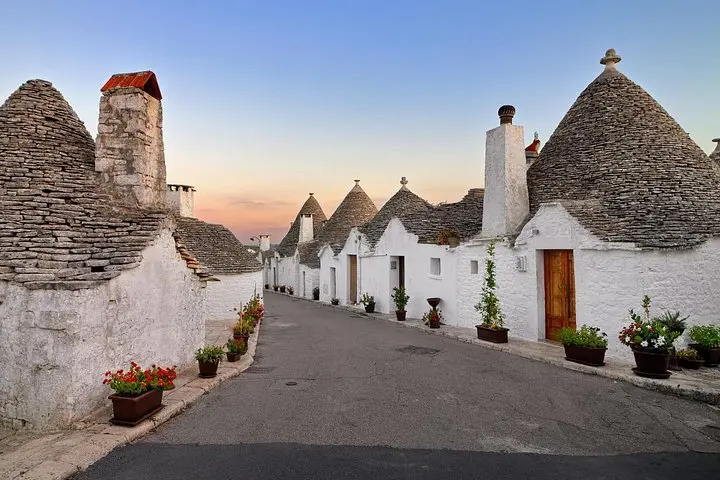


Step off the GT bus and the town rearranges itself around you: whitewashed cone-roofed trulli cluster down narrow alleys, laundry arcs like small flags, and the stone streets click underfoot.
Step off the GT bus and the town rearranges itself around you: whitewashed cone-roofed trulli cluster down narrow alleys, laundry arcs like small flags, and the stone streets click underfoot.
Alberobello’s trulli date to medieval dry-stone building techniques; their thick limestone walls and conical roofs reflect local geology—karst limestone sculpted into stacked, mortarless forms. UNESCO recognized the town for this unique vernacular architecture in 1996. Culturally, the town is a working village: families live above souvenir shops, and small osterias serve orecchiette and local olive oil beside centuries-old walls.
Your self-guided visit typically gives about three hours to move at your pace — photograph the iconic Trullo Sovrano, drift through the quieter Rione Aia Piccola, and climb a low viewpoint for the patchwork of roofs. Audio guides and interactive maps orient you to history, landmark trulli, and suggested walking loops.
Practicalities matter: cobbles are uneven, space in peak season is tight, and many trulli are private or small museums with modest hours. Wear sturdy shoes, carry water, and plan your return to the coach stop in advance—the drop-off is a short walk from the historic center. Morning light favors photos and cooler temperatures; late afternoons are quieter as day-trippers leave.
This half-day format suits travelers who want a concentrated cultural experience with time left for Bari or the surrounding Itria Valley. Follow local signs, respect private properties, and enjoy a compact, tactile lesson in Apulia’s stone-built past.