THE ADVENTURE COLLECTIVE® · Independent discovery and booking for outdoor travel

Experience two of Kathmandu’s most revered Buddhist sites in a single morning. Climb the wooded steps to Swayambhunath’s golden spire, then complete a contemplative clockwise kora around the giant Boudhanath stupa.
Experience two of Kathmandu’s most revered Buddhist sites in a single morning. Climb the wooded steps to Swayambhunath’s golden spire, then complete a contemplative clockwise kora around the giant Boudhanath stupa.
Morning light slices through prayer flags as you climb a tree-lined stair to Swayambhunath, the golden spire catching the valley’s first glow. Monkeys claim ledges, bells toll from shrines, and the city hums below — this is a compact cultural circuit that moves from a wooded hilltop stupa to one of the largest Buddhist monuments in the world.
Verified experiences and guided adventures in the surrounding area.
Operated by Peak to Peak Tours and Treks Pvt Ltd · Kathmandu, Bagmati Province
Morning light slices through prayer flags as you climb a tree-lined stair to Swayambhunath, the golden spire catching the valley’s first glow. Monkeys claim ledges, bells toll from shrines, and the city hums below — this is a compact cultural circuit that moves from a wooded hilltop stupa to one of the largest Buddhist monuments in the world.
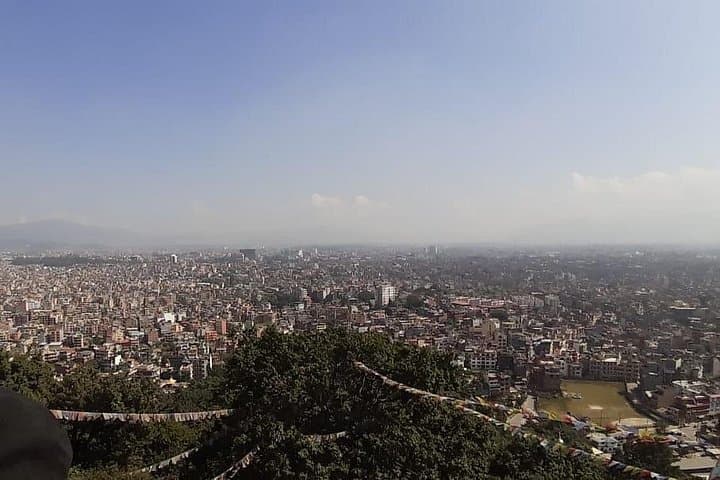
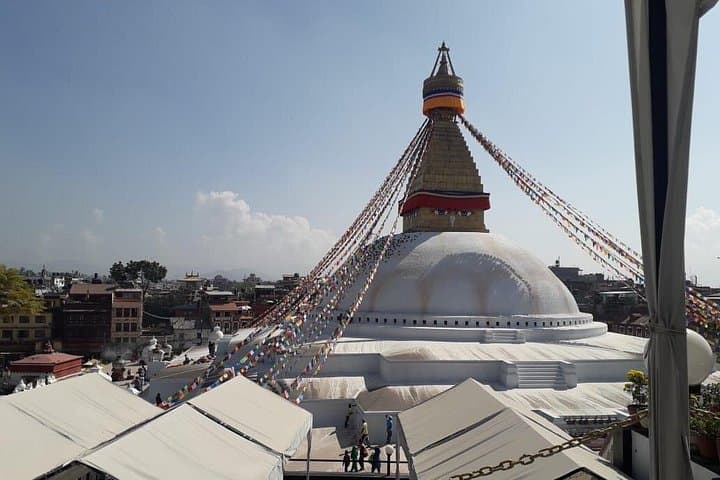
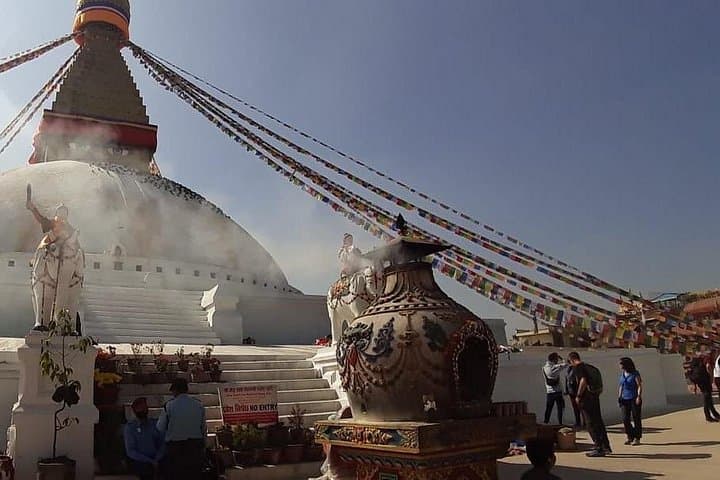
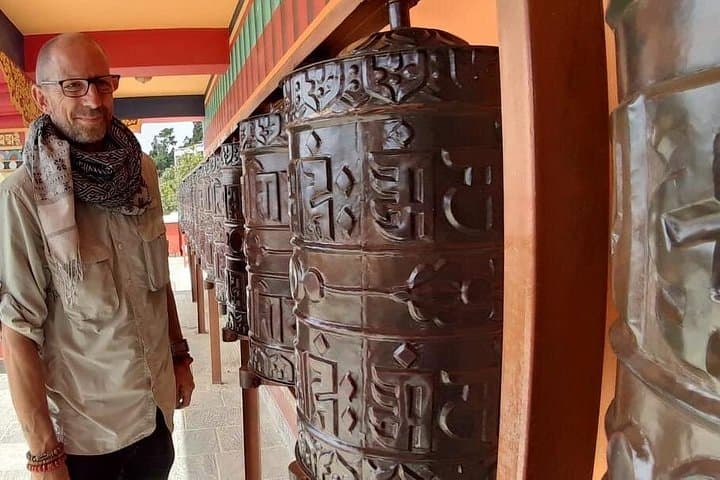
Swayambhunath sits on a conical hill west of central Kathmandu; its white dome and gilded eyes are visible across the valley. The climb involves roughly 365 stone steps and short forested sections, offering informal viewpoints over the bowl-shaped Kathmandu Valley carved between surrounding ridgelines. Boudhanath, eight kilometers to the east, is a monumental octagonal stupa ringed by gompas and Tibetan shops; devotees perform a clockwise kora around a roughly 1 km paved base, spinning prayer wheels and tracing mani walls.
Culturally, both sites are active centers of Buddhist practice — Lamas, chanting, butter lamps and ritual prostrations are common. Historically, Swayambhu is among the valley’s oldest shrines; Boudhanath grew as a hub for Tibetan Buddhism after mid-20th century migrations.
Practical guide: allow 3–4 hours for pickup, the short climb at Swayambhunath and the stroll at Boudha. Wear modest clothing that covers shoulders and knees, sturdy shoes for stone steps, and bring water and sun protection. Visit early to avoid crowds and mid-day heat. Respect shrine etiquette: remove hats, keep phone use discreet, and follow your guide’s lead for photography and donations. The tour includes an English-speaking guide and air-conditioned transfer, making this a manageable half-day immersion into Kathmandu’s living Buddhist heritage.
The tour is approximately 3–4 hours and includes pickup, an English-speaking licensed guide, air-conditioned transport, and visits to Swayambhunath and Boudhanath.
Children can join, but the stair climb at Swayambhunath may be difficult for people with limited mobility; contact the operator about private pickup/drop options closer to the hilltop.
Policies vary; the tour listing notes admission is not included for some sites, so carry small cash for possible local fees or donations.
Early morning is best for cooler temperatures, softer light for photos, and fewer visitors; late afternoon is an alternative for golden light and quieter gompa atmospheres.
Peak to Peak Tours and Treks Pvt Ltd operates guided outdoor trips and adventures with an emphasis on safety, stewardship, and memorable experiences.
Morning light slices through prayer flags as you climb a tree-lined stair to Swayambhunath, the golden spire catching the valley’s first glow. Monkeys claim ledges, bells toll from shrines, and the city hums below — this is a compact cultural circuit that moves from a wooded hilltop stupa to one of the largest Buddhist monuments in the world.
Morning light slices through prayer flags as you climb a tree-lined stair to Swayambhunath, the golden spire catching the valley’s first glow. Monkeys claim ledges, bells toll from shrines, and the city hums below — this is a compact cultural circuit that moves from a wooded hilltop stupa to one of the largest Buddhist monuments in the world.
Swayambhunath sits on a conical hill west of central Kathmandu; its white dome and gilded eyes are visible across the valley. The climb involves roughly 365 stone steps and short forested sections, offering informal viewpoints over the bowl-shaped Kathmandu Valley carved between surrounding ridgelines. Boudhanath, eight kilometers to the east, is a monumental octagonal stupa ringed by gompas and Tibetan shops; devotees perform a clockwise kora around a roughly 1 km paved base, spinning prayer wheels and tracing mani walls.
Culturally, both sites are active centers of Buddhist practice — Lamas, chanting, butter lamps and ritual prostrations are common. Historically, Swayambhu is among the valley’s oldest shrines; Boudhanath grew as a hub for Tibetan Buddhism after mid-20th century migrations.
Practical guide: allow 3–4 hours for pickup, the short climb at Swayambhunath and the stroll at Boudha. Wear modest clothing that covers shoulders and knees, sturdy shoes for stone steps, and bring water and sun protection. Visit early to avoid crowds and mid-day heat. Respect shrine etiquette: remove hats, keep phone use discreet, and follow your guide’s lead for photography and donations. The tour includes an English-speaking guide and air-conditioned transfer, making this a manageable half-day immersion into Kathmandu’s living Buddhist heritage.