THE ADVENTURE COLLECTIVE® · Independent discovery and booking for outdoor travel

Two days of mountain riding from Marrakech into the High Atlas, crossing Ouirgane Valley, pine forests, and Berber villages. Expect mountain tracks, a home-cooked lunch with a Berber family, and overnight in a mountain guesthouse.
Two days of mountain riding from Marrakech into the High Atlas, crossing Ouirgane Valley, pine forests, and Berber villages. Expect mountain tracks, a home-cooked lunch with a Berber family, and overnight in a mountain guesthouse.
You emerge from Marrakech’s bustle into air that tastes of pine resin and dry earth. The first day’s saddle-time climbs through juniper and oak, the valley opening in ribbons of terraced fields and red shale; by late afternoon the horses pick their way to a Berber village where smoke curls from stone ovens.
Verified experiences and guided adventures in the surrounding area.
You emerge from Marrakech’s bustle into air that tastes of pine resin and dry earth. The first day’s saddle-time climbs through juniper and oak, the valley opening in ribbons of terraced fields and red shale; by late afternoon the horses pick their way to a Berber village where smoke curls from stone ovens.
The High Atlas is young, rugged geology — folded and faulted rock that throws up sharp ridgelines and sheltered plateaus. Human history here is layered too: centuries of transhumant shepherding and a salt-and-barter economy that once tied remote valleys to Marrakech’s souks. The route through Ouirgane Valley crosses ancient mule tracks, olive orchards, and a local salt mine, offering close contact with Berber farming life and the chance to share a home-cooked lunch with a family during a three‑hour saddle day.
Expect varied terrain: dirt farm tracks, short rocky ascents, and grassy spurs, with cumulative elevation change up to ~800–1,000 m over two days and peaks near 2,000 m. Riders cover roughly 25–40 km across both days, mostly walking with controlled trots on open stretches.
Practical edge: bring layered clothing for warm days and cool mountain nights, sturdy boots for tack and mounting, a small daypack, and plenty of water — potable supply can be limited on trail. Basic riding experience helps; guides handle navigation and local exchanges. Plan for a moderate pace, lean on local guides for cultural context, and leave space in your itinerary to absorb the slow, horse-led rhythm of the High Atlas.
Basic riding experience is recommended—comfortable at walk and trot for extended periods. Guides can accommodate beginners but safety and balance help enjoyment.
The trip typically includes a one-night stay in a guesthouse or simple mountain lodge in or near Ouirgane; facilities are basic but comfortable.
Rides approach 2,000 m on the route; most travelers acclimate easily, but take it slow if you have recent travel from sea level and watch for headaches or fatigue.
Meals on the trail usually include a shared lunch with a Berber family and local dinners the nightstay; potable water is limited—bring a purifier or extra supply.
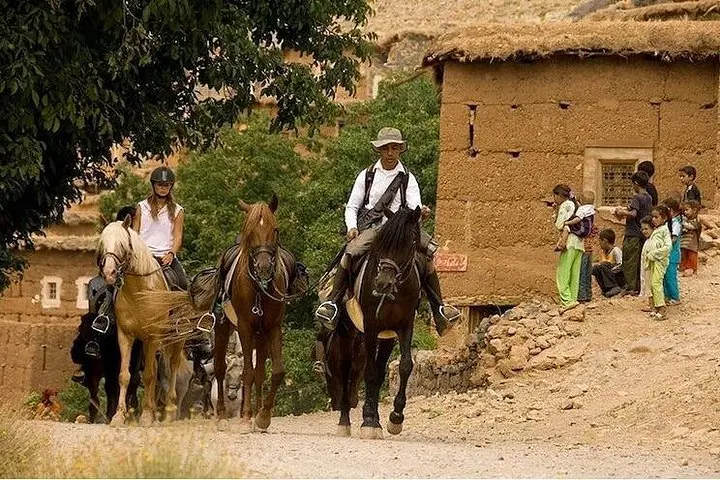
You emerge from Marrakech’s bustle into air that tastes of pine resin and dry earth. The first day’s saddle-time climbs through juniper and oak, the valley opening in ribbons of terraced fields and red shale; by late afternoon the horses pick their way to a Berber village where smoke curls from stone ovens.
You emerge from Marrakech’s bustle into air that tastes of pine resin and dry earth. The first day’s saddle-time climbs through juniper and oak, the valley opening in ribbons of terraced fields and red shale; by late afternoon the horses pick their way to a Berber village where smoke curls from stone ovens.
The High Atlas is young, rugged geology — folded and faulted rock that throws up sharp ridgelines and sheltered plateaus. Human history here is layered too: centuries of transhumant shepherding and a salt-and-barter economy that once tied remote valleys to Marrakech’s souks. The route through Ouirgane Valley crosses ancient mule tracks, olive orchards, and a local salt mine, offering close contact with Berber farming life and the chance to share a home-cooked lunch with a family during a three‑hour saddle day.
Expect varied terrain: dirt farm tracks, short rocky ascents, and grassy spurs, with cumulative elevation change up to ~800–1,000 m over two days and peaks near 2,000 m. Riders cover roughly 25–40 km across both days, mostly walking with controlled trots on open stretches.
Practical edge: bring layered clothing for warm days and cool mountain nights, sturdy boots for tack and mounting, a small daypack, and plenty of water — potable supply can be limited on trail. Basic riding experience helps; guides handle navigation and local exchanges. Plan for a moderate pace, lean on local guides for cultural context, and leave space in your itinerary to absorb the slow, horse-led rhythm of the High Atlas.