THE ADVENTURE COLLECTIVE® · Independent discovery and booking for outdoor travel

Walk the High Line from Hudson Yards to Chelsea Market in a focused two-hour small-group tour. Experience elevated gardens, public art, the Vessel's geometry and city views while learning the history behind Manhattan’s most celebrated urban renewal.
Walk the High Line from Hudson Yards to Chelsea Market in a focused two-hour small-group tour. Experience elevated gardens, public art, the Vessel's geometry and city views while learning the history behind Manhattan’s most celebrated urban renewal.
You step off the city grid and onto a raised ribbon of green that threads the West Side of Manhattan. At chest height, shipping-container warehouses and delivery trucks shrink; below you, streets hum, but up here the air feels different — cooler, scented with cut grass and late-blooming perennials. The High Line lifts you roughly 30–40 feet above traffic and, over the next 1.45 miles (about 2.3 km), the walk alternates between broad boardwalks, narrow park benches, sculptural viewpoints and the gleam of Hudson Yards on the horizon.
Verified experiences and guided adventures in the surrounding area.
Operated by Royal City Tours LLC · New York, NY
You step off the city grid and onto a raised ribbon of green that threads the West Side of Manhattan. At chest height, shipping-container warehouses and delivery trucks shrink; below you, streets hum, but up here the air feels different — cooler, scented with cut grass and late-blooming perennials. The High Line lifts you roughly 30–40 feet above traffic and, over the next 1.45 miles (about 2.3 km), the walk alternates between broad boardwalks, narrow park benches, sculptural viewpoints and the gleam of Hudson Yards on the horizon.
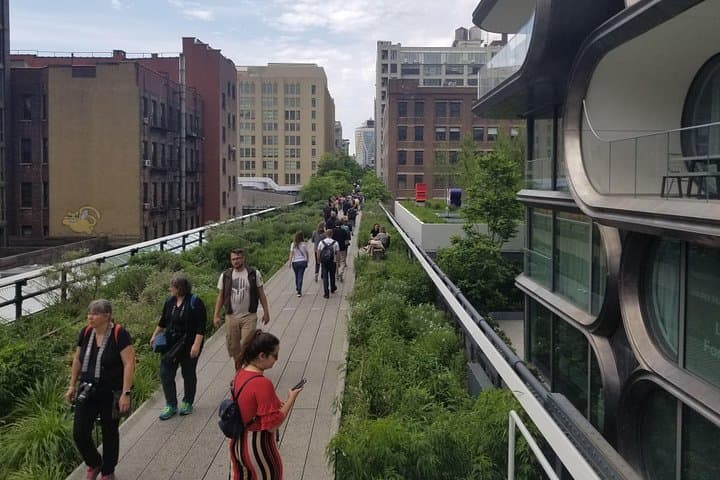
This two-hour small-group walk moves at an exploratory pace. You’ll pass the sharp geometry of the Zaha Hadid-designed building, pause to photograph the Vessel’s latticework from the plaza, and stand on the 10th Avenue Square to watch traffic fold into a cinematic grid below. The path itself is a reclaimed freight rail line, originally built in the 1930s to remove dangerous trains from street level. Abandoned in the 1980s, activists and designers transformed it into an elevated park that opened in phases beginning 2009 — a case study in adaptive reuse and urban design.
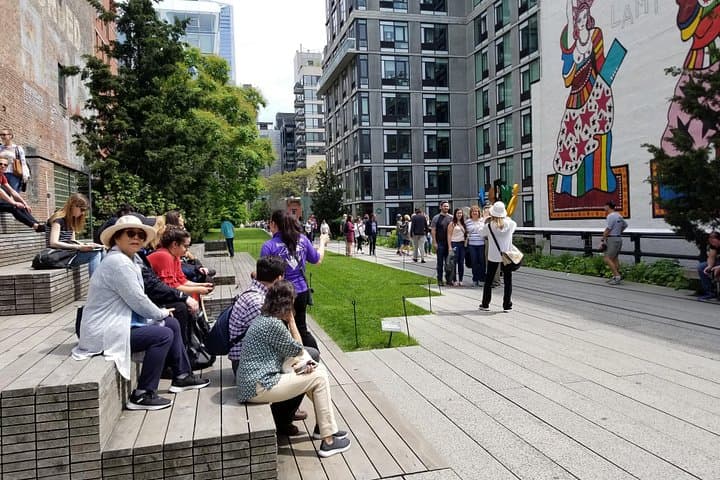
Geology here is urban: Manhattan schist remains far below the street, but what feels like natural topography is actually careful choreography — planting beds chosen for seasonal variety, engineered soils, and drainage that drains to the river. Culture is layered too: industrial past, artists’ studios in Chelsea, and the new wealth of Hudson Yards collide in public art, murals, and the food stalls you’ll spy at Chelsea Market, the tour’s endpoint.
Practicalities: the High Line is paved with a mix of wood and concrete, with ramps and stairs rather than steep climbs — total elevation change is modest, so it’s accessible for most walkers though the tour recommends moderate fitness. Wear supportive shoes for long stretches of standing and uneven boardwalk seams. Bring a refillable bottle; water and restrooms are available at Chelsea Market and Hudson Yards but can require a short detour. Mornings and late afternoons yield the best light for photos and fewer crowds; midday on weekends can be thick with visitors.
The guide will point out plant species selected to thrive in wind and salt spray, public artworks, and micro-views of the Hudson River that feel unexpectedly private. Expect 15 people or fewer, bring a charged camera, and plan your transit: the meeting point is at Equinox Hudson Yards; the tour finishes at the Whitney Museum near Gansevoort Street, where you can linger over food and galleries.
This isn’t a wilderness hike; it’s an urban hike — an engineered greenway that dares you to see Manhattan from an angle most visitors miss.
Meeting point is Equinox Hudson Yards (32 Hudson Yards); the tour ends near the Whitney Museum at Gansevoort Street and Chelsea Market.
Many sections have ramps and are wheelchair accessible, though some viewpoints include stairs; the tour notes accessibility but contact the operator for specific needs.
Yes—strollers are permitted and the route is family-friendly, but the guide recommends supervising children on stairs and crowded viewpoints.
Tours may be canceled for severe weather; check the operator’s cancellation policy and expect light rain to be manageable with proper gear.
No—this is a walking tour focused on public spaces; entrance fees to attractions are not included.
Arrive 10 minutes before the scheduled start to check in; guides ask guests to be punctual as they will wait no more than 10 minutes.
Royal City Tours LLC operates guided outdoor trips and adventures with an emphasis on safety, stewardship, and memorable experiences.

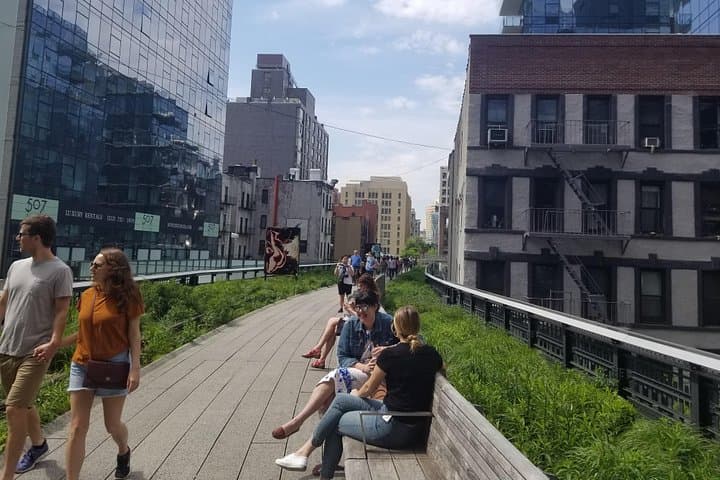
You step off the city grid and onto a raised ribbon of green that threads the West Side of Manhattan. At chest height, shipping-container warehouses and delivery trucks shrink; below you, streets hum, but up here the air feels different — cooler, scented with cut grass and late-blooming perennials. The High Line lifts you roughly 30–40 feet above traffic and, over the next 1.45 miles (about 2.3 km), the walk alternates between broad boardwalks, narrow park benches, sculptural viewpoints and the gleam of Hudson Yards on the horizon.
You step off the city grid and onto a raised ribbon of green that threads the West Side of Manhattan. At chest height, shipping-container warehouses and delivery trucks shrink; below you, streets hum, but up here the air feels different — cooler, scented with cut grass and late-blooming perennials. The High Line lifts you roughly 30–40 feet above traffic and, over the next 1.45 miles (about 2.3 km), the walk alternates between broad boardwalks, narrow park benches, sculptural viewpoints and the gleam of Hudson Yards on the horizon.
This two-hour small-group walk moves at an exploratory pace. You’ll pass the sharp geometry of the Zaha Hadid-designed building, pause to photograph the Vessel’s latticework from the plaza, and stand on the 10th Avenue Square to watch traffic fold into a cinematic grid below. The path itself is a reclaimed freight rail line, originally built in the 1930s to remove dangerous trains from street level. Abandoned in the 1980s, activists and designers transformed it into an elevated park that opened in phases beginning 2009 — a case study in adaptive reuse and urban design.
Geology here is urban: Manhattan schist remains far below the street, but what feels like natural topography is actually careful choreography — planting beds chosen for seasonal variety, engineered soils, and drainage that drains to the river. Culture is layered too: industrial past, artists’ studios in Chelsea, and the new wealth of Hudson Yards collide in public art, murals, and the food stalls you’ll spy at Chelsea Market, the tour’s endpoint.
Practicalities: the High Line is paved with a mix of wood and concrete, with ramps and stairs rather than steep climbs — total elevation change is modest, so it’s accessible for most walkers though the tour recommends moderate fitness. Wear supportive shoes for long stretches of standing and uneven boardwalk seams. Bring a refillable bottle; water and restrooms are available at Chelsea Market and Hudson Yards but can require a short detour. Mornings and late afternoons yield the best light for photos and fewer crowds; midday on weekends can be thick with visitors.
The guide will point out plant species selected to thrive in wind and salt spray, public artworks, and micro-views of the Hudson River that feel unexpectedly private. Expect 15 people or fewer, bring a charged camera, and plan your transit: the meeting point is at Equinox Hudson Yards; the tour finishes at the Whitney Museum near Gansevoort Street, where you can linger over food and galleries.
This isn’t a wilderness hike; it’s an urban hike — an engineered greenway that dares you to see Manhattan from an angle most visitors miss.