THE ADVENTURE COLLECTIVE® · Independent discovery and booking for outdoor travel

Walk four miles of Hadrian’s Wall with a local guide who combines Roman history, geology and panoramic viewpoints. This private tour from The Sill uses the AD122 bus, visits Housesteads and Sycamore Gap, and includes poles, binoculars and a bespoke map.
Walk four miles of Hadrian’s Wall with a local guide who combines Roman history, geology and panoramic viewpoints. This private tour from The Sill uses the AD122 bus, visits Housesteads and Sycamore Gap, and includes poles, binoculars and a bespoke map.
The morning air on Hadrian’s Wall feels like a held breath—wind pushing across open moor and grass, sheep working the slopes below, and the grey line of Roman stone cutting the horizon. You meet at The Sill, step onto the AD122 bus and watch the landscape open to reveal farmed valley and crag as the guide points out the Stanegate Road and in‑situ milestones.
Verified experiences and guided adventures in the surrounding area.
Operated by Curius Compass · Once Brewed, Northumberland
The morning air on Hadrian’s Wall feels like a held breath—wind pushing across open moor and grass, sheep working the slopes below, and the grey line of Roman stone cutting the horizon. You meet at The Sill, step onto the AD122 bus and watch the landscape open to reveal farmed valley and crag as the guide points out the Stanegate Road and in‑situ milestones.
This four‑mile loop threads living history with geology: the Whin Sill dolerite underpins the Wall’s defensive line, creating the steep escarpments Romans exploited when Emperor Hadrian ordered the frontier in AD 122. Housesteads Roman Fort and nearby milecastles (37 and 39) offer tangible traces of frontier life; elsewhere the landscape still carries medieval field systems and charcoal pits that speak to centuries of human use.
Culturally, the Wall is more than ruins—it's a working boundary in local memory, tied to shepherding, wartime stories, and recent conservation efforts. Your guide balances history with local insights, pointing out a hidden Roman carving, the site of Sycamore Gap and the resilient tree’s regrowth, and Peel Gap Tower’s unmarked presence.
Practical notes: expect uneven stone and grass paths, short steep sections, and open exposure to wind and rain. The tour runs about 3–4 hours with photo stops and short interpretive talks; it’s tailored to pace and includes poles and binoculars. Wear sturdy footwear, layer for sudden weather shifts, and plan transport back to The Sill—the day often ends with a warm café visit and a chance to handle an authentic Roman artefact.
Yes—well‑behaved dogs are welcome but must be kept on a lead due to livestock and fragile sites.
The itinerary includes time at Housesteads for views and interpretation, but this particular tour does not include entry into the fort building itself.
The route has uneven ground and short steep sections; participants should have moderate fitness—contact the operator about alternative, gentler paths if needed.
The tour includes AD122 bus tickets and interpretive stops; entrance fees to paid sites are not included—this tour often views some sites from the path rather than entering.
Curius Compass operates guided outdoor trips and adventures with an emphasis on safety, stewardship, and memorable experiences.
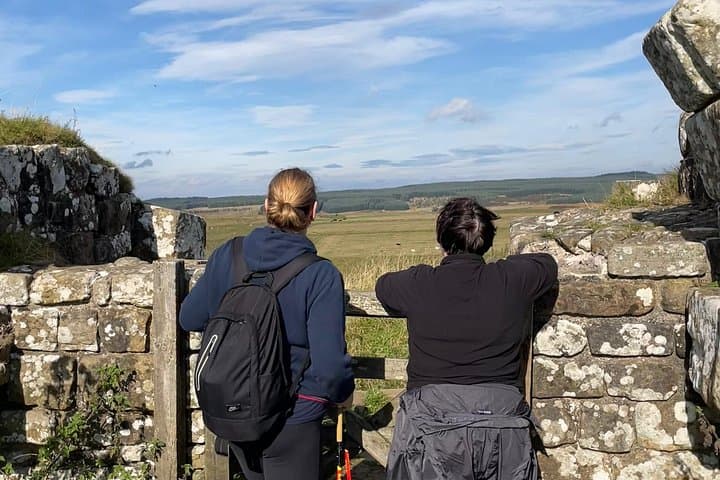


The morning air on Hadrian’s Wall feels like a held breath—wind pushing across open moor and grass, sheep working the slopes below, and the grey line of Roman stone cutting the horizon. You meet at The Sill, step onto the AD122 bus and watch the landscape open to reveal farmed valley and crag as the guide points out the Stanegate Road and in‑situ milestones.
The morning air on Hadrian’s Wall feels like a held breath—wind pushing across open moor and grass, sheep working the slopes below, and the grey line of Roman stone cutting the horizon. You meet at The Sill, step onto the AD122 bus and watch the landscape open to reveal farmed valley and crag as the guide points out the Stanegate Road and in‑situ milestones.
This four‑mile loop threads living history with geology: the Whin Sill dolerite underpins the Wall’s defensive line, creating the steep escarpments Romans exploited when Emperor Hadrian ordered the frontier in AD 122. Housesteads Roman Fort and nearby milecastles (37 and 39) offer tangible traces of frontier life; elsewhere the landscape still carries medieval field systems and charcoal pits that speak to centuries of human use.
Culturally, the Wall is more than ruins—it's a working boundary in local memory, tied to shepherding, wartime stories, and recent conservation efforts. Your guide balances history with local insights, pointing out a hidden Roman carving, the site of Sycamore Gap and the resilient tree’s regrowth, and Peel Gap Tower’s unmarked presence.
Practical notes: expect uneven stone and grass paths, short steep sections, and open exposure to wind and rain. The tour runs about 3–4 hours with photo stops and short interpretive talks; it’s tailored to pace and includes poles and binoculars. Wear sturdy footwear, layer for sudden weather shifts, and plan transport back to The Sill—the day often ends with a warm café visit and a chance to handle an authentic Roman artefact.