THE ADVENTURE COLLECTIVE® · Independent discovery and booking for outdoor travel

A compact day that pairs a two-hour rainforest hike with a private boat trip to Taino-painted caves, Los Haitises delivers karst geology, mangrove channels, and cultural history in about 5–6 hours.
A compact day that pairs a two-hour rainforest hike with a private boat trip to Taino-painted caves, Los Haitises delivers karst geology, mangrove channels, and cultural history in about 5–6 hours.
You step off the small pier and the forest seems to inhale — humidity pressing warm and green against your skin as boats slip away through narrow mangrove fingers. The first steps on the trail are soft with leaf litter; roots knot the path and a chorus of insects marks your pace. For the next two hours the island’s interior rearranges your sense of scale: squat limestone mogotes rise like interrupted hills, the canopy closes in, and the river channels push and pull the sound of the boat from memory.
Verified experiences and guided adventures in the surrounding area.
Operated by The Whales Las Ballenas · Sabana de la Mar, Samaná Province
You step off the small pier and the forest seems to inhale — humidity pressing warm and green against your skin as boats slip away through narrow mangrove fingers. The first steps on the trail are soft with leaf litter; roots knot the path and a chorus of insects marks your pace. For the next two hours the island’s interior rearranges your sense of scale: squat limestone mogotes rise like interrupted hills, the canopy closes in, and the river channels push and pull the sound of the boat from memory.
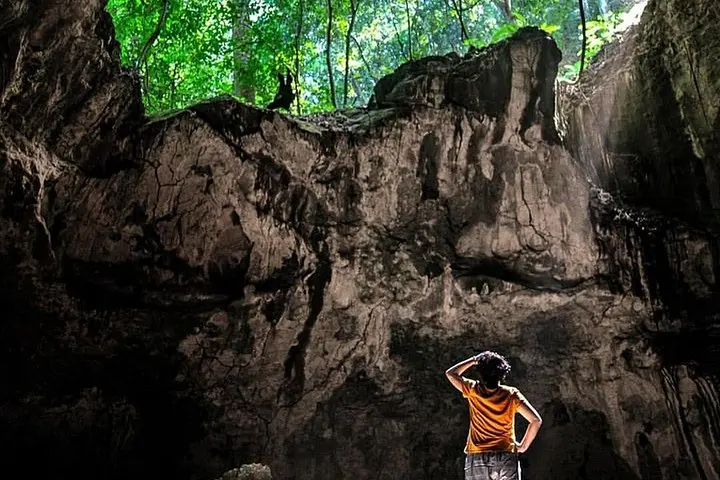
Los Haitises is a geologic story written in limestone and water. The park protects one of the Dominican Republic’s most extensive karst landscapes — caves scored by prehistoric seas, stalactites, and the caves where Taíno people left pictographs and offering sites. Spanish colonial ships once skirted these coves; today, the same caves host quiet explanations of pre-Columbian life and the biology that thrives where freshwater meets salt.
Culturally, the walk folds together medicinal-plant lore and modern stewardship. Local guides point out yautía and guava used in traditional remedies and explain how mangrove roots filter sediment before it reaches the bay. The hike finishes at Caño Salado pier and, depending on the tide, a private boat takes you to Cueva de la Línea and Cueva de la Arena — caves whose walls still display charcoal-and-ochre marks attributed to Taíno visitors, and whose low ceilings demand a careful, reverent entrance.
Practical details are straightforward. The full excursion runs about 5–6 hours; the hike portion is roughly 2 hours and covers undulating coastal rainforest trails with minimal elevation gain (expect 50–150 ft total, but lots of short rooty ups and downs). Terrain is often muddy after rain and lined with exposed roots; the boat segments traverse mangrove channels and open-water bays. Guides provide interpretation; there’s no official visitor center at the trailhead, and transfers to the park are typically not included — meet points are Sabana de la Mar or Caño Hondo.
Plan for heat and bugs: light, quick-dry clothing, waterproof footwear with good tread, and liberal insect repellent. Bring a dry bag for electronics, at least 2 liters of water, and sun protection for the boat stretches. Respect cave art — no touching — and follow your guide’s instructions for low-ceiling passages.
For travelers who want a compact but rich day in the Dominican wilds, this pairing of rainforest hike and private cave cruise delivers geology, cultural history, and marine vistas in a single, accessible outing.
The guided hike portion is approximately 2 hours on forest trails with light ups and downs and sections that can be muddy after rain.
Children can join but must be supervised closely in low-ceiling caves; parents should assess mobility and comfort in confined, dark spaces.
Transfers are typically not included; meeting points are Sabana de la Mar or Caño Hondo — confirm exact pickup details with the operator before booking.
Yes, guided visits include caves with Taíno pictographs; touching or flash photography may be restricted to preserve the art.
Quick-dry clothing and a light waterproof layer are best; boat spray and shade can make conditions cooler than the inland trail.
Facilities are limited; expect basic or no toilets at trailheads and piers — plan accordingly before the tour.
The Whales Las Ballenas operates guided outdoor trips and adventures with an emphasis on safety, stewardship, and memorable experiences.
You step off the small pier and the forest seems to inhale — humidity pressing warm and green against your skin as boats slip away through narrow mangrove fingers. The first steps on the trail are soft with leaf litter; roots knot the path and a chorus of insects marks your pace. For the next two hours the island’s interior rearranges your sense of scale: squat limestone mogotes rise like interrupted hills, the canopy closes in, and the river channels push and pull the sound of the boat from memory.
You step off the small pier and the forest seems to inhale — humidity pressing warm and green against your skin as boats slip away through narrow mangrove fingers. The first steps on the trail are soft with leaf litter; roots knot the path and a chorus of insects marks your pace. For the next two hours the island’s interior rearranges your sense of scale: squat limestone mogotes rise like interrupted hills, the canopy closes in, and the river channels push and pull the sound of the boat from memory.
Los Haitises is a geologic story written in limestone and water. The park protects one of the Dominican Republic’s most extensive karst landscapes — caves scored by prehistoric seas, stalactites, and the caves where Taíno people left pictographs and offering sites. Spanish colonial ships once skirted these coves; today, the same caves host quiet explanations of pre-Columbian life and the biology that thrives where freshwater meets salt.
Culturally, the walk folds together medicinal-plant lore and modern stewardship. Local guides point out yautía and guava used in traditional remedies and explain how mangrove roots filter sediment before it reaches the bay. The hike finishes at Caño Salado pier and, depending on the tide, a private boat takes you to Cueva de la Línea and Cueva de la Arena — caves whose walls still display charcoal-and-ochre marks attributed to Taíno visitors, and whose low ceilings demand a careful, reverent entrance.
Practical details are straightforward. The full excursion runs about 5–6 hours; the hike portion is roughly 2 hours and covers undulating coastal rainforest trails with minimal elevation gain (expect 50–150 ft total, but lots of short rooty ups and downs). Terrain is often muddy after rain and lined with exposed roots; the boat segments traverse mangrove channels and open-water bays. Guides provide interpretation; there’s no official visitor center at the trailhead, and transfers to the park are typically not included — meet points are Sabana de la Mar or Caño Hondo.
Plan for heat and bugs: light, quick-dry clothing, waterproof footwear with good tread, and liberal insect repellent. Bring a dry bag for electronics, at least 2 liters of water, and sun protection for the boat stretches. Respect cave art — no touching — and follow your guide’s instructions for low-ceiling passages.
For travelers who want a compact but rich day in the Dominican wilds, this pairing of rainforest hike and private cave cruise delivers geology, cultural history, and marine vistas in a single, accessible outing.