THE ADVENTURE COLLECTIVE® · Independent discovery and booking for outdoor travel

A full‑day loop from Hanoi that pairs the ancient temples of Hoa Lu with a classic sampan trip through Tam Coc’s karst river and an easy bicycle loop through rice paddies and village lanes. Expect caves, quiet waters and a day of steady, low‑impact exploration.
A full‑day loop from Hanoi that pairs the ancient temples of Hoa Lu with a classic sampan trip through Tam Coc’s karst river and an easy bicycle loop through rice paddies and village lanes. Expect caves, quiet waters and a day of steady, low‑impact exploration.
The morning bus eases out of Hanoi and the low karst peaks of Ninh Binh grow larger, their limestone faces catching light like folded pages. By mid‑morning the group is at Hoa Lu, where stout temple walls and cracked stone courtways mark Vietnam’s 10th–11th century seat of power. The place feels worn by rain and time, yet the battered gates frame the same skyline that once watched court processions.
Verified experiences and guided adventures in the surrounding area.
Operated by MC Travel · Tam Coc, Ninh Binh
The morning bus eases out of Hanoi and the low karst peaks of Ninh Binh grow larger, their limestone faces catching light like folded pages. By mid‑morning the group is at Hoa Lu, where stout temple walls and cracked stone courtways mark Vietnam’s 10th–11th century seat of power. The place feels worn by rain and time, yet the battered gates frame the same skyline that once watched court processions.
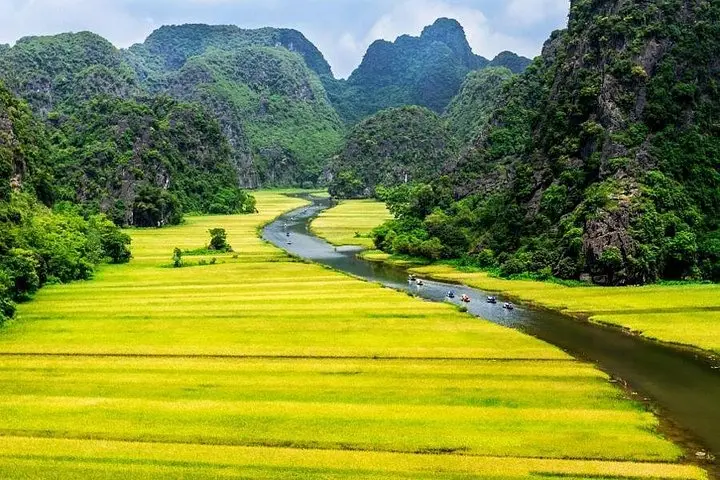
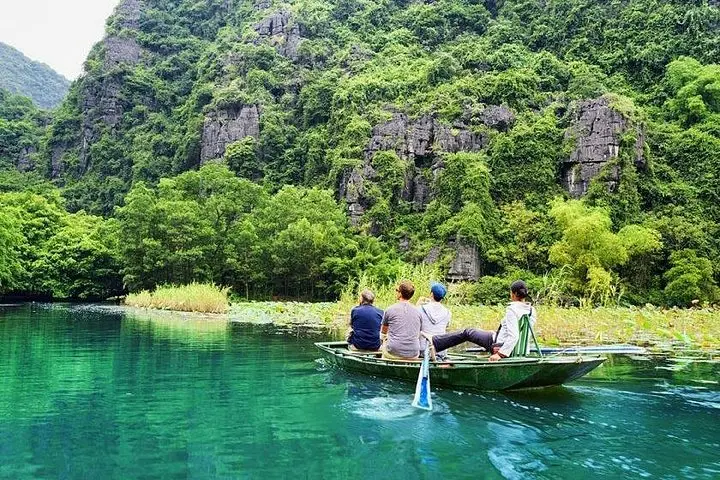
After lunch the trip moves to Ngo Dong river. Local rowers steer narrow sampans under low cave mouths; the river threads between steep limestone ribs and rice fields that push to the water’s edge. The caverns — Hang Ca, Hang Hai, Hang Ba — are river‑carved mouths that smell faintly of damp earth and bat guano, and the oars’ rhythm sets a slow, meditative pace.
A cycle ride through country lanes follows, past mud walls, water buffalo grazing, and houses where laundry lines flap in the breeze. The terrain is flat with short, uneven village roads; expect soft shoulders and occasional gravel.
Practical guidance: start early to avoid midday heat, bring sun protection and cash for tips, and wear shoes that can handle both bike pedals and muddy paths. The full‑day schedule runs roughly 10–11 hours with moderate physical demand — mostly gentle pedaling and short walks — suitable for most travelers who can mount a standard bicycle.
Respect local customs: ask before photographing people, and keep plastic out of the river. With minimal technical challenge, the day balances history, karst geology and hands‑on village travel into a single, accessible outing.
Basic cycling ability is required—routes are flat but include village traffic and loose gravel; e-bikes are occasionally available on request.
Sampans are stable and shallow; rowers keep speed slow through caves, but those with severe water anxiety may prefer to skip the boat portion.
Guides are English‑speaking and pickup/drop‑off in Hanoi Old Quarter is included in most bookings.
A buffet lunch is included and local restaurants typically offer vegetarian dishes—notify the operator in advance for specific dietary needs.
MC Travel operates guided outdoor trips and adventures with an emphasis on safety, stewardship, and memorable experiences.


The morning bus eases out of Hanoi and the low karst peaks of Ninh Binh grow larger, their limestone faces catching light like folded pages. By mid‑morning the group is at Hoa Lu, where stout temple walls and cracked stone courtways mark Vietnam’s 10th–11th century seat of power. The place feels worn by rain and time, yet the battered gates frame the same skyline that once watched court processions.
The morning bus eases out of Hanoi and the low karst peaks of Ninh Binh grow larger, their limestone faces catching light like folded pages. By mid‑morning the group is at Hoa Lu, where stout temple walls and cracked stone courtways mark Vietnam’s 10th–11th century seat of power. The place feels worn by rain and time, yet the battered gates frame the same skyline that once watched court processions.
After lunch the trip moves to Ngo Dong river. Local rowers steer narrow sampans under low cave mouths; the river threads between steep limestone ribs and rice fields that push to the water’s edge. The caverns — Hang Ca, Hang Hai, Hang Ba — are river‑carved mouths that smell faintly of damp earth and bat guano, and the oars’ rhythm sets a slow, meditative pace.
A cycle ride through country lanes follows, past mud walls, water buffalo grazing, and houses where laundry lines flap in the breeze. The terrain is flat with short, uneven village roads; expect soft shoulders and occasional gravel.
Practical guidance: start early to avoid midday heat, bring sun protection and cash for tips, and wear shoes that can handle both bike pedals and muddy paths. The full‑day schedule runs roughly 10–11 hours with moderate physical demand — mostly gentle pedaling and short walks — suitable for most travelers who can mount a standard bicycle.
Respect local customs: ask before photographing people, and keep plastic out of the river. With minimal technical challenge, the day balances history, karst geology and hands‑on village travel into a single, accessible outing.