THE ADVENTURE COLLECTIVE® · Independent discovery and booking for outdoor travel

Ride a shuttle through Hegra’s monumental rock-cut tombs and explore at your own pace with a multilingual Multimedia Guide. This hop-on hop-off loop connects the Visitor Centre, Qasr al-Farid, Diwan Tombs and Jabal Ithlib, letting you linger where you choose.
Ride a shuttle through Hegra’s monumental rock-cut tombs and explore at your own pace with a multilingual Multimedia Guide. This hop-on hop-off loop connects the Visitor Centre, Qasr al-Farid, Diwan Tombs and Jabal Ithlib, letting you linger where you choose.
A dry wind moves through honey-colored sandstone as a low bus eases past carved tomb facades—Qasr al-Farid rising like an unfinished story in the center of the frame. Visitors step off, guided by a handheld Multimedia Guide (MMG), and the past clicks to life in multiple languages while the cliffs keep their watch.
Verified experiences and guided adventures in the surrounding area.
Operated by Golden Destination · AlUla, Al Madinah Region
A dry wind moves through honey-colored sandstone as a low bus eases past carved tomb facades—Qasr al-Farid rising like an unfinished story in the center of the frame. Visitors step off, guided by a handheld Multimedia Guide (MMG), and the past clicks to life in multiple languages while the cliffs keep their watch.
Hegra (Madâin Sâlih) was the southern outpost of the Nabataean Kingdom; its monumental rock-cut tombs and carved facades date mainly to the 1st century BCE–1st century CE. Geology here is stark: cross-bedded sandstone sculpted by wind and occasional flash floods into ridges, hollows, and natural amphitheaters that accent the funerary architecture.
Culturally, the site reveals a trading civilization between Arabia and the Mediterranean; inscriptions and funerary motifs trace links across the ancient world. Modern AlUla lies a short drive away, where new interpretation and hospitality services support visits while respecting archaeological zones.
Practically, the hop-on hop-off service loops four main stops (Visitor Centre, Qasr al-Farid, Diwan Tombs, Jabal Ithlib) with buses every 10 minutes from 8:00–17:00. The MMG device provides maps, audio, and short games, letting families move at their own pace. Expect sun, reflective rock, and uneven walking surfaces: bring sun protection, at least 1–2 liters of water, and sturdy shoes. Photography is permitted, but climbing on monuments is prohibited. Free parking at the Visitor Centre makes arrival simple; allow 1–3 hours to sample key highlights or a half day to explore thoroughly. Timing early morning or late afternoon reduces heat and casts the tomb facades in strong, revealing light.
Buses loop the site every 10 minutes between the Visitor Centre and the three main stops, allowing frequent hop-on hop-off access.
Yes; the MMG device is included and offers English, Arabic, Chinese, French and Italian audio and content.
Yes; the hop-on hop-off format lets you exit at any stop and reboard later—buses continue on the loop throughout operating hours.
Free parking is available at the Visitor Centre; parts of the main archaeological area have level paths, but many tombs are on uneven ground and may be limited for wheelchairs.
Golden Destination operates guided outdoor trips and adventures with an emphasis on safety, stewardship, and memorable experiences.
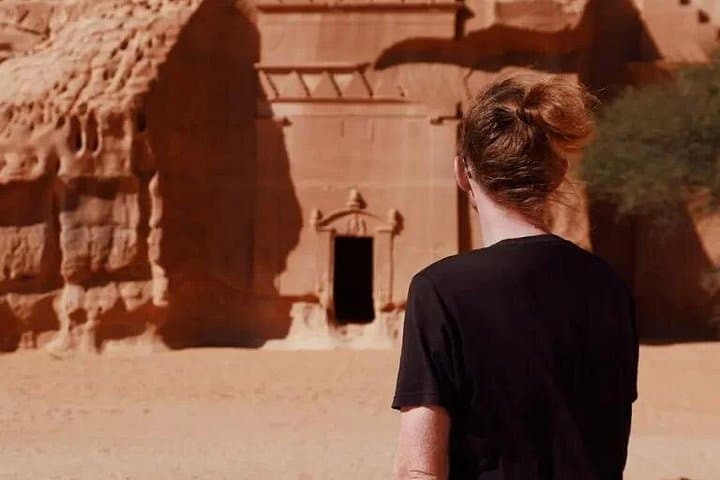


A dry wind moves through honey-colored sandstone as a low bus eases past carved tomb facades—Qasr al-Farid rising like an unfinished story in the center of the frame. Visitors step off, guided by a handheld Multimedia Guide (MMG), and the past clicks to life in multiple languages while the cliffs keep their watch.
A dry wind moves through honey-colored sandstone as a low bus eases past carved tomb facades—Qasr al-Farid rising like an unfinished story in the center of the frame. Visitors step off, guided by a handheld Multimedia Guide (MMG), and the past clicks to life in multiple languages while the cliffs keep their watch.
Hegra (Madâin Sâlih) was the southern outpost of the Nabataean Kingdom; its monumental rock-cut tombs and carved facades date mainly to the 1st century BCE–1st century CE. Geology here is stark: cross-bedded sandstone sculpted by wind and occasional flash floods into ridges, hollows, and natural amphitheaters that accent the funerary architecture.
Culturally, the site reveals a trading civilization between Arabia and the Mediterranean; inscriptions and funerary motifs trace links across the ancient world. Modern AlUla lies a short drive away, where new interpretation and hospitality services support visits while respecting archaeological zones.
Practically, the hop-on hop-off service loops four main stops (Visitor Centre, Qasr al-Farid, Diwan Tombs, Jabal Ithlib) with buses every 10 minutes from 8:00–17:00. The MMG device provides maps, audio, and short games, letting families move at their own pace. Expect sun, reflective rock, and uneven walking surfaces: bring sun protection, at least 1–2 liters of water, and sturdy shoes. Photography is permitted, but climbing on monuments is prohibited. Free parking at the Visitor Centre makes arrival simple; allow 1–3 hours to sample key highlights or a half day to explore thoroughly. Timing early morning or late afternoon reduces heat and casts the tomb facades in strong, revealing light.