THE ADVENTURE COLLECTIVE® · Independent discovery and booking for outdoor travel

Board a hill-country train, breathe the cold highland air, and walk the plateau trails to World’s End—the cliff that drops into mist and the Indian Ocean’s imagined horizon. This day tour pairs rail heritage with a compact, dramatic hike through Sri Lanka’s montane ecosystem.
Board a hill-country train, breathe the cold highland air, and walk the plateau trails to World’s End—the cliff that drops into mist and the Indian Ocean’s imagined horizon. This day tour pairs rail heritage with a compact, dramatic hike through Sri Lanka’s montane ecosystem.
A predawn train slices through the Sri Lankan hill country—tea terraces slide past, mist clings to ridgelines, and by the time you step off at Ohiya the air has the brisk bite of altitude. From the station the landscape opens into a plateau where grassland runs like a short, wind-scoured sea and cloud forest knots itself around rocky knolls.
Verified experiences and guided adventures in the surrounding area.
Operated by KINGFISHER TOURS SRI LANKA · Ohiya, Central Province
A predawn train slices through the Sri Lankan hill country—tea terraces slide past, mist clings to ridgelines, and by the time you step off at Ohiya the air has the brisk bite of altitude. From the station the landscape opens into a plateau where grassland runs like a short, wind-scoured sea and cloud forest knots itself around rocky knolls.
Horton Plains National Park sits at roughly 2,100–2,300 m in the central highlands, a remnant of montane cloud ecosystem shaped by uplifted rock and heavy rainfall. The trails cross heathland and alder forest, reveal Baker’s Falls—a 20 m cascade named for 19th-century explorer Samuel Baker—and end at World’s End, a sheer escarpment with a nearly 1,200 m drop that pushes the sky into sudden perspective.
Local culture around Nuwara Eliya and Ohiya is defined by tea estates and small hill villages; the railway itself is a Victorian-era legacy that became a lifeline for plantation communities. Conservation here focuses on protecting endemic plants and preventing invasive species from changing the fragile plateau.
Practical guide: plan an early start—park gates and trails are cold and often mist-shrouded by mid-morning, visibility clears after dawn. Wear sturdy, waterproof shoes for muddy boardwalks, bring layers and a rain shell, and pack at least 1–2 liters of water. The main hike to World’s End and Baker’s Falls can be done in 3–4 hours at a steady pace; expect uneven terrain and occasional steep rock steps. Respect trail closures and keep distance from cliff edges—wind can be abrupt. After the hike, allow time to warm up with a hot drink in Ohiya or Nuwara Eliya before catching the return train.
The main loop from the park entrance to World’s End and Baker’s Falls and back typically takes 3–4 hours, depending on pace and stops.
Many organized tours include a scenic train segment to Ohiya or nearby stations; confirm inclusion before booking and keep your mobile ticket handy.
Yes—entry fees and park permits are required; tour operators usually handle admissions, but independent visitors should purchase tickets at the park office.
You can expect to encounter birds, sambar deer, and small mammals—dense vegetation and mist mean sightings are occasional rather than guaranteed.
KINGFISHER TOURS SRI LANKA operates guided outdoor trips and adventures with an emphasis on safety, stewardship, and memorable experiences.


A predawn train slices through the Sri Lankan hill country—tea terraces slide past, mist clings to ridgelines, and by the time you step off at Ohiya the air has the brisk bite of altitude. From the station the landscape opens into a plateau where grassland runs like a short, wind-scoured sea and cloud forest knots itself around rocky knolls.
A predawn train slices through the Sri Lankan hill country—tea terraces slide past, mist clings to ridgelines, and by the time you step off at Ohiya the air has the brisk bite of altitude. From the station the landscape opens into a plateau where grassland runs like a short, wind-scoured sea and cloud forest knots itself around rocky knolls.
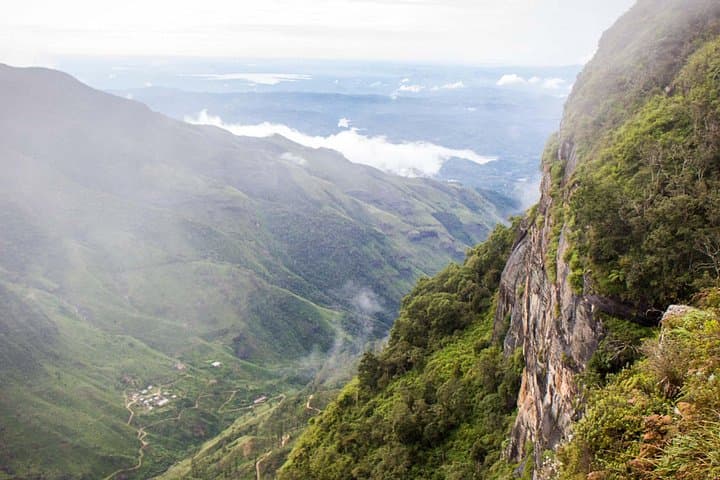
Horton Plains National Park sits at roughly 2,100–2,300 m in the central highlands, a remnant of montane cloud ecosystem shaped by uplifted rock and heavy rainfall. The trails cross heathland and alder forest, reveal Baker’s Falls—a 20 m cascade named for 19th-century explorer Samuel Baker—and end at World’s End, a sheer escarpment with a nearly 1,200 m drop that pushes the sky into sudden perspective.
Local culture around Nuwara Eliya and Ohiya is defined by tea estates and small hill villages; the railway itself is a Victorian-era legacy that became a lifeline for plantation communities. Conservation here focuses on protecting endemic plants and preventing invasive species from changing the fragile plateau.
Practical guide: plan an early start—park gates and trails are cold and often mist-shrouded by mid-morning, visibility clears after dawn. Wear sturdy, waterproof shoes for muddy boardwalks, bring layers and a rain shell, and pack at least 1–2 liters of water. The main hike to World’s End and Baker’s Falls can be done in 3–4 hours at a steady pace; expect uneven terrain and occasional steep rock steps. Respect trail closures and keep distance from cliff edges—wind can be abrupt. After the hike, allow time to warm up with a hot drink in Ohiya or Nuwara Eliya before catching the return train.