THE ADVENTURE COLLECTIVE® · Independent discovery and booking for outdoor travel

Combine Hue’s wartime history with the subterranean drama of Paradise Cave on a full-day trip that moves from memorial bridges to towering limestone caverns. Expect long travel stretches, a tram to the cave entrance, and a walking circuit through vast, well-lit chambers.
Combine Hue’s wartime history with the subterranean drama of Paradise Cave on a full-day trip that moves from memorial bridges to towering limestone caverns. Expect long travel stretches, a tram to the cave entrance, and a walking circuit through vast, well-lit chambers.
Dawn in Hue is river-gray and cool; the tourist car slips out of the city and the landscape opens into low rice plains and roadside memorials to Vietnam’s 20th-century conflicts. By midmorning the scenery grows wilder — rippling karst outcrops rise from green fields and the road edges the Annamite foothills — leading to Phong Nha’s rim where Paradise Cave makes its claim.
Verified experiences and guided adventures in the surrounding area.
Operated by Alotour · Phong Nha, Quang Binh
Dawn in Hue is river-gray and cool; the tourist car slips out of the city and the landscape opens into low rice plains and roadside memorials to Vietnam’s 20th-century conflicts. By midmorning the scenery grows wilder — rippling karst outcrops rise from green fields and the road edges the Annamite foothills — leading to Phong Nha’s rim where Paradise Cave makes its claim.
The day pairs wartime history with karst geology: stops in Quang Tri include the Hien Luong Bridge and Ben Hai River, sites that divided the country during the war and now serve as quiet historical markers. Geologically, Phong Nha–Ke Bang is a limestone massif carved by subterranean rivers; Paradise Cave is a dry cave with tall vaulted chambers and extensive stalactite and stalagmite formations discovered for tourism in the early 2000s.
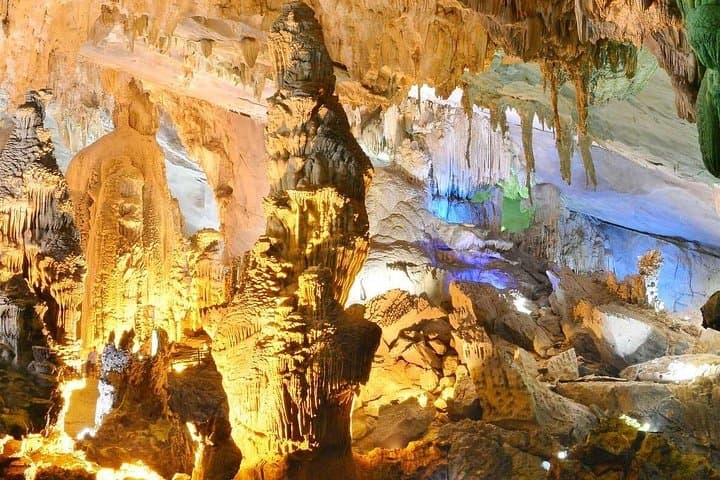
Inside the cave, scale is the story — columns and draperies the size of small buildings, formations with local names that echo familiar shapes like terraces and towers. Outside, small markets and simple restaurants serve central-Vietnamese rice and noodles; the people here reflect a countryside culture tied to river transport and farming.
Practical guidance: the tour is long (about 12 hours) and mostly low-impact walking on paved or stepped paths, but expect stairs inside the cave and humidity. Bring breathable clothing, sturdy walking shoes, sun protection for the outdoor segments, and a refillable water bottle. Start early to avoid midday heat and keep pace with the group — the itinerary moves steadily from memorials to lunch to the cave tram and the walking circuit. This day delivers both context and spectacle: historical perspective on the coastal plains, then a subterranean landscape that commands quiet attention.
Expect about 12 hours total including pick-up, travel time (roughly 3–4 hours each way), stops at historical sites, lunch, and the Paradise Cave visit.
Yes—most of the cave route is on maintained paths and steps, but it requires stair climbing; those with significant mobility issues should consider skipping the cave circuit.
This tour includes Paradise Cave admission and a provided lunch, plus bottled water and tram transfer to the cave foothill as stated in the itinerary.
Light, breathable clothing and closed-toe shoes; caves are cool but humid, so a thin layer is sufficient for comfort.
Alotour operates guided outdoor trips and adventures with an emphasis on safety, stewardship, and memorable experiences.



Dawn in Hue is river-gray and cool; the tourist car slips out of the city and the landscape opens into low rice plains and roadside memorials to Vietnam’s 20th-century conflicts. By midmorning the scenery grows wilder — rippling karst outcrops rise from green fields and the road edges the Annamite foothills — leading to Phong Nha’s rim where Paradise Cave makes its claim.
Dawn in Hue is river-gray and cool; the tourist car slips out of the city and the landscape opens into low rice plains and roadside memorials to Vietnam’s 20th-century conflicts. By midmorning the scenery grows wilder — rippling karst outcrops rise from green fields and the road edges the Annamite foothills — leading to Phong Nha’s rim where Paradise Cave makes its claim.
The day pairs wartime history with karst geology: stops in Quang Tri include the Hien Luong Bridge and Ben Hai River, sites that divided the country during the war and now serve as quiet historical markers. Geologically, Phong Nha–Ke Bang is a limestone massif carved by subterranean rivers; Paradise Cave is a dry cave with tall vaulted chambers and extensive stalactite and stalagmite formations discovered for tourism in the early 2000s.
Inside the cave, scale is the story — columns and draperies the size of small buildings, formations with local names that echo familiar shapes like terraces and towers. Outside, small markets and simple restaurants serve central-Vietnamese rice and noodles; the people here reflect a countryside culture tied to river transport and farming.
Practical guidance: the tour is long (about 12 hours) and mostly low-impact walking on paved or stepped paths, but expect stairs inside the cave and humidity. Bring breathable clothing, sturdy walking shoes, sun protection for the outdoor segments, and a refillable water bottle. Start early to avoid midday heat and keep pace with the group — the itinerary moves steadily from memorials to lunch to the cave tram and the walking circuit. This day delivers both context and spectacle: historical perspective on the coastal plains, then a subterranean landscape that commands quiet attention.