THE ADVENTURE COLLECTIVE® · Independent discovery and booking for outdoor travel

A long, disciplined day from Hurghada delivers Cairo’s Egyptian Museum and the Giza Plateau in one circuit—expect highway miles, security lines, and unforgettable proximity to the Great Pyramid and Sphinx. Practical tips and timing make the difference on this intensive archaeological day trip.
A long, disciplined day from Hurghada delivers Cairo’s Egyptian Museum and the Giza Plateau in one circuit—expect highway miles, security lines, and unforgettable proximity to the Great Pyramid and Sphinx. Practical tips and timing make the difference on this intensive archaeological day trip.
You step off the bus into a wind that pushes desert grit across sun-baked stone; the Great Pyramid rises ahead, its blocks casting hard-edged shadows that measure centuries. The day begins before dawn in Hurghada and unfolds across highway and scrub toward Cairo, with the Egyptian Museum’s bronze and gold waiting in the city center and the Giza Plateau’s ancient geometry anchoring the afternoon.
Verified experiences and guided adventures in the surrounding area.
You step off the bus into a wind that pushes desert grit across sun-baked stone; the Great Pyramid rises ahead, its blocks casting hard-edged shadows that measure centuries. The day begins before dawn in Hurghada and unfolds across highway and scrub toward Cairo, with the Egyptian Museum’s bronze and gold waiting in the city center and the Giza Plateau’s ancient geometry anchoring the afternoon.
The Egyptian Museum on Tahrir Square holds artifacts that map pharaonic life—from Tutankhamun’s gold to routine tools—while just west the plateaus of Giza host Khufu (Cheops), Khafre (Chephren) and Menkaure (Mykerinos), built around 4,500 years ago. The Sphinx, a half-buried composite of lion and royal visage, watches the desert horizon. Geologically the plateau is limestone, quarried by the very builders whose funerary ambitions shaped the landscape. Culturally, the sites span millennia of religion, craft, and trade; nearby papyrus workshops demonstrate how ink met reed.
Practically: expect a long travel day—roughly 450 km (280 miles) round trip with 4–6 hours each way depending on traffic. Security checks and ticket lines are standard; interior access to the Great Pyramid requires a separate, limited ticket. Bring water, a sun hat, and sturdy shoes for uneven limestone footing. Schedule resting stops on the drive, and leave room in your timing for bargaining at papyrus and camel-photo offers. The reward is straightforward: close contact with structures that changed how humans imagined death and monumentality, plus a compact survey of Egypt’s museum holdings and craft traditions—all achievable in a single, intensive day.
Expect roughly 4–6 hours one-way depending on traffic and stops; many operators schedule early departures and late returns for a full day.
Interior access requires a separate ticket that may be limited; confirm availability ahead since access can be restricted for conservation and crowd control.
Inclusions vary by operator—verify whether museum and archaeological site tickets are included, and budget for any optional interior pyramid tickets or guides.
Yes; modest tips for guides, drivers, and camel handlers are customary, and camel/photo offers typically involve small negotiated fees.
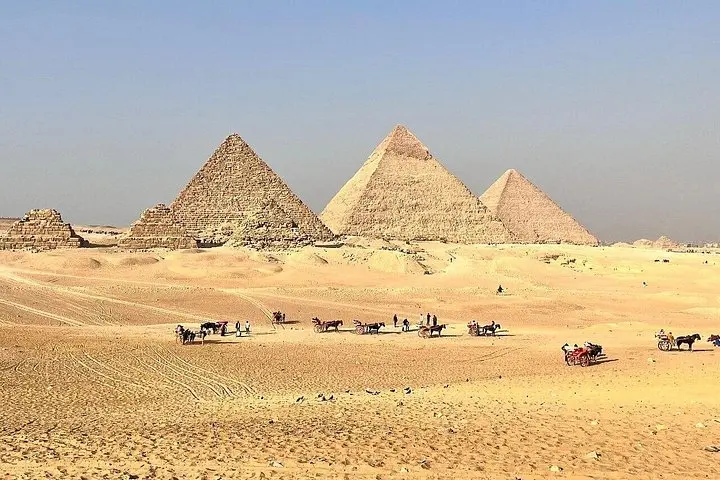
You step off the bus into a wind that pushes desert grit across sun-baked stone; the Great Pyramid rises ahead, its blocks casting hard-edged shadows that measure centuries. The day begins before dawn in Hurghada and unfolds across highway and scrub toward Cairo, with the Egyptian Museum’s bronze and gold waiting in the city center and the Giza Plateau’s ancient geometry anchoring the afternoon.
You step off the bus into a wind that pushes desert grit across sun-baked stone; the Great Pyramid rises ahead, its blocks casting hard-edged shadows that measure centuries. The day begins before dawn in Hurghada and unfolds across highway and scrub toward Cairo, with the Egyptian Museum’s bronze and gold waiting in the city center and the Giza Plateau’s ancient geometry anchoring the afternoon.
The Egyptian Museum on Tahrir Square holds artifacts that map pharaonic life—from Tutankhamun’s gold to routine tools—while just west the plateaus of Giza host Khufu (Cheops), Khafre (Chephren) and Menkaure (Mykerinos), built around 4,500 years ago. The Sphinx, a half-buried composite of lion and royal visage, watches the desert horizon. Geologically the plateau is limestone, quarried by the very builders whose funerary ambitions shaped the landscape. Culturally, the sites span millennia of religion, craft, and trade; nearby papyrus workshops demonstrate how ink met reed.
Practically: expect a long travel day—roughly 450 km (280 miles) round trip with 4–6 hours each way depending on traffic. Security checks and ticket lines are standard; interior access to the Great Pyramid requires a separate, limited ticket. Bring water, a sun hat, and sturdy shoes for uneven limestone footing. Schedule resting stops on the drive, and leave room in your timing for bargaining at papyrus and camel-photo offers. The reward is straightforward: close contact with structures that changed how humans imagined death and monumentality, plus a compact survey of Egypt’s museum holdings and craft traditions—all achievable in a single, intensive day.