THE ADVENTURE COLLECTIVE® · Independent discovery and booking for outdoor travel
Leave Hurghada before dawn and spend a long, packed day exploring the Egyptian Museum, the Great Pyramids, and the Sphinx on a semi-private minivan tour. Expect extensive driving, museum stops, and close-up views of one of the world’s oldest monuments.
Leave Hurghada before dawn and spend a long, packed day exploring the Egyptian Museum, the Great Pyramids, and the Sphinx on a semi-private minivan tour. Expect extensive driving, museum stops, and close-up views of one of the world’s oldest monuments.
A still predawn highway carries the minivan west from Hurghada, the Red Sea slipping behind you as desert light hardens into long, gold ribs across the asphalt. By late morning the skyline opens to limestone and stone-cut roads; the Pyramids of Giza appear like a final gesture of an older world, their angled faces catching sun.
Verified experiences and guided adventures in the surrounding area.
A still predawn highway carries the minivan west from Hurghada, the Red Sea slipping behind you as desert light hardens into long, gold ribs across the asphalt. By late morning the skyline opens to limestone and stone-cut roads; the Pyramids of Giza appear like a final gesture of an older world, their angled faces catching sun.
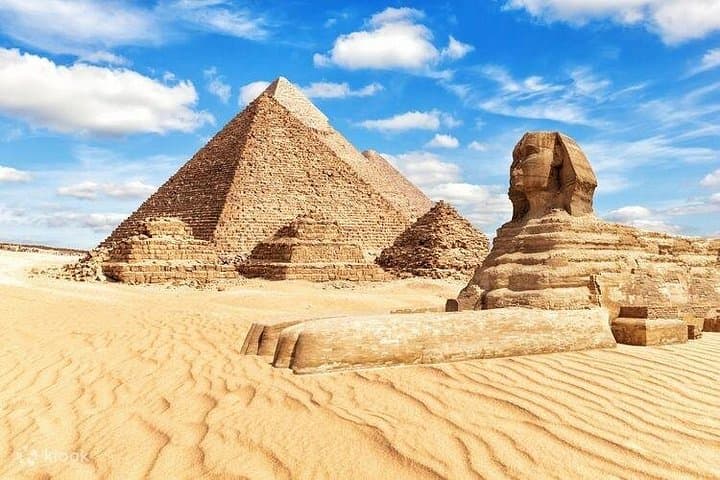
The day tour moves fast: a stop at the Egyptian Museum on Tahrir Square to view New Kingdom treasures, followed by lunch and the ceremonial approach to the Giza Plateau. The pyramids—Khufu, Khafre, and Menkaure—date to the Fourth Dynasty, roughly 4,500 years ago, and the adjacent Great Sphinx wears centuries of wind on its limestone face. Nearby, the Papyrus Museum demonstrates how reeds were transformed into writing material that helped record pharaonic life.
Geology here is simple and direct: Eocene limestone underpins the plateau, quarried by hand in antiquity. Culturally, Cairo is layered—Pharaonic, Coptic, Islamic—visible in architecture and markets if time allows.
Practical guidance: expect a full, long day with several hours of driving each way (roughly 4.5–6 hours one-way depending on traffic). Bring sun protection, a refillable water bottle, comfortable shoes for uneven, sandy surfaces, and a light layer for early morning or evening chill. Confirm what entrance fees and museum access are included with your operator, and plan for steep crowds around major monuments. Respect barriers and follow your guide; preservation zones are enforced. This semi-private minivan format gives flexibility for photography stops and short detours, but it remains a travel-heavy itinerary—best suited to travelers prepared for a long, rewarding day.
Expect roughly 4.5–6 hours one-way by road depending on traffic and stops; the tour is an all-day affair.
Inclusions vary by operator—confirm before booking; many tours either include entrance fees or list them as optional extras.
Access to pyramid interiors depends on site regulations and ticket availability; check with the tour provider for current access policies.
The itinerary requires long sit-down transfers and walking on uneven ground; travelers with limited mobility should check accessibility and consider shorter, Cairo-based visits.
A still predawn highway carries the minivan west from Hurghada, the Red Sea slipping behind you as desert light hardens into long, gold ribs across the asphalt. By late morning the skyline opens to limestone and stone-cut roads; the Pyramids of Giza appear like a final gesture of an older world, their angled faces catching sun.
A still predawn highway carries the minivan west from Hurghada, the Red Sea slipping behind you as desert light hardens into long, gold ribs across the asphalt. By late morning the skyline opens to limestone and stone-cut roads; the Pyramids of Giza appear like a final gesture of an older world, their angled faces catching sun.
The day tour moves fast: a stop at the Egyptian Museum on Tahrir Square to view New Kingdom treasures, followed by lunch and the ceremonial approach to the Giza Plateau. The pyramids—Khufu, Khafre, and Menkaure—date to the Fourth Dynasty, roughly 4,500 years ago, and the adjacent Great Sphinx wears centuries of wind on its limestone face. Nearby, the Papyrus Museum demonstrates how reeds were transformed into writing material that helped record pharaonic life.
Geology here is simple and direct: Eocene limestone underpins the plateau, quarried by hand in antiquity. Culturally, Cairo is layered—Pharaonic, Coptic, Islamic—visible in architecture and markets if time allows.
Practical guidance: expect a full, long day with several hours of driving each way (roughly 4.5–6 hours one-way depending on traffic). Bring sun protection, a refillable water bottle, comfortable shoes for uneven, sandy surfaces, and a light layer for early morning or evening chill. Confirm what entrance fees and museum access are included with your operator, and plan for steep crowds around major monuments. Respect barriers and follow your guide; preservation zones are enforced. This semi-private minivan format gives flexibility for photography stops and short detours, but it remains a travel-heavy itinerary—best suited to travelers prepared for a long, rewarding day.
