THE ADVENTURE COLLECTIVE® · Independent discovery and booking for outdoor travel

Walk the concrete avenues where architecture became propaganda. This guided tour moves from the Documentation Center by Dutzendteich to Zeppelin Field, unpacking how scale, design, and ritual were used—and how Nuremberg now interprets that legacy.
Walk the concrete avenues where architecture became propaganda. This guided tour moves from the Documentation Center by Dutzendteich to Zeppelin Field, unpacking how scale, design, and ritual were used—and how Nuremberg now interprets that legacy.
You step out from the Documentation Center onto a broad, open expanse where concrete terraces and the flattened sweep of the parade ground stretch toward Dutzendteich. The Congress Hall’s skeleton rises to one side, its unfinished arches throwing long shadows; ahead, the Zeppelin Field’s stripped grandstand reads like architecture turned into message.
Verified experiences and guided adventures in the surrounding area.
Operated by Geschichte Für Alle e.V. · Nuremberg, Bavaria
You step out from the Documentation Center onto a broad, open expanse where concrete terraces and the flattened sweep of the parade ground stretch toward Dutzendteich. The Congress Hall’s skeleton rises to one side, its unfinished arches throwing long shadows; ahead, the Zeppelin Field’s stripped grandstand reads like architecture turned into message.
The site was planned and used in the 1930s as a theatrical backdrop for mass rallies—large-scale propaganda staged to project power through scale and repetition. The Documentation Center occupies part of the former Congress Hall and explains how design, ceremony, and coercion combined. Geologically the area sits on the low, sandy floodplain south of central Nuremberg, with open lawns, packed gravel paths and stretches of exposed concrete that reflect heat in summer and hold mud in spring.
Today the grounds are a place of interpretation and civic reckoning: guided tours parse the symbolism, the crimes behind the events, and the postwar decisions that left ruins, memorials, and a museum where education is prioritized over commemoration. Cultural context matters here—this is not sightseeing but learning in situ.
Practical guide: expect about 2 hours on mostly flat terrain and roughly 2–3 km of walking. Wear sturdy shoes; bring water and a weather layer. Respect signs and memorials and listen to the guide—some areas are sensitive and access can change (the Golden Hall is occasionally opened). Trams and buses serve the Documentation Center; tours run rain or shine and are suitable for most fitness levels. Photography is generally allowed, but avoid staging images that sensationalize the site.
The guided tour lasts about 2 hours and covers roughly 2–3 km on mostly flat terrain with minimal elevation change.
The route is generally accessible and the operator notes wheelchair accessibility, but some surfaces can be uneven—contact the operator in advance to discuss specific needs.
The tour starts at the Documentation Center and includes outdoor highlights; occasional access to the Golden Hall is included only if that area is open to visitors that day.
Photography is usually permitted outdoors, but be respectful: avoid recreations that glamorize the site, and follow any restrictions the guide points out.
Geschichte Für Alle e.V. operates guided outdoor trips and adventures with an emphasis on safety, stewardship, and memorable experiences.
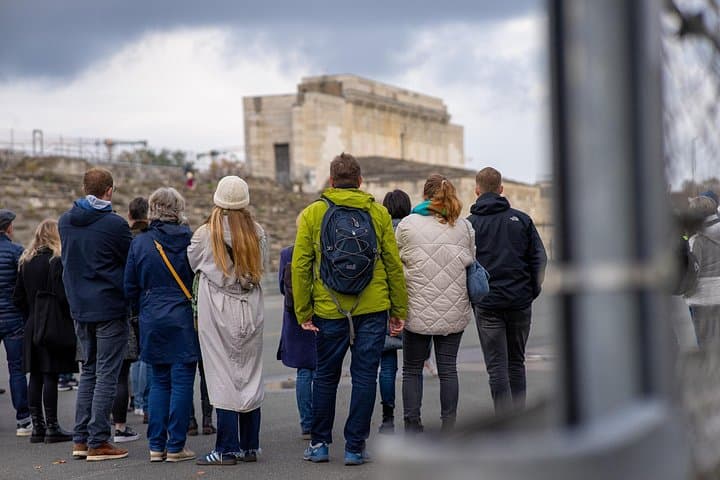


You step out from the Documentation Center onto a broad, open expanse where concrete terraces and the flattened sweep of the parade ground stretch toward Dutzendteich. The Congress Hall’s skeleton rises to one side, its unfinished arches throwing long shadows; ahead, the Zeppelin Field’s stripped grandstand reads like architecture turned into message.
You step out from the Documentation Center onto a broad, open expanse where concrete terraces and the flattened sweep of the parade ground stretch toward Dutzendteich. The Congress Hall’s skeleton rises to one side, its unfinished arches throwing long shadows; ahead, the Zeppelin Field’s stripped grandstand reads like architecture turned into message.
The site was planned and used in the 1930s as a theatrical backdrop for mass rallies—large-scale propaganda staged to project power through scale and repetition. The Documentation Center occupies part of the former Congress Hall and explains how design, ceremony, and coercion combined. Geologically the area sits on the low, sandy floodplain south of central Nuremberg, with open lawns, packed gravel paths and stretches of exposed concrete that reflect heat in summer and hold mud in spring.
Today the grounds are a place of interpretation and civic reckoning: guided tours parse the symbolism, the crimes behind the events, and the postwar decisions that left ruins, memorials, and a museum where education is prioritized over commemoration. Cultural context matters here—this is not sightseeing but learning in situ.
Practical guide: expect about 2 hours on mostly flat terrain and roughly 2–3 km of walking. Wear sturdy shoes; bring water and a weather layer. Respect signs and memorials and listen to the guide—some areas are sensitive and access can change (the Golden Hall is occasionally opened). Trams and buses serve the Documentation Center; tours run rain or shine and are suitable for most fitness levels. Photography is generally allowed, but avoid staging images that sensationalize the site.