THE ADVENTURE COLLECTIVE® · Independent discovery and booking for outdoor travel

Explore the National Gallery with an art historian on a focused two-hour walk through 200 years of European painting. Small group size and expert commentary make this a practical, revealing introduction to the gallery’s newly rehung collection.
Explore the National Gallery with an art historian on a focused two-hour walk through 200 years of European painting. Small group size and expert commentary make this a practical, revealing introduction to the gallery’s newly rehung collection.
Step into Trafalgar Square and the city's pulse gives way to a quieter order: the National Gallery’s stone façade, its Portland stone planes catching London light, opens onto rooms where paint and silence negotiate the day's rhythm.
Verified experiences and guided adventures in the surrounding area.
Operated by NEJA's Art Walks · London, Greater London
Step into Trafalgar Square and the city's pulse gives way to a quieter order: the National Gallery’s stone façade, its Portland stone planes catching London light, opens onto rooms where paint and silence negotiate the day's rhythm.
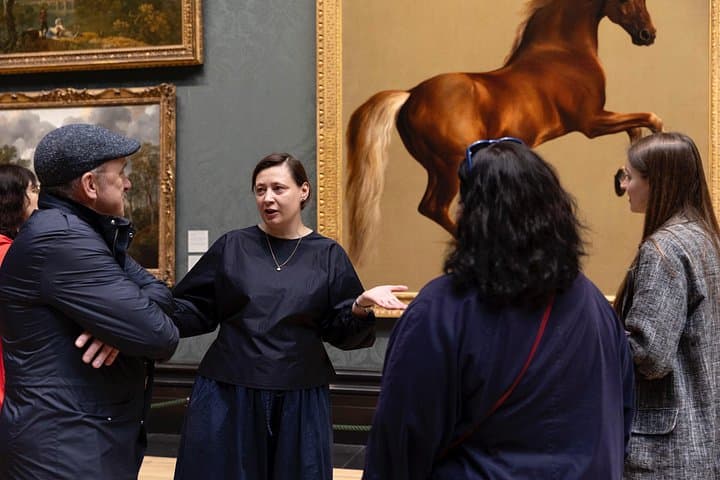
This two-hour, small-group tour places an art historian at your shoulder to navigate the gallery’s 200-year story — from its 1824 founding to the grand relocation to Trafalgar Square — and the recent rehang that brought 400 additional paintings into view. The route threads Old Masters (Holbein, Canaletto, Caravaggio) to the shockwaves of Impressionism (Monet, Renoir, Degas) and stops to examine the scarce but crucial presence of women artists on display.
Architectural detail matters here: Wilkins’ neoclassical rooms and the modern Sainsbury Wing create contrasts in scale and light that shaped painting displays for generations. Guides unpack curatorial choices, acquisition history and how 17th-century Dutch light found its echo in later experimental techniques.
Practicalities are straightforward: meet at the main entrance on Trafalgar Square, expect calm walking across polished floors and some standing during close looks, and keep cameras flash-free. The tour is wheelchair accessible and capped at 10 participants for conversational pace. Arrive by tube (Charing Cross/Charing Cross station walk), allow time for security checks, and bring a notebook — the session gives new ways of seeing works you’ll revisit on your own.
For anyone curious about how paintings live inside a museum — and how museums choose what to show — this tour compresses museum history, focused scholarship and approachable close-looking into 120 minutes of guided discovery.
The National Gallery’s permanent collection has free admission; the guided tour fee covers the guide’s expertise and small-group format.
Yes — the gallery and tour are wheelchair accessible; inform organizers of any accessibility needs when booking.
Photography without flash is permitted in the gallery, but avoid flash and follow any room-specific restrictions the guide notes.
Yes — no prior knowledge is required; the guide adapts explanations for general audiences and families, though some children may prefer shorter visits.
NEJA's Art Walks operates guided outdoor trips and adventures with an emphasis on safety, stewardship, and memorable experiences.


Step into Trafalgar Square and the city's pulse gives way to a quieter order: the National Gallery’s stone façade, its Portland stone planes catching London light, opens onto rooms where paint and silence negotiate the day's rhythm.
Step into Trafalgar Square and the city's pulse gives way to a quieter order: the National Gallery’s stone façade, its Portland stone planes catching London light, opens onto rooms where paint and silence negotiate the day's rhythm.
This two-hour, small-group tour places an art historian at your shoulder to navigate the gallery’s 200-year story — from its 1824 founding to the grand relocation to Trafalgar Square — and the recent rehang that brought 400 additional paintings into view. The route threads Old Masters (Holbein, Canaletto, Caravaggio) to the shockwaves of Impressionism (Monet, Renoir, Degas) and stops to examine the scarce but crucial presence of women artists on display.
Architectural detail matters here: Wilkins’ neoclassical rooms and the modern Sainsbury Wing create contrasts in scale and light that shaped painting displays for generations. Guides unpack curatorial choices, acquisition history and how 17th-century Dutch light found its echo in later experimental techniques.
Practicalities are straightforward: meet at the main entrance on Trafalgar Square, expect calm walking across polished floors and some standing during close looks, and keep cameras flash-free. The tour is wheelchair accessible and capped at 10 participants for conversational pace. Arrive by tube (Charing Cross/Charing Cross station walk), allow time for security checks, and bring a notebook — the session gives new ways of seeing works you’ll revisit on your own.
For anyone curious about how paintings live inside a museum — and how museums choose what to show — this tour compresses museum history, focused scholarship and approachable close-looking into 120 minutes of guided discovery.