THE ADVENTURE COLLECTIVE® · Independent discovery and booking for outdoor travel

Move from a living lava forest to a reflective water chamber and windswept wooden corridors on this private Jeju tour. Expect volcanic geology, Jun Itami’s minimalist architecture, and a stop at O’sulloc tea fields—booked months in advance.
Move from a living lava forest to a reflective water chamber and windswept wooden corridors on this private Jeju tour. Expect volcanic geology, Jun Itami’s minimalist architecture, and a stop at O’sulloc tea fields—booked months in advance.
A minibus eases to a stop under a dense Gotjawal canopy and the air smells of damp basalt and pine resin. Guests step out into a half-hidden forest where northern and southern plant species press close to one another, then move on to low-slung buildings where water, wind and stone are made architectural: a circular water mirror, a timber wind hall, and iron-and-basalt rooms that frame light.
Verified experiences and guided adventures in the surrounding area.
Operated by Jeju K Tour(Jeju K Travel Agency Co., Ltd.) · Seogwipo, Jeju-do
A minibus eases to a stop under a dense Gotjawal canopy and the air smells of damp basalt and pine resin. Guests step out into a half-hidden forest where northern and southern plant species press close to one another, then move on to low-slung buildings where water, wind and stone are made architectural: a circular water mirror, a timber wind hall, and iron-and-basalt rooms that frame light.
Jeju’s landscape is volcanic in origin — slow, viscous lava that broke into boulder fields created Gotjawal’s porous ground and the layered cliffs at Yongmeori, carved by sea and time. Architect Jun Itami’s Water, Wind and Stone Museum engages those materials directly: reflecting pools that capture the sky, wooden corridors that amplify coastal breezes, and basalt installations that catch slanted sun. Nearby O’sulloc Tea fields link land use and culture, where centuries of Korean tea practice meet modern interpretation.
Practicalities matter: this private, vehicle-based tour runs as a 7–8 hour outing with multiple stops (Gotjawal, Yongmeori Coast, the museum cluster, O’sulloc), and internal bus access to some museum areas requires reservations made at least three months in advance. The museum holds limited, non-refundable seats because admission is pre-paid; wheelchair access is available at major stops but some paths are uneven. Bring sturdy shoes for short walks on volcanic rock, a light layer for coastal wind, and a reusable water bottle. Plan for a full day: early departures avoid afternoon crowds and give better light on basalt cliffs.
Yes — internal museum bus access and reserved admission require booking at least three months in advance and a non-refundable deposit.
Major sites including the Water, Wind and Stone Museum list wheelchair access, but some outdoor paths in Gotjawal and coastal areas remain uneven; check ahead for specific mobility needs.
Museum admission is non-refundable due to advance deposits; other fees may be refundable—confirm with the operator before booking.
Drivers speak basic English and an English tour guide accompanies groups when 13 or more guests are booked; request language needs at booking.
Jeju K Tour(Jeju K Travel Agency Co., Ltd.) operates guided outdoor trips and adventures with an emphasis on safety, stewardship, and memorable experiences.
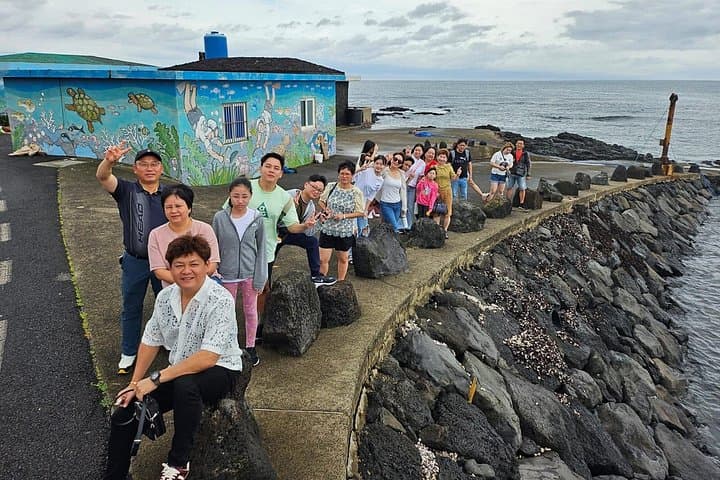


A minibus eases to a stop under a dense Gotjawal canopy and the air smells of damp basalt and pine resin. Guests step out into a half-hidden forest where northern and southern plant species press close to one another, then move on to low-slung buildings where water, wind and stone are made architectural: a circular water mirror, a timber wind hall, and iron-and-basalt rooms that frame light.
A minibus eases to a stop under a dense Gotjawal canopy and the air smells of damp basalt and pine resin. Guests step out into a half-hidden forest where northern and southern plant species press close to one another, then move on to low-slung buildings where water, wind and stone are made architectural: a circular water mirror, a timber wind hall, and iron-and-basalt rooms that frame light.
Jeju’s landscape is volcanic in origin — slow, viscous lava that broke into boulder fields created Gotjawal’s porous ground and the layered cliffs at Yongmeori, carved by sea and time. Architect Jun Itami’s Water, Wind and Stone Museum engages those materials directly: reflecting pools that capture the sky, wooden corridors that amplify coastal breezes, and basalt installations that catch slanted sun. Nearby O’sulloc Tea fields link land use and culture, where centuries of Korean tea practice meet modern interpretation.
Practicalities matter: this private, vehicle-based tour runs as a 7–8 hour outing with multiple stops (Gotjawal, Yongmeori Coast, the museum cluster, O’sulloc), and internal bus access to some museum areas requires reservations made at least three months in advance. The museum holds limited, non-refundable seats because admission is pre-paid; wheelchair access is available at major stops but some paths are uneven. Bring sturdy shoes for short walks on volcanic rock, a light layer for coastal wind, and a reusable water bottle. Plan for a full day: early departures avoid afternoon crowds and give better light on basalt cliffs.