THE ADVENTURE COLLECTIVE® · Independent discovery and booking for outdoor travel

Cut out of Great Cruz Bay and skim the Pillsbury Sound on a guided one-hour jet ski tour. Expect reef views, cays, and a local guide who keeps the route safe and marine-aware.
Cut out of Great Cruz Bay and skim the Pillsbury Sound on a guided one-hour jet ski tour. Expect reef views, cays, and a local guide who keeps the route safe and marine-aware.
The engine cuts through morning glass as riders peel out of Great Cruz Bay, spray lifting like a challenge from the Caribbean. Guides line the route through Pillsbury Sound, threading riders between low cays and open water with St. Thomas’ cliffs on the horizon. Wind pushes, sun warms, and the sea smells cleanly of salt and reef.
Verified experiences and guided adventures in the surrounding area.
The engine cuts through morning glass as riders peel out of Great Cruz Bay, spray lifting like a challenge from the Caribbean. Guides line the route through Pillsbury Sound, threading riders between low cays and open water with St. Thomas’ cliffs on the horizon. Wind pushes, sun warms, and the sea smells cleanly of salt and reef.
Geology here is volcanic bedrock capped by coral growth; reefs skirt the shallows and small sandy cays mark former reef edges. Cruz Bay bears layers of colonial history—from Arawak presence to Danish settlement—visible in ruins, place names, and local fishing traditions. The Virgin Islands’ marine culture centers on reef stewardship and small-boat seamanship: guides know where to slow, where to point out turtles, and where currents tighten.
Practical guidance follows the thrill. Tours run about 60 minutes and typically cover roughly 8–12 miles (13–19 km) depending on sea state. Operators require riders to be 18+ to drive, and all participants must be able to swim; children 10–17 can ride as passengers. Expect a safety briefing, fitted personal flotation device, and rules about speed and reef protection. Seas can be choppy—follow the guide’s line, stay spaced, and watch for wake from larger boats.
Pack reef-safe sunscreen, a small dry bag for keys/phone, and sunglasses with a retainer. Aim for morning departures to avoid stronger afternoon winds and to catch calmer water and clearer visibility for wildlife sightings. This is a short, high-energy way to meet the islands: fast, marine-focused, and governed by local knowledge aimed at keeping reefs and riders safe.
No prior experience is required; guides give a safety briefing and basic handling instructions. Riders must be 18+ to operate.
Yes—children ages 10–17 may ride as passengers but cannot drive; kids under 10 are not permitted.
Operators typically cancel or reschedule tours for high winds or unsafe seas—check the cancellation policy and expect weather-related adjustments.
Drivers must be at least 18 and able to swim; operators may have weight limits or medical restrictions—confirm with the provider before booking.
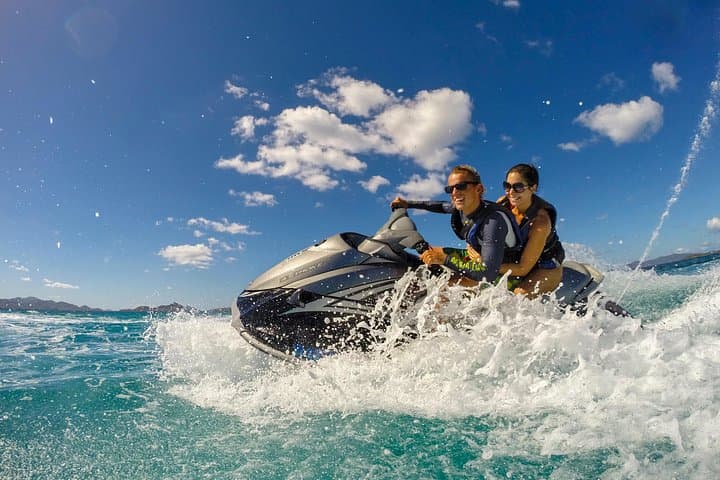
The engine cuts through morning glass as riders peel out of Great Cruz Bay, spray lifting like a challenge from the Caribbean. Guides line the route through Pillsbury Sound, threading riders between low cays and open water with St. Thomas’ cliffs on the horizon. Wind pushes, sun warms, and the sea smells cleanly of salt and reef.
The engine cuts through morning glass as riders peel out of Great Cruz Bay, spray lifting like a challenge from the Caribbean. Guides line the route through Pillsbury Sound, threading riders between low cays and open water with St. Thomas’ cliffs on the horizon. Wind pushes, sun warms, and the sea smells cleanly of salt and reef.
Geology here is volcanic bedrock capped by coral growth; reefs skirt the shallows and small sandy cays mark former reef edges. Cruz Bay bears layers of colonial history—from Arawak presence to Danish settlement—visible in ruins, place names, and local fishing traditions. The Virgin Islands’ marine culture centers on reef stewardship and small-boat seamanship: guides know where to slow, where to point out turtles, and where currents tighten.
Practical guidance follows the thrill. Tours run about 60 minutes and typically cover roughly 8–12 miles (13–19 km) depending on sea state. Operators require riders to be 18+ to drive, and all participants must be able to swim; children 10–17 can ride as passengers. Expect a safety briefing, fitted personal flotation device, and rules about speed and reef protection. Seas can be choppy—follow the guide’s line, stay spaced, and watch for wake from larger boats.
Pack reef-safe sunscreen, a small dry bag for keys/phone, and sunglasses with a retainer. Aim for morning departures to avoid stronger afternoon winds and to catch calmer water and clearer visibility for wildlife sightings. This is a short, high-energy way to meet the islands: fast, marine-focused, and governed by local knowledge aimed at keeping reefs and riders safe.