THE ADVENTURE COLLECTIVE® · Independent discovery and booking for outdoor travel

A full-day trek connects Jiankou’s raw, unrestored ridgeline with Mutianyu’s restored towers. Expect steep scrambles, sweeping ridgeline views, and a toboggan exit back to the valley.
A full-day trek connects Jiankou’s raw, unrestored ridgeline with Mutianyu’s restored towers. Expect steep scrambles, sweeping ridgeline views, and a toboggan exit back to the valley.
You set off before traffic, the city shrinking behind a ribbon of highway while the hills ahead sharpen into serrated ridgelines. The air at Xizhazi tastes like leaf-stem and stone; Jiankou’s unrestored crenellations loom up, raw and vertical, daring you to gain them. Walks here alternate between exposed scrambles and narrow watchtower ramps, then ease onto the broad, restored steps of Mutianyu where carved stones straighten into a tourist-ready outlook.
Verified experiences and guided adventures in the surrounding area.
Operated by Great Wall Beijing · Beijing, Beijing
You set off before traffic, the city shrinking behind a ribbon of highway while the hills ahead sharpen into serrated ridgelines. The air at Xizhazi tastes like leaf-stem and stone; Jiankou’s unrestored crenellations loom up, raw and vertical, daring you to gain them. Walks here alternate between exposed scrambles and narrow watchtower ramps, then ease onto the broad, restored steps of Mutianyu where carved stones straighten into a tourist-ready outlook.
The route stitches two eras of the Great Wall: Jiankou’s Ming-era, erosion-worn towers and Mutianyu’s later restorations that shaped the modern image of the Wall. Geology is simple and uncompromising — steep limestone and sandstone ridges cut by seasonal streams — giving views that track ridgelines for kilometers. Local villages like Xizhazi are working landscapes; you’ll see terraced fields and small tea plots and sometimes hear rural vendors calling from courtyard gates.
Practical guidance: the full experience is a 7–9 hour day including about 2 hours drive from central Beijing each way. Expect 3–5 hours of hiking on mixed terrain, roughly 6–8 km of trail with 300–400 m of cumulative ascent on uneven rock and stairs. Jiankou requires sure-footed attention and occasional light scrambling; Mutianyu returns you to steady stone steps. Bring layered clothing, sturdy boots, at least 2 liters of water, and snacks. A private English-speaking driver handles logistics and tolls, but park admission and optional Mutianyu toboggan are paid on site. Start early to avoid crowds and finish with a sled ride or cable descent to meet your driver back in the valley.
Hiking time on the wall and trails typically runs 3–5 hours depending on pace and photo stops; the entire tour is 7–9 hours including driving time.
Jiankou is unrestored, with loose rock and exposed drops — it’s not technical climbing but requires sure footing, no fear of exposure, and a high level of fitness.
No — the tour includes bottled water, vehicle, driver, and tolls; wall admission and optional Mutianyu toboggan or cable car are paid on site.
Not recommended for very young children; older, experienced hikers may join but must be capable of steep climbs and following safety guidance.
Great Wall Beijing operates guided outdoor trips and adventures with an emphasis on safety, stewardship, and memorable experiences.



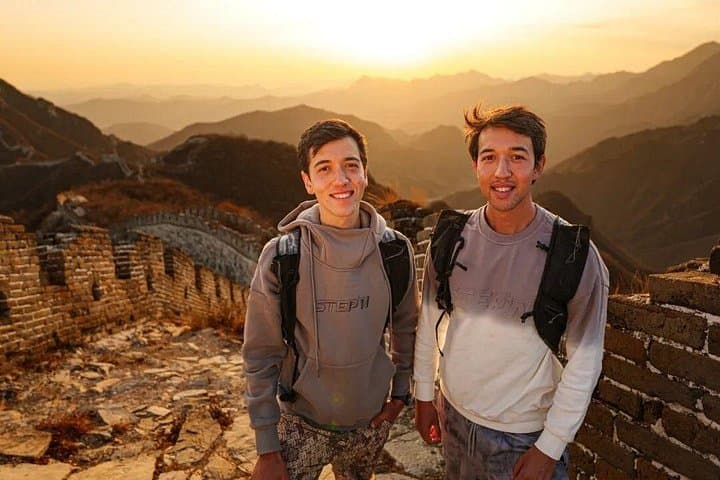
You set off before traffic, the city shrinking behind a ribbon of highway while the hills ahead sharpen into serrated ridgelines. The air at Xizhazi tastes like leaf-stem and stone; Jiankou’s unrestored crenellations loom up, raw and vertical, daring you to gain them. Walks here alternate between exposed scrambles and narrow watchtower ramps, then ease onto the broad, restored steps of Mutianyu where carved stones straighten into a tourist-ready outlook.
You set off before traffic, the city shrinking behind a ribbon of highway while the hills ahead sharpen into serrated ridgelines. The air at Xizhazi tastes like leaf-stem and stone; Jiankou’s unrestored crenellations loom up, raw and vertical, daring you to gain them. Walks here alternate between exposed scrambles and narrow watchtower ramps, then ease onto the broad, restored steps of Mutianyu where carved stones straighten into a tourist-ready outlook.
The route stitches two eras of the Great Wall: Jiankou’s Ming-era, erosion-worn towers and Mutianyu’s later restorations that shaped the modern image of the Wall. Geology is simple and uncompromising — steep limestone and sandstone ridges cut by seasonal streams — giving views that track ridgelines for kilometers. Local villages like Xizhazi are working landscapes; you’ll see terraced fields and small tea plots and sometimes hear rural vendors calling from courtyard gates.
Practical guidance: the full experience is a 7–9 hour day including about 2 hours drive from central Beijing each way. Expect 3–5 hours of hiking on mixed terrain, roughly 6–8 km of trail with 300–400 m of cumulative ascent on uneven rock and stairs. Jiankou requires sure-footed attention and occasional light scrambling; Mutianyu returns you to steady stone steps. Bring layered clothing, sturdy boots, at least 2 liters of water, and snacks. A private English-speaking driver handles logistics and tolls, but park admission and optional Mutianyu toboggan are paid on site. Start early to avoid crowds and finish with a sled ride or cable descent to meet your driver back in the valley.