THE ADVENTURE COLLECTIVE® · Independent discovery and booking for outdoor travel

Escape San Diego for a private 10‑hour drive into Joshua Tree National Park. This guided day trip delivers iconic rock formations, sculptural Joshua trees and short hikes with the convenience of hotel pickup and bottled water included.
Escape San Diego for a private 10‑hour drive into Joshua Tree National Park. This guided day trip delivers iconic rock formations, sculptural Joshua trees and short hikes with the convenience of hotel pickup and bottled water included.
You slide out of the cool of San Diego morning into a Lexus that hums its way east, the city’s humidity unspooling behind you as highway pavement gives way to the wide, sun-baked tilt of the Mojave. Desert air arrives with the sharp perfume of creosote; Joshua trees—aloof, sculptural—begin to appear on the horizon like wind‑swept sentries. For the next ten hours the rhythm is simple: drive, pause, step onto sand and rock, and let the landscape reset your pace.
Verified experiences and guided adventures in the surrounding area.
Operated by Alba Tours · Joshua Tree, California
You slide out of the cool of San Diego morning into a Lexus that hums its way east, the city’s humidity unspooling behind you as highway pavement gives way to the wide, sun-baked tilt of the Mojave. Desert air arrives with the sharp perfume of creosote; Joshua trees—aloof, sculptural—begin to appear on the horizon like wind‑swept sentries. For the next ten hours the rhythm is simple: drive, pause, step onto sand and rock, and let the landscape reset your pace.
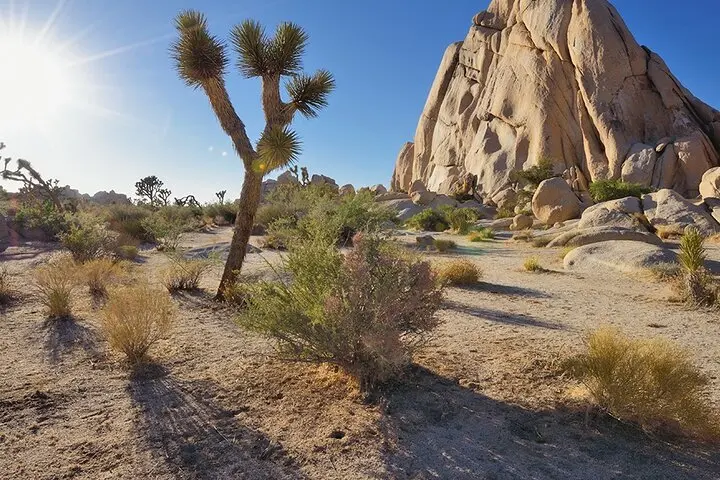
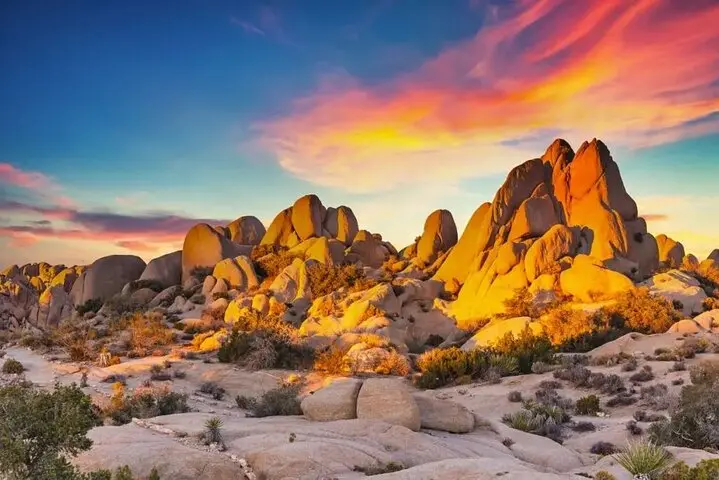
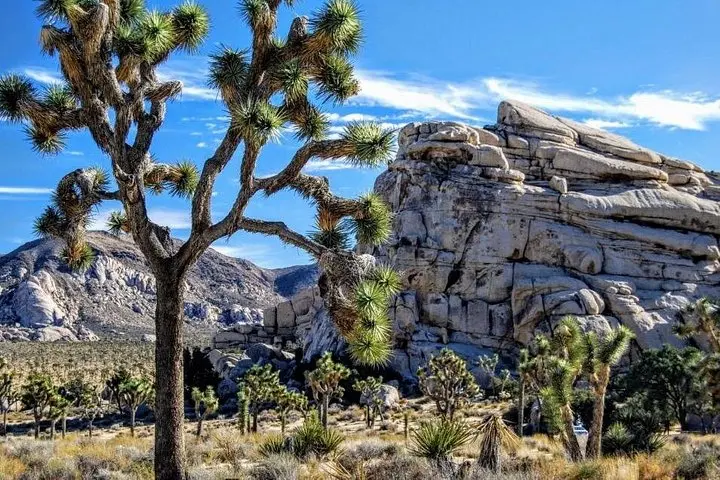
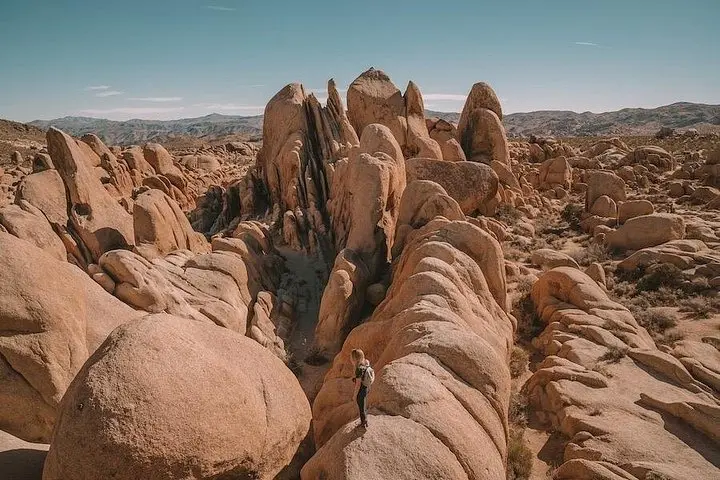
Joshua Tree National Park reads like geology on display. The rounded monzogranite boulders you’ll stand on were born deep underground and exposed by eons of uplift and exfoliation; their surfaces peel into stacked domes that invite scrambling and wide views. The namesake Yucca brevifolia—known locally as the Joshua tree—belongs to the Mojave Desert’s higher, cooler band and gives this place its unmistakable silhouette.
Human history threads through the park too. Indigenous groups including the Serrano, Cahuilla and Chemehuevi passed through and tended desert resources long before miners and homesteaders arrived in the 19th and early 20th centuries. The area received protection as a national monument in 1936 and became a national park in 1994; today it balances recreation, cultural sites and fragile desert ecosystems.
On this private from‑San‑Diego tour you’ll have roughly two to three hours of time inside the park—enough for a short hike, a photo stop at iconic formations, and a breath of desert quiet—while a knowledgeable driver handles the five‑hour roundtrip transit. The itinerary commonly includes visitor center orientation, a stop where you can stretch at a trailhead, and brief interpretive moments about flora, fauna and geology. Expect limited cell service; the silence is part of the point.
Practicalities: bring plenty of water (the tour supplies bottled water and snacks but extras never hurt), sun protection and sturdy shoes for uneven, sandy trails. Restrooms are located at visitor centers and main trailheads; if you want a longer hike, plan to arrive in better‑condition seasons (spring or fall) when temperatures are milder. Photography rewards both low and high sun—late afternoon light slants through the trees and sets boulders aglow.
For travelers based in San Diego, a private pickup within 20 miles makes this a low‑stress way to see the park in a day. If you’re chasing a specific spot—Barker Dam, Skull Rock, Keys View—tell your guide in advance so the schedule can be tailored. Above all, move deliberately: the desert seems still until you notice the small things—the scratch of a lizard, the distant call of a raven—and those are the moments that stay with you long after the drive home.
Roundtrip drive time is typically 5 to 5.5 hours depending on traffic; the full tour is about 10 hours including time in the park.
Yes—entrance fee is included in this private tour's listed inclusions.
The tour includes a stop for a short hike of up to 1–2 miles; longer or strenuous hikes aren’t practical on a same‑day roundtrip from San Diego.
Restrooms are available at the visitor centers and major trailheads; however facilities are limited in more remote areas.
Yes—it's described as physically easy with short walks; however anyone with mobility limitations should notify the operator ahead of time.
Cell coverage is spotty inside the park; plan accordingly and download maps or photos you’ll need in advance.
Alba Tours operates guided outdoor trips and adventures with an emphasis on safety, stewardship, and memorable experiences.
You slide out of the cool of San Diego morning into a Lexus that hums its way east, the city’s humidity unspooling behind you as highway pavement gives way to the wide, sun-baked tilt of the Mojave. Desert air arrives with the sharp perfume of creosote; Joshua trees—aloof, sculptural—begin to appear on the horizon like wind‑swept sentries. For the next ten hours the rhythm is simple: drive, pause, step onto sand and rock, and let the landscape reset your pace.
You slide out of the cool of San Diego morning into a Lexus that hums its way east, the city’s humidity unspooling behind you as highway pavement gives way to the wide, sun-baked tilt of the Mojave. Desert air arrives with the sharp perfume of creosote; Joshua trees—aloof, sculptural—begin to appear on the horizon like wind‑swept sentries. For the next ten hours the rhythm is simple: drive, pause, step onto sand and rock, and let the landscape reset your pace.
Joshua Tree National Park reads like geology on display. The rounded monzogranite boulders you’ll stand on were born deep underground and exposed by eons of uplift and exfoliation; their surfaces peel into stacked domes that invite scrambling and wide views. The namesake Yucca brevifolia—known locally as the Joshua tree—belongs to the Mojave Desert’s higher, cooler band and gives this place its unmistakable silhouette.
Human history threads through the park too. Indigenous groups including the Serrano, Cahuilla and Chemehuevi passed through and tended desert resources long before miners and homesteaders arrived in the 19th and early 20th centuries. The area received protection as a national monument in 1936 and became a national park in 1994; today it balances recreation, cultural sites and fragile desert ecosystems.
On this private from‑San‑Diego tour you’ll have roughly two to three hours of time inside the park—enough for a short hike, a photo stop at iconic formations, and a breath of desert quiet—while a knowledgeable driver handles the five‑hour roundtrip transit. The itinerary commonly includes visitor center orientation, a stop where you can stretch at a trailhead, and brief interpretive moments about flora, fauna and geology. Expect limited cell service; the silence is part of the point.
Practicalities: bring plenty of water (the tour supplies bottled water and snacks but extras never hurt), sun protection and sturdy shoes for uneven, sandy trails. Restrooms are located at visitor centers and main trailheads; if you want a longer hike, plan to arrive in better‑condition seasons (spring or fall) when temperatures are milder. Photography rewards both low and high sun—late afternoon light slants through the trees and sets boulders aglow.
For travelers based in San Diego, a private pickup within 20 miles makes this a low‑stress way to see the park in a day. If you’re chasing a specific spot—Barker Dam, Skull Rock, Keys View—tell your guide in advance so the schedule can be tailored. Above all, move deliberately: the desert seems still until you notice the small things—the scratch of a lizard, the distant call of a raven—and those are the moments that stay with you long after the drive home.