THE ADVENTURE COLLECTIVE® · Independent discovery and booking for outdoor travel

Walk Kallmi Hill’s coastal ridge from beach to city and trace layers of Adriatic history, geology, and coastal ecology. This private 2–3 hour tour blends seaside panoramas with archaeological insights and small-bay stops.
Walk Kallmi Hill’s coastal ridge from beach to city and trace layers of Adriatic history, geology, and coastal ecology. This private 2–3 hour tour blends seaside panoramas with archaeological insights and small-bay stops.
A salt-bright wind pushes you along a low coastal ridge as the Adriatic slides past on your right and the hill’s scrubby terraces hold the shape of older lives on your left. The path rises and falls across limestone outcrops, opens on a small pebbled bay, and threads through stands of maquis where the scent of thyme and pine sharpens the air.
Verified experiences and guided adventures in the surrounding area.
Operated by Artan · Durrës, Durrës County
A salt-bright wind pushes you along a low coastal ridge as the Adriatic slides past on your right and the hill’s scrubby terraces hold the shape of older lives on your left. The path rises and falls across limestone outcrops, opens on a small pebbled bay, and threads through stands of maquis where the scent of thyme and pine sharpens the air.
This private walking tour follows Kallmi Hill’s margins into Durrës, a landscape shaped by millennia of human navigation and natural change. Epidamnos—ancient Durrës—sat astride Adriatic trade routes, and the shoreline still tells that story: shallow shelf geology, buried ship remains, and coastal sediment that recorded Roman, Byzantine, and Ottoman activity. Locals repurposed the hill through the 20th century; restricted military zones until 2009 left sections of flora and fauna relatively undisturbed.
Expect a mix of rocky trail, coastal scrub, and short stretches of paved approach as you move from wild to urban. Guides often point out geological strata, coastal plants, and the sites of sunken craft; they also provide printed historic maps and a bibliographic list for deeper reading.
Practical guidance: plan for roughly 2–3 hours on uneven ground—sturdy shoes and sun protection are essential. Bring at least 1–1.5 liters of water, and start in the morning or late afternoon to avoid midday heat. The walk is family-friendly for older teens and suited to travelers with moderate fitness; it’s private, so pacing and stops adapt to your group. Leave no trace: the open access is recent, and the area benefits from low-impact visitation.
The tour lasts about 2–3 hours over mixed terrain—rocky coastal paths and short paved sections—and is rated moderate; suitable for those with regular walking ability.
Yes for older teens (16+) and families with reasonably fit children; younger kids may find some uneven sections challenging.
Guides discuss ancient Epidamnos (Durrës), evidence of maritime trade, historic shoreline changes, and local sites tied to 20th-century industry and settlement patterns.
Service animals are permitted; non-service pets should be checked with the operator in advance due to fragile habitats and private-transport logistics.
Artan operates guided outdoor trips and adventures with an emphasis on safety, stewardship, and memorable experiences.
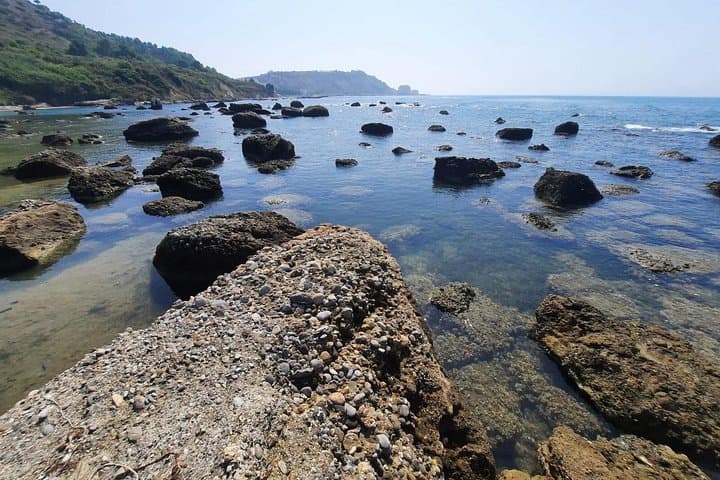


A salt-bright wind pushes you along a low coastal ridge as the Adriatic slides past on your right and the hill’s scrubby terraces hold the shape of older lives on your left. The path rises and falls across limestone outcrops, opens on a small pebbled bay, and threads through stands of maquis where the scent of thyme and pine sharpens the air.
A salt-bright wind pushes you along a low coastal ridge as the Adriatic slides past on your right and the hill’s scrubby terraces hold the shape of older lives on your left. The path rises and falls across limestone outcrops, opens on a small pebbled bay, and threads through stands of maquis where the scent of thyme and pine sharpens the air.
This private walking tour follows Kallmi Hill’s margins into Durrës, a landscape shaped by millennia of human navigation and natural change. Epidamnos—ancient Durrës—sat astride Adriatic trade routes, and the shoreline still tells that story: shallow shelf geology, buried ship remains, and coastal sediment that recorded Roman, Byzantine, and Ottoman activity. Locals repurposed the hill through the 20th century; restricted military zones until 2009 left sections of flora and fauna relatively undisturbed.
Expect a mix of rocky trail, coastal scrub, and short stretches of paved approach as you move from wild to urban. Guides often point out geological strata, coastal plants, and the sites of sunken craft; they also provide printed historic maps and a bibliographic list for deeper reading.
Practical guidance: plan for roughly 2–3 hours on uneven ground—sturdy shoes and sun protection are essential. Bring at least 1–1.5 liters of water, and start in the morning or late afternoon to avoid midday heat. The walk is family-friendly for older teens and suited to travelers with moderate fitness; it’s private, so pacing and stops adapt to your group. Leave no trace: the open access is recent, and the area benefits from low-impact visitation.