THE ADVENTURE COLLECTIVE® · Independent discovery and booking for outdoor travel

A compact two-day trek from Pokhara to Kapuche Glacier Lake via Sikles, combining high mountain views with village culture. Ideal for hikers with moderate fitness who want remote alpine scenery without a long expedition.
A compact two-day trek from Pokhara to Kapuche Glacier Lake via Sikles, combining high mountain views with village culture. Ideal for hikers with moderate fitness who want remote alpine scenery without a long expedition.
Morning mist lifts off terraced ridges as a private jeep from Pokhara bumps up narrow mountain tracks toward Sikles, the door to the Kapuche Glacier Lake trek. After four hours of switchbacks and village glimpses, trekkers step onto a trail that threads pine and rhododendron, a corridor that leads higher toward a clear blue basin at 2,546 meters.
Verified experiences and guided adventures in the surrounding area.
Operated by CAN Travels · Pokhara, Gandaki Province
Morning mist lifts off terraced ridges as a private jeep from Pokhara bumps up narrow mountain tracks toward Sikles, the door to the Kapuche Glacier Lake trek. After four hours of switchbacks and village glimpses, trekkers step onto a trail that threads pine and rhododendron, a corridor that leads higher toward a clear blue basin at 2,546 meters.
The route follows ancestral footpaths used by Gurung and Magar communities; villages like Sikles display carved wooden houses and stepped fields that reflect centuries of mountain agriculture. Geologically the lake sits at a moraine foot beneath glaciated slopes tied to the Annapurna-Manaslu massif, so the landscape alternates between rounded moraines, dense forest, and exposed scree. Local guides share stories of seasonal herding, and the trail offers regular encounters with mountain birds and the distant rumble of thaw and avalanche in late spring.
Practically, the trek is a short, two-day loop suited to hikers with moderate fitness: expect 4–6 hours of walking per day over uneven terrain and a highest point near the lake at about 2,546 m. Tea-house accommodation is basic but warm; pack layers, waterproof footwear, and a headlamp. Start early to capture lake reflections and to avoid afternoon cloud buildup; potable water may be scarce on higher sections so carry filtration or purification. Mobile signal is intermittent; rely on your guide and a paper map when needed. With thoughtful pacing, this compact trek delivers high mountain views, living culture, and the rare quiet of a glacier-fed lake and photography opportunities.
A private jeep transfer (about 3–4 hours) takes you from Pokhara to Sikles where the trek begins; the tour normally includes pickup and drop-off.
Trekking in this part of Kaski typically requires local permits handled by the operator; confirm that TIMS or any local paperwork is included.
Overnight stays are in basic tea houses with simple meals, shared facilities, and limited hot water—comfortable for short treks but not luxury-level.
The highest point is modest (~2,546 m), so altitude sickness risk is low for most; still hydrate, move steadily, and inform guides of any symptoms.
CAN Travels operates guided outdoor trips and adventures with an emphasis on safety, stewardship, and memorable experiences.

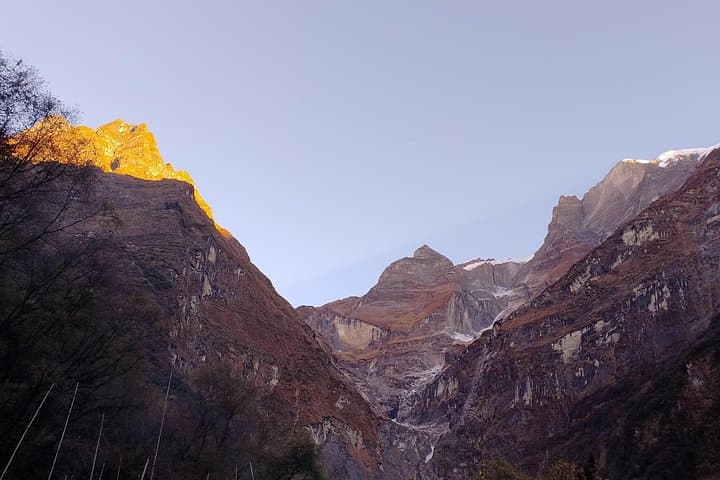


Morning mist lifts off terraced ridges as a private jeep from Pokhara bumps up narrow mountain tracks toward Sikles, the door to the Kapuche Glacier Lake trek. After four hours of switchbacks and village glimpses, trekkers step onto a trail that threads pine and rhododendron, a corridor that leads higher toward a clear blue basin at 2,546 meters.
Morning mist lifts off terraced ridges as a private jeep from Pokhara bumps up narrow mountain tracks toward Sikles, the door to the Kapuche Glacier Lake trek. After four hours of switchbacks and village glimpses, trekkers step onto a trail that threads pine and rhododendron, a corridor that leads higher toward a clear blue basin at 2,546 meters.
The route follows ancestral footpaths used by Gurung and Magar communities; villages like Sikles display carved wooden houses and stepped fields that reflect centuries of mountain agriculture. Geologically the lake sits at a moraine foot beneath glaciated slopes tied to the Annapurna-Manaslu massif, so the landscape alternates between rounded moraines, dense forest, and exposed scree. Local guides share stories of seasonal herding, and the trail offers regular encounters with mountain birds and the distant rumble of thaw and avalanche in late spring.
Practically, the trek is a short, two-day loop suited to hikers with moderate fitness: expect 4–6 hours of walking per day over uneven terrain and a highest point near the lake at about 2,546 m. Tea-house accommodation is basic but warm; pack layers, waterproof footwear, and a headlamp. Start early to capture lake reflections and to avoid afternoon cloud buildup; potable water may be scarce on higher sections so carry filtration or purification. Mobile signal is intermittent; rely on your guide and a paper map when needed. With thoughtful pacing, this compact trek delivers high mountain views, living culture, and the rare quiet of a glacier-fed lake and photography opportunities.