THE ADVENTURE COLLECTIVE® · Independent discovery and booking for outdoor travel

Escape Mumbai for a day and walk into two millennia of rock‑cut Buddhist architecture. This private day trip to Karla and Bhaja Caves pairs dramatic basalt chaityas with hilltop views and local cuisine.
Escape Mumbai for a day and walk into two millennia of rock‑cut Buddhist architecture. This private day trip to Karla and Bhaja Caves pairs dramatic basalt chaityas with hilltop views and local cuisine.
The morning begins on Mumbai’s broad arteries as a private car carries travelers inland, the skyline giving way to green ridges and monsoon-fed streams that seem to dare you farther from the city. By mid-morning the rock faces of Karla appear: a broad chaitya hall carved into basalt where light filters through the pillared veranda and stories of ancient monks come into view.
Verified experiences and guided adventures in the surrounding area.
Operated by Agora Voyages Pvt. Ltd. · Lonavala, Maharashtra
The morning begins on Mumbai’s broad arteries as a private car carries travelers inland, the skyline giving way to green ridges and monsoon-fed streams that seem to dare you farther from the city. By mid-morning the rock faces of Karla appear: a broad chaitya hall carved into basalt where light filters through the pillared veranda and stories of ancient monks come into view.
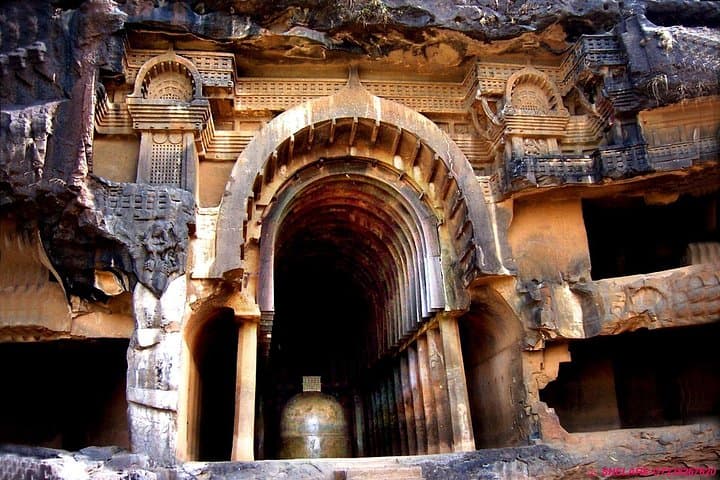
Karla and Bhaja are working archives of 2nd‑century BCE to early Common Era Buddhist architecture. Karla’s cavernous chaitya and intricate reliefs reflect religious patronage tied to trade routes that once threaded this plateau. Bhaja, smaller and perched on a rocky outcrop, offers stupas, carved doorways and a long flight of rock-cut steps that give a raw sense of stone‑work and monastic life.
Geologically, both sites are cut from the Deccan basalt flows; the hardness of the rock preserved crisp carvings but also creates steep approaches and narrow ledges. Locally, small village vendors serve spiced tea and vada pav; language and food are Maharashtrian, and guides will often explain inscriptions, iconography, and the caves’ place on ancient coastal and inland trade corridors.
Practicalities: plan for a full day (9–10 hours), wear sturdy shoes for uneven basalt, and carry water and sun protection. Monsoon months turn the steps slippery but amplify the landscape’s drama; winter visits are cooler and clearer for photos. Entry is ticketed; a guide deepens the visit. Respect religious spaces, keep to marked paths, and allow time at viewpoints between caves to feel how the landscape once framed ritual and travel.
Expect 9–10 hours; the itinerary includes private hotel pickup in Mumbai, guided visits to Karla and Bhaja Caves, lunch at a local restaurant (if selected), entrance fees (if option selected), and return drop‑off.
Yes — both caves are generally suitable for children and older visitors but require negotiating stone steps and uneven ground; the tour is rated physically easy but not barrier-free.
October–February (post-monsoon and winter) offers cooler, clearer days for walking and photography; the monsoon (June–September) makes the landscape lush but paths slippery.
Guides and entrance fees are included only if the corresponding options are selected when booking—confirm inclusions at checkout.
Agora Voyages Pvt. Ltd. operates guided outdoor trips and adventures with an emphasis on safety, stewardship, and memorable experiences.
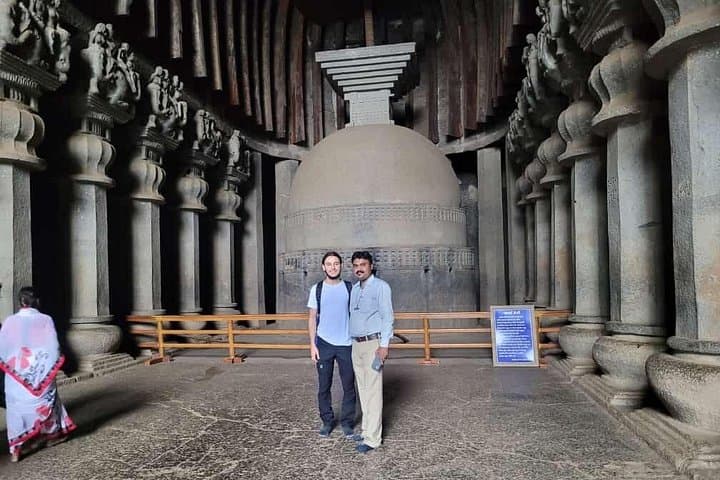
The morning begins on Mumbai’s broad arteries as a private car carries travelers inland, the skyline giving way to green ridges and monsoon-fed streams that seem to dare you farther from the city. By mid-morning the rock faces of Karla appear: a broad chaitya hall carved into basalt where light filters through the pillared veranda and stories of ancient monks come into view.
The morning begins on Mumbai’s broad arteries as a private car carries travelers inland, the skyline giving way to green ridges and monsoon-fed streams that seem to dare you farther from the city. By mid-morning the rock faces of Karla appear: a broad chaitya hall carved into basalt where light filters through the pillared veranda and stories of ancient monks come into view.
Karla and Bhaja are working archives of 2nd‑century BCE to early Common Era Buddhist architecture. Karla’s cavernous chaitya and intricate reliefs reflect religious patronage tied to trade routes that once threaded this plateau. Bhaja, smaller and perched on a rocky outcrop, offers stupas, carved doorways and a long flight of rock-cut steps that give a raw sense of stone‑work and monastic life.
Geologically, both sites are cut from the Deccan basalt flows; the hardness of the rock preserved crisp carvings but also creates steep approaches and narrow ledges. Locally, small village vendors serve spiced tea and vada pav; language and food are Maharashtrian, and guides will often explain inscriptions, iconography, and the caves’ place on ancient coastal and inland trade corridors.
Practicalities: plan for a full day (9–10 hours), wear sturdy shoes for uneven basalt, and carry water and sun protection. Monsoon months turn the steps slippery but amplify the landscape’s drama; winter visits are cooler and clearer for photos. Entry is ticketed; a guide deepens the visit. Respect religious spaces, keep to marked paths, and allow time at viewpoints between caves to feel how the landscape once framed ritual and travel.