THE ADVENTURE COLLECTIVE® · Independent discovery and booking for outdoor travel

A full-day, pro-level mountain bike route from Thamel to the Nagarkot viewpoint — 35 km one-way, 800 m of climbing, and an 8–9 hour round-trip that threads Newar villages, pine ridges, and a Himalayan panorama. Expect technical terrain, sustained effort, and big rewards for experienced riders.
A full-day, pro-level mountain bike route from Thamel to the Nagarkot viewpoint — 35 km one-way, 800 m of climbing, and an 8–9 hour round-trip that threads Newar villages, pine ridges, and a Himalayan panorama. Expect technical terrain, sustained effort, and big rewards for experienced riders.
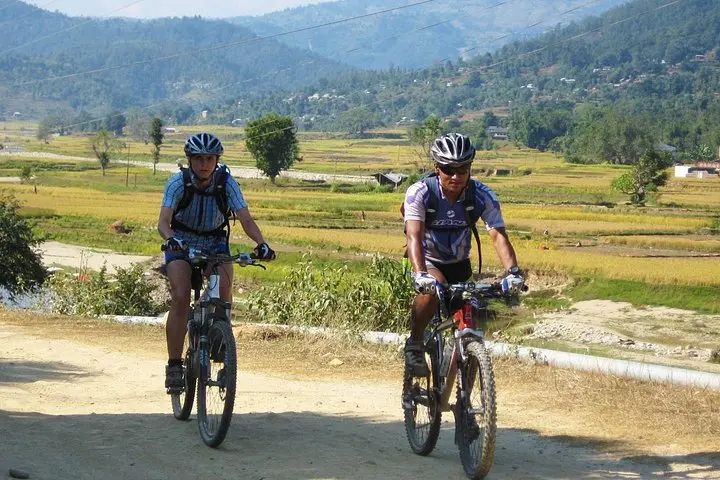
The day begins in Thamel before dawn, when the city still smells of frying lentils and diesel and the narrow alleys are empty enough for a small convoy of mountain bikes. You pedal out of Kathmandu at 1,300 meters, the houses giving way to terraced fields and scattered temples; the road tilts upward and the air takes on a thinner, colder quality. By mid-morning the valley opens and the trail tightens, testing your legs as it climbs toward Nagarkot — a viewpoint that can put the entire southern rim of the Himalaya into one frame.
Verified experiences and guided adventures in the surrounding area.
Operated by Breakfree Adventures Pvt. Ltd. · Kathmandu, Bagmati Province
The day begins in Thamel before dawn, when the city still smells of frying lentils and diesel and the narrow alleys are empty enough for a small convoy of mountain bikes. You pedal out of Kathmandu at 1,300 meters, the houses giving way to terraced fields and scattered temples; the road tilts upward and the air takes on a thinner, colder quality. By mid-morning the valley opens and the trail tightens, testing your legs as it climbs toward Nagarkot — a viewpoint that can put the entire southern rim of the Himalaya into one frame.
This is not a casual ride. The route covers roughly 35 km one-way with a net gain of about 800 meters to the highest viewpoint at 2,100 m. The terrain alternates between paved village lanes, rocky singletrack, and loose descents. Local guides steer the rhythm: short technical climbs, long switchbacks, and a couple of fast pinball sections through pine stands where the trees seem to push you forward.
Historically the route threads through Newar settlements—Sankhu and Bhaktapur—places where medieval brickwork and carved wooden windows survived earthquakes and empire shifts. Bhaktapur’s Durbar Square offers a glimpse of the valley’s urban history; Sankhu’s small temples and community rituals feel older, close to the land that feeds them.
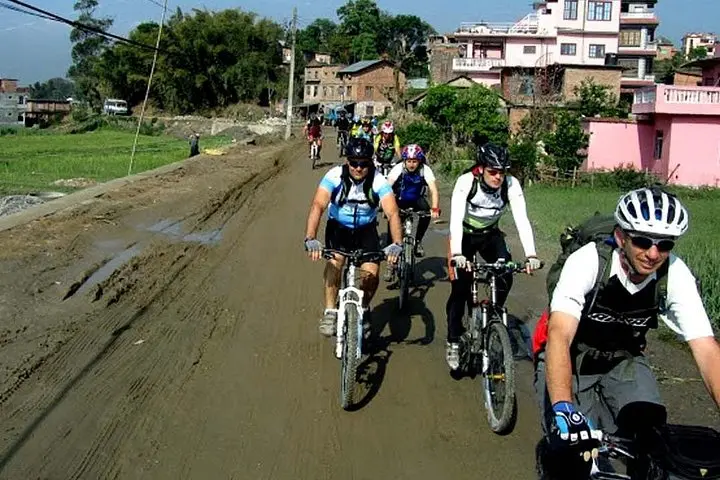
Geologically, the ride moves across alluvial terraces and steeper schist outcrops formed by the collision of the Indian and Eurasian plates; it’s why the climbs feel abrupt and the views can be so dramatic. Culturally, expect to pass farmers, holy shrines and roadside tea stalls—locals are used to cyclists here and often wave or call encouragement.
Practical edge: this is best for experienced riders. The tour provides customized front-suspension Giant or Fuji bikes and a helmet plus a mechanic and guide, but you still need confident descending skills and endurance for an 8–9 hour day. Hydrate early and often; Kathmandu’s altitude change is enough to make exertion feel sharper. Aim to start early to catch clearer mountain views—pollution and haze increase later in the day.
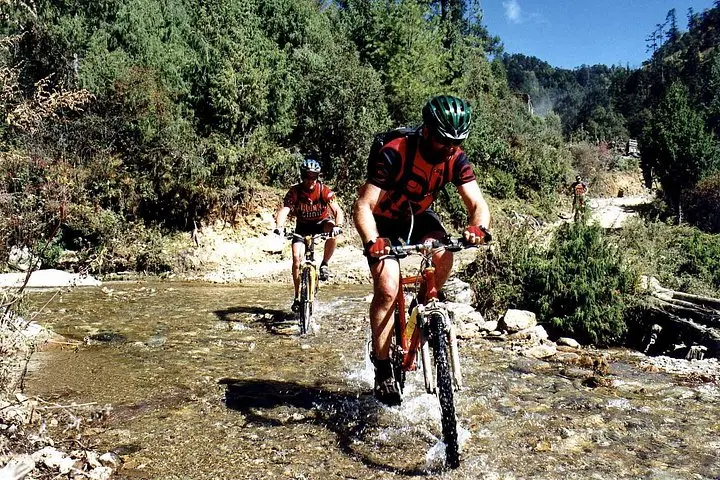
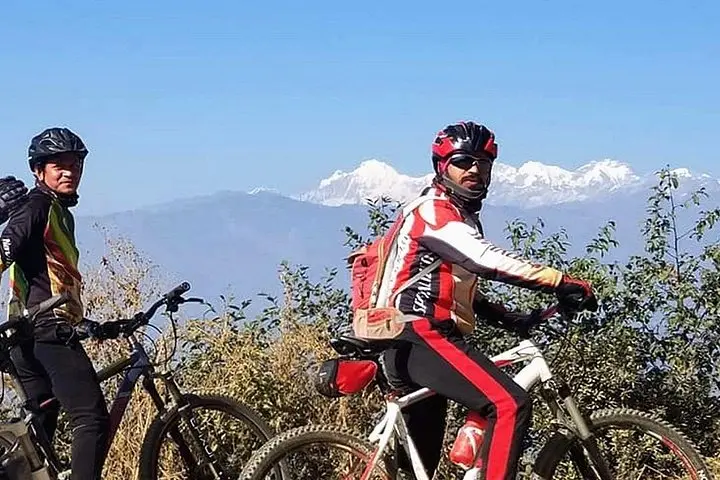
Wear grippy shoes, layers for shifting temperatures, and carry a compact repair kit. Expect variable weather—sun in the valley, wind at Nagarkot, and sometimes sudden showers that turn singletrack into glazed mud. The payoff is a sweeping Himalayan panorama on a clear day—Everest and the higher peaks sit like distant teeth on the skyline—and the ride back through medieval Bhaktapur where narrow lanes demand slow, precise handling.
For riders who want a full, hard day on the bike, the Kathmandu–Nagarkot loop is a tight, physical, and uniquely Nepali mountain-biking experience: cultural sights, shifting geology, and sustained technical riding packed into one long, rewarding day.
This is a demanding 8–9 hour day for experienced riders—regular hill training and long rides at elevation are recommended.
Yes—customized Giant or Fuji front-suspension bikes and helmets are provided, plus a guide and mechanic support.
Not recommended—this tour is designed for professional-level riders due to technical terrain and sustained climbing.
Yes—hotel pickup in Kathmandu is offered; timings vary so confirm your pickup point when booking.
Clear views depend on weather; guides will still proceed when safe, but peak mountain views are season- and weather-dependent.
Bring 2–3 liters of water and high-energy snacks (bars, nuts, gels). Eat small portions frequently to maintain energy on long climbs.
Breakfree Adventures Pvt. Ltd. operates guided outdoor trips and adventures with an emphasis on safety, stewardship, and memorable experiences.
The day begins in Thamel before dawn, when the city still smells of frying lentils and diesel and the narrow alleys are empty enough for a small convoy of mountain bikes. You pedal out of Kathmandu at 1,300 meters, the houses giving way to terraced fields and scattered temples; the road tilts upward and the air takes on a thinner, colder quality. By mid-morning the valley opens and the trail tightens, testing your legs as it climbs toward Nagarkot — a viewpoint that can put the entire southern rim of the Himalaya into one frame.
The day begins in Thamel before dawn, when the city still smells of frying lentils and diesel and the narrow alleys are empty enough for a small convoy of mountain bikes. You pedal out of Kathmandu at 1,300 meters, the houses giving way to terraced fields and scattered temples; the road tilts upward and the air takes on a thinner, colder quality. By mid-morning the valley opens and the trail tightens, testing your legs as it climbs toward Nagarkot — a viewpoint that can put the entire southern rim of the Himalaya into one frame.
This is not a casual ride. The route covers roughly 35 km one-way with a net gain of about 800 meters to the highest viewpoint at 2,100 m. The terrain alternates between paved village lanes, rocky singletrack, and loose descents. Local guides steer the rhythm: short technical climbs, long switchbacks, and a couple of fast pinball sections through pine stands where the trees seem to push you forward.
Historically the route threads through Newar settlements—Sankhu and Bhaktapur—places where medieval brickwork and carved wooden windows survived earthquakes and empire shifts. Bhaktapur’s Durbar Square offers a glimpse of the valley’s urban history; Sankhu’s small temples and community rituals feel older, close to the land that feeds them.
Geologically, the ride moves across alluvial terraces and steeper schist outcrops formed by the collision of the Indian and Eurasian plates; it’s why the climbs feel abrupt and the views can be so dramatic. Culturally, expect to pass farmers, holy shrines and roadside tea stalls—locals are used to cyclists here and often wave or call encouragement.
Practical edge: this is best for experienced riders. The tour provides customized front-suspension Giant or Fuji bikes and a helmet plus a mechanic and guide, but you still need confident descending skills and endurance for an 8–9 hour day. Hydrate early and often; Kathmandu’s altitude change is enough to make exertion feel sharper. Aim to start early to catch clearer mountain views—pollution and haze increase later in the day.
Wear grippy shoes, layers for shifting temperatures, and carry a compact repair kit. Expect variable weather—sun in the valley, wind at Nagarkot, and sometimes sudden showers that turn singletrack into glazed mud. The payoff is a sweeping Himalayan panorama on a clear day—Everest and the higher peaks sit like distant teeth on the skyline—and the ride back through medieval Bhaktapur where narrow lanes demand slow, precise handling.
For riders who want a full, hard day on the bike, the Kathmandu–Nagarkot loop is a tight, physical, and uniquely Nepali mountain-biking experience: cultural sights, shifting geology, and sustained technical riding packed into one long, rewarding day.