THE ADVENTURE COLLECTIVE® · Independent discovery and booking for outdoor travel

A single-day private tour that pairs Kathmandu’s UNESCO‑listed spiritual sites with a hilltop sunset at Nagarkot. Visit Boudhanath and Pashupatinath, then drive for panoramic Himalayan views as the light shifts across the peaks.
A single-day private tour that pairs Kathmandu’s UNESCO‑listed spiritual sites with a hilltop sunset at Nagarkot. Visit Boudhanath and Pashupatinath, then drive for panoramic Himalayan views as the light shifts across the peaks.
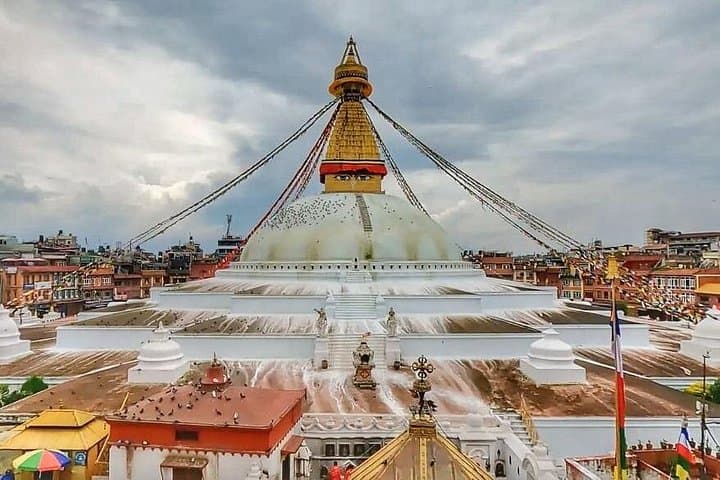
You step out of an air‑conditioned car into a mosaic of prayer flags and incense smoke — the city’s religious life spills onto the street. Morning light catches the gilded dome of Boudhanath as monks circle the stupa, while downstream the Bagmati River moves past the open cremation ghats at Pashupatinath with a steady, uncompromising rhythm.
Verified experiences and guided adventures in the surrounding area.
Operated by Nepal Viajes · Kathmandu, Bagmati Province
You step out of an air‑conditioned car into a mosaic of prayer flags and incense smoke — the city’s religious life spills onto the street. Morning light catches the gilded dome of Boudhanath as monks circle the stupa, while downstream the Bagmati River moves past the open cremation ghats at Pashupatinath with a steady, uncompromising rhythm.
Kathmandu Valley holds layers of history: Newar artisans, centuries of Hindu and Buddhist devotion, and a landscape carved by Kathmandu’s river terraces and the rising Himalayan foothills. Boudhanath’s massive mandala is a center of Tibetan Buddhist practice; Pashupatinath is one of Hinduism’s most important Shiva temples and a place where life and death have public faces. Drive time to Nagarkot climbs to roughly 2,000–2,100 m, passing rice terraces, military outposts, and villages that still rely on seasonal streams and terraced fields.
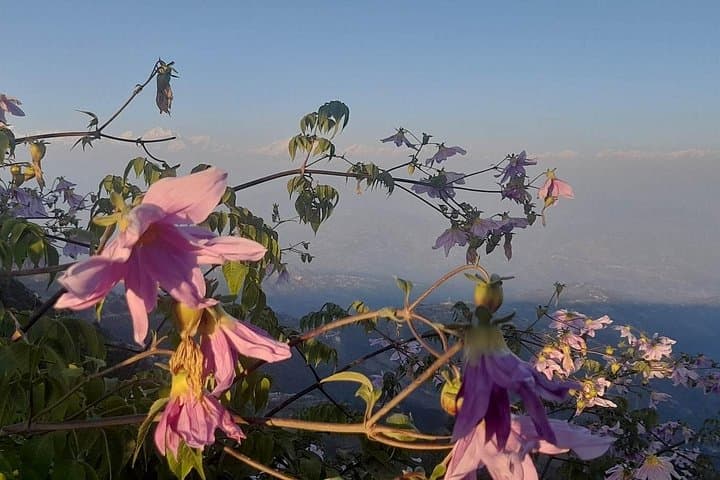
On clear days Nagarkot’s western rim offers a pulsing sunset over the Himalaya — Annapurna to the northwest, Everest further east on very clear mornings — the mountains asserting themselves like a slow, ancient tide.
Practical guidance: the full private tour runs about 7–8 hours and involves short, mostly paved walks and some stair sections at religious sites. Dress conservatively at temples, carry a light jacket for Nagarkot’s chill after sunset, and bring water and sun protection. Respect rituals and photography restrictions at Pashupatinath’s ghats. Expect steady driving through Kathmandu traffic and a bumpy rural ascent to Nagarkot; weather determines visibility, so plan for early or late windows for the best mountain light.
Non‑Hindus are not allowed inside the inner sanctum but can view much of the complex from designated terraces and the eastern rim; follow signage and your guide’s instructions.
Visibility depends on season and weather—late autumn to early spring (October–March) typically offers the clearest views, but mornings can show peaks when evenings are hazy.
Cremation ghats are public and visible, but they are active religious sites; behave respectfully, avoid photographing mourners, and follow your guide’s lead.
Yes—this private tour is listed as suitable for all fitness levels, though participants should be able to climb short flights of stairs and tolerate vehicle travel on winding roads.
Nepal Viajes operates guided outdoor trips and adventures with an emphasis on safety, stewardship, and memorable experiences.


You step out of an air‑conditioned car into a mosaic of prayer flags and incense smoke — the city’s religious life spills onto the street. Morning light catches the gilded dome of Boudhanath as monks circle the stupa, while downstream the Bagmati River moves past the open cremation ghats at Pashupatinath with a steady, uncompromising rhythm.
You step out of an air‑conditioned car into a mosaic of prayer flags and incense smoke — the city’s religious life spills onto the street. Morning light catches the gilded dome of Boudhanath as monks circle the stupa, while downstream the Bagmati River moves past the open cremation ghats at Pashupatinath with a steady, uncompromising rhythm.
Kathmandu Valley holds layers of history: Newar artisans, centuries of Hindu and Buddhist devotion, and a landscape carved by Kathmandu’s river terraces and the rising Himalayan foothills. Boudhanath’s massive mandala is a center of Tibetan Buddhist practice; Pashupatinath is one of Hinduism’s most important Shiva temples and a place where life and death have public faces. Drive time to Nagarkot climbs to roughly 2,000–2,100 m, passing rice terraces, military outposts, and villages that still rely on seasonal streams and terraced fields.
On clear days Nagarkot’s western rim offers a pulsing sunset over the Himalaya — Annapurna to the northwest, Everest further east on very clear mornings — the mountains asserting themselves like a slow, ancient tide.
Practical guidance: the full private tour runs about 7–8 hours and involves short, mostly paved walks and some stair sections at religious sites. Dress conservatively at temples, carry a light jacket for Nagarkot’s chill after sunset, and bring water and sun protection. Respect rituals and photography restrictions at Pashupatinath’s ghats. Expect steady driving through Kathmandu traffic and a bumpy rural ascent to Nagarkot; weather determines visibility, so plan for early or late windows for the best mountain light.