THE ADVENTURE COLLECTIVE® · Independent discovery and booking for outdoor travel

Explore two of Cambodia’s rawest Angkorian sites in a single day — Beng Mealea’s vine‑choked galleries and Koh Ker’s rare stepped pyramid. Expect long drives, uneven stone, and dramatic, crowd‑light views.
Explore two of Cambodia’s rawest Angkorian sites in a single day — Beng Mealea’s vine‑choked galleries and Koh Ker’s rare stepped pyramid. Expect long drives, uneven stone, and dramatic, crowd‑light views.
Morning light slices through tall trees as an air‑conditioned van slips out of Siem Reap and the road gives way to red earth. At Beng Mealea the jungle reaches across cracked sandstone blocks; roots grasp doorways and corridors pitch visitors into a slow, tactile archaeology of shadow and sun. Later, the stepped pyramid of Koh Ker rises like an abrupt island of stone above open rice paddies — a raw, vertical skyline that rewards careful climbs with wide, wind‑washed views.
Verified experiences and guided adventures in the surrounding area.
Operated by Offbeatletrack Driver Cambodia · Koh Ker, Siem Reap Province
Morning light slices through tall trees as an air‑conditioned van slips out of Siem Reap and the road gives way to red earth. At Beng Mealea the jungle reaches across cracked sandstone blocks; roots grasp doorways and corridors pitch visitors into a slow, tactile archaeology of shadow and sun. Later, the stepped pyramid of Koh Ker rises like an abrupt island of stone above open rice paddies — a raw, vertical skyline that rewards careful climbs with wide, wind‑washed views.
Both sites belong to the Angkorian arc but tell different stories: Beng Mealea, a sprawling 12th‑century complex partly reclaimed by forest, feels improvised and cinematic, while Koh Ker served as a short‑lived 10th‑century capital and its Prasat Thom pyramid is an uncommon, blunt monument to a turbulent era of Khmer kings. Geology here favors hard sandstone blocks quarried from nearby plains; erosion and vegetation create uneven surfaces and collapsed galleries that hint at past engineering and present entropy.
Expect dirt tracks, uneven stone steps, and short, unmarked paths through shade and open scrub. Local villages and rice fields bracket the monuments; birdcalls and the occasional macaque punctuate the quiet. Practicalities: the tour is a long day — plan for 7–9 hours, bring sun protection, sturdy shoes, and cash for site entrances or local guides. Hydrate before each walk; insect repellent matters after dusk. If you climb the Koh Ker summit, take slow, deliberate steps — the view is the point, not the rush. This is exploration with a pragmatic edge: immersive, slightly wild, and richly historic without the crowds of Angkor Wat.
Most operators don’t include site admissions; bring cash for local entry fees or pay at official ticket stations if available.
Roads can be paved near main approaches but include dirt and bumpy sections; expect some dust and slower travel, especially in the rainy season.
The summit involves steep, irregular stone steps — safe with caution, but not recommended for those with severe vertigo or mobility limits.
This particular trip includes bottled water and snacks; a full lunch isn’t guaranteed—confirm with the operator or plan to buy a local meal en route.
Offbeatletrack Driver Cambodia operates guided outdoor trips and adventures with an emphasis on safety, stewardship, and memorable experiences.
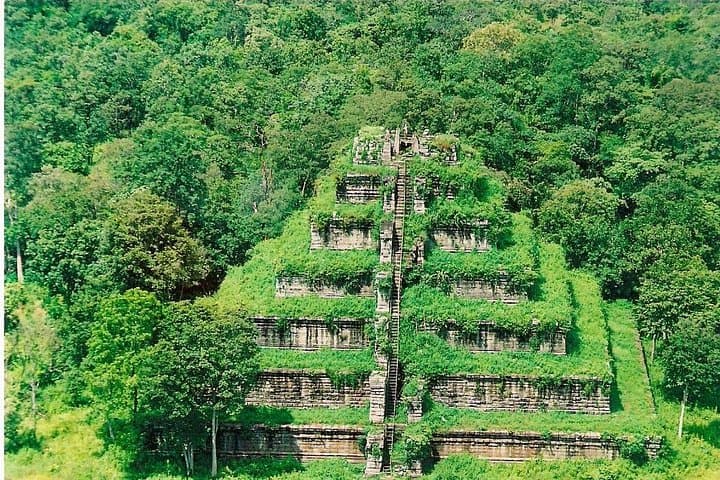


Morning light slices through tall trees as an air‑conditioned van slips out of Siem Reap and the road gives way to red earth. At Beng Mealea the jungle reaches across cracked sandstone blocks; roots grasp doorways and corridors pitch visitors into a slow, tactile archaeology of shadow and sun. Later, the stepped pyramid of Koh Ker rises like an abrupt island of stone above open rice paddies — a raw, vertical skyline that rewards careful climbs with wide, wind‑washed views.
Morning light slices through tall trees as an air‑conditioned van slips out of Siem Reap and the road gives way to red earth. At Beng Mealea the jungle reaches across cracked sandstone blocks; roots grasp doorways and corridors pitch visitors into a slow, tactile archaeology of shadow and sun. Later, the stepped pyramid of Koh Ker rises like an abrupt island of stone above open rice paddies — a raw, vertical skyline that rewards careful climbs with wide, wind‑washed views.
Both sites belong to the Angkorian arc but tell different stories: Beng Mealea, a sprawling 12th‑century complex partly reclaimed by forest, feels improvised and cinematic, while Koh Ker served as a short‑lived 10th‑century capital and its Prasat Thom pyramid is an uncommon, blunt monument to a turbulent era of Khmer kings. Geology here favors hard sandstone blocks quarried from nearby plains; erosion and vegetation create uneven surfaces and collapsed galleries that hint at past engineering and present entropy.
Expect dirt tracks, uneven stone steps, and short, unmarked paths through shade and open scrub. Local villages and rice fields bracket the monuments; birdcalls and the occasional macaque punctuate the quiet. Practicalities: the tour is a long day — plan for 7–9 hours, bring sun protection, sturdy shoes, and cash for site entrances or local guides. Hydrate before each walk; insect repellent matters after dusk. If you climb the Koh Ker summit, take slow, deliberate steps — the view is the point, not the rush. This is exploration with a pragmatic edge: immersive, slightly wild, and richly historic without the crowds of Angkor Wat.