THE ADVENTURE COLLECTIVE® · Independent discovery and booking for outdoor travel

A 90-minute helicopter flight along Hawai‘i Island’s Kohala Coast unspools volcano summits, hidden valleys, and tiered waterfalls. Choose doors-off for unobstructed photos and prepare for a practical pre-flight checklist—this is sightseeing with rules and rewards.
A 90-minute helicopter flight along Hawai‘i Island’s Kohala Coast unspools volcano summits, hidden valleys, and tiered waterfalls. Choose doors-off for unobstructed photos and prepare for a practical pre-flight checklist—this is sightseeing with rules and rewards.
You lift off from the brown-walled Big Island Jet Center and Kona falls away beneath the skids: a grid of coral reefs, spinner dolphins flicking like commas in blue ink, and the shallow ribbon of Kailua Bay that seems to glow from within. The helicopter climbs, and the island rearranges itself—black river of rock becomes ridged shoulders of volcanoes, then a curtain of waterfalls spilling down the Kohala cliffs. For 90 minutes you travel along the spine of Hawai‘i Island, where fire and water argue openly across the landscape.
Verified experiences and guided adventures in the surrounding area.
Operated by Rainbow Helicopters · Kailua-Kona, Hawaii
You lift off from the brown-walled Big Island Jet Center and Kona falls away beneath the skids: a grid of coral reefs, spinner dolphins flicking like commas in blue ink, and the shallow ribbon of Kailua Bay that seems to glow from within. The helicopter climbs, and the island rearranges itself—black river of rock becomes ridged shoulders of volcanoes, then a curtain of waterfalls spilling down the Kohala cliffs. For 90 minutes you travel along the spine of Hawai‘i Island, where fire and water argue openly across the landscape.
This flight threads together the island’s volcanic narrative. Mauna Loa—Earth’s largest active volcano—fills the western horizon with its mute scale; Hualālai and the Ka‘ūpūlehu Crater show a rougher, more recent scarring. Mauna Kea, crowned in alpine clouds at 13,796 feet, reads like a sacred highpoint; to the north the extinct Kohala volcano steps down toward the lush Pu‘u Wa‘awa‘a forest and the ancient valleys of Kamehameha’s childhood.
Geology is the show’s backbone: pahoehoe and ‘a‘ā flows, cliffs carved by persistent rainfall, and black sand beaches where lava has met the sea. Culturally, the flight is also a tour of place-names and histories—Waipi‘o, the Valley of the Kings, with its steep taro terraces; Pololū and Waimanu, where waterfalls pour directly into the ocean and oral histories remain alive in local communities.
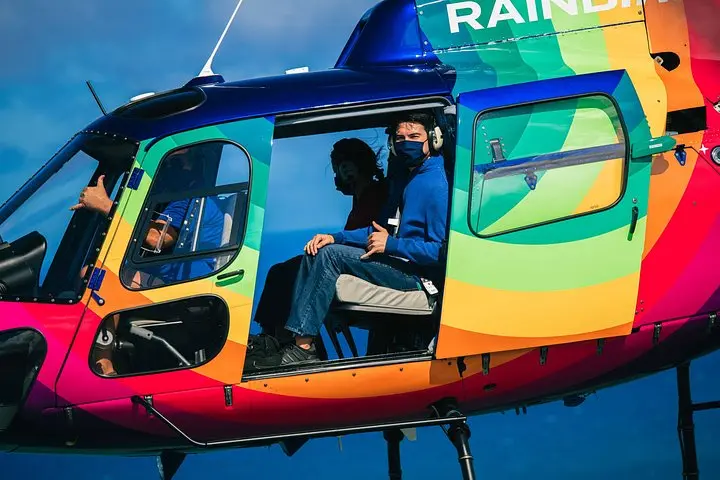
For photographers, the doors-off option is kinetic: waterfalls that seem to clench and release, reef mosaics, and shoreline ancient fishponds scrawled along the coast. For conservation-minded travelers, the tour is a reminder: these views are finite. Respect the islands—leave no trash, stay curious but not extractive, and support outfits that follow local land access and wildlife guidelines.
Practicalities carve the rest of the itinerary. Plan to arrive 60 minutes before your flight for weight/manifest checks and safety briefings; all passengers over 24 months must have a ticket. Doors-off flights require a snug jacket, closed-toe shoes, long pants and hair secured. Expect possible weight-and-balance fees for guests over the posted limits; operators may refuse intoxicated passengers for safety.
Weather dictates the day—vog, trade winds, and heavy showers can reroute or cancel flights—so keep a flexible window in your travel plans. Bring a small, secured camera or phone with a tether, motion-sickness remedies if you’re prone, and a short list of the sights you most want to see: Mauna Loa, Kohala waterfalls, Waipi‘o Valley, and Makalawena Beach often top the list.
This is not merely a scenic hop; it’s an aerial field guide to an island shaped by fire, water, and human stories. Up here, Pele’s fingerprints are obvious—and the view compels a quieter kind of awe, one that turns sightseeing into stewardship.
Doors-off is available but seat assignment may not guarantee adjacency to an open door—operators balance weight and safety first.
Infants under 24 months must sit on an adult’s lap; all passengers 24 months and older must purchase a full fare seat.
Flights can be canceled for safety due to wind, vog, or rain—operators typically offer a full refund or rescheduling if canceled at least 24 hours in advance.
The operator lists wheelchair accessibility for ground facilities, but boarding the helicopter may have restrictions—contact the operator in advance to discuss specific needs.
Yes—guests 260–279 lbs may incur a 50% seat fee; guests 280 lbs and above may need to purchase an additional seat for proper weight-and-balance.
No—the tour is a continuous aerial pass; it circumnavigates valleys and waterfalls without landing at those remote sites.
Rainbow Helicopters operates guided outdoor trips and adventures with an emphasis on safety, stewardship, and memorable experiences.
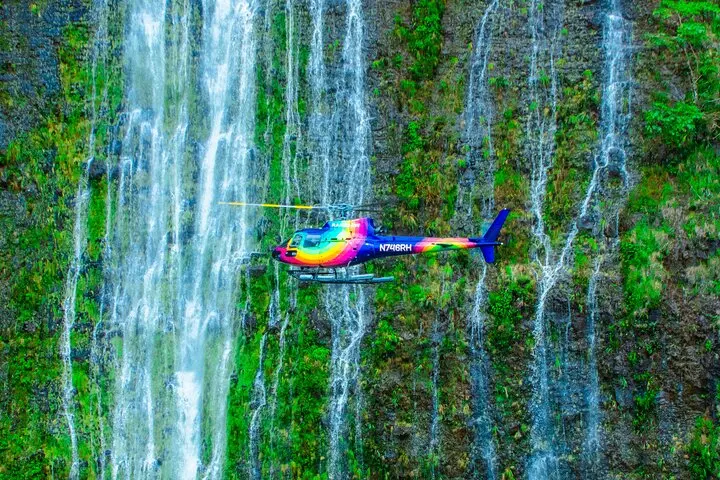
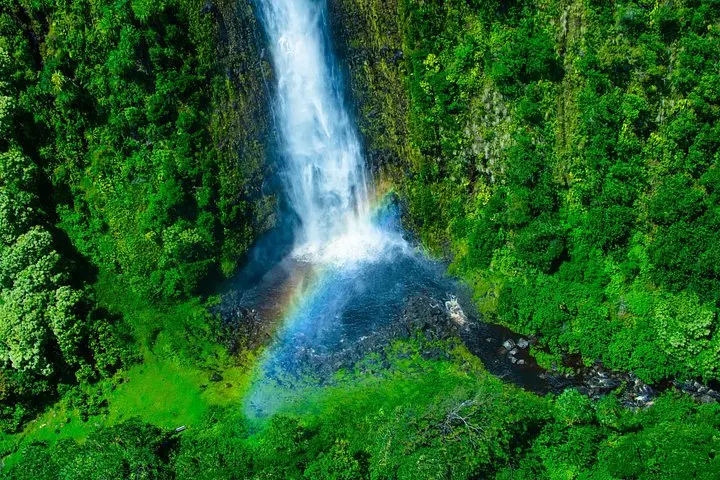
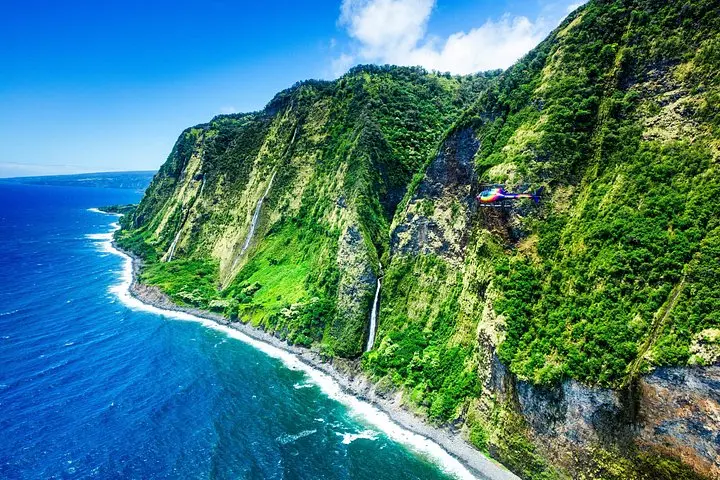
You lift off from the brown-walled Big Island Jet Center and Kona falls away beneath the skids: a grid of coral reefs, spinner dolphins flicking like commas in blue ink, and the shallow ribbon of Kailua Bay that seems to glow from within. The helicopter climbs, and the island rearranges itself—black river of rock becomes ridged shoulders of volcanoes, then a curtain of waterfalls spilling down the Kohala cliffs. For 90 minutes you travel along the spine of Hawai‘i Island, where fire and water argue openly across the landscape.
You lift off from the brown-walled Big Island Jet Center and Kona falls away beneath the skids: a grid of coral reefs, spinner dolphins flicking like commas in blue ink, and the shallow ribbon of Kailua Bay that seems to glow from within. The helicopter climbs, and the island rearranges itself—black river of rock becomes ridged shoulders of volcanoes, then a curtain of waterfalls spilling down the Kohala cliffs. For 90 minutes you travel along the spine of Hawai‘i Island, where fire and water argue openly across the landscape.
This flight threads together the island’s volcanic narrative. Mauna Loa—Earth’s largest active volcano—fills the western horizon with its mute scale; Hualālai and the Ka‘ūpūlehu Crater show a rougher, more recent scarring. Mauna Kea, crowned in alpine clouds at 13,796 feet, reads like a sacred highpoint; to the north the extinct Kohala volcano steps down toward the lush Pu‘u Wa‘awa‘a forest and the ancient valleys of Kamehameha’s childhood.
Geology is the show’s backbone: pahoehoe and ‘a‘ā flows, cliffs carved by persistent rainfall, and black sand beaches where lava has met the sea. Culturally, the flight is also a tour of place-names and histories—Waipi‘o, the Valley of the Kings, with its steep taro terraces; Pololū and Waimanu, where waterfalls pour directly into the ocean and oral histories remain alive in local communities.
For photographers, the doors-off option is kinetic: waterfalls that seem to clench and release, reef mosaics, and shoreline ancient fishponds scrawled along the coast. For conservation-minded travelers, the tour is a reminder: these views are finite. Respect the islands—leave no trash, stay curious but not extractive, and support outfits that follow local land access and wildlife guidelines.
Practicalities carve the rest of the itinerary. Plan to arrive 60 minutes before your flight for weight/manifest checks and safety briefings; all passengers over 24 months must have a ticket. Doors-off flights require a snug jacket, closed-toe shoes, long pants and hair secured. Expect possible weight-and-balance fees for guests over the posted limits; operators may refuse intoxicated passengers for safety.
Weather dictates the day—vog, trade winds, and heavy showers can reroute or cancel flights—so keep a flexible window in your travel plans. Bring a small, secured camera or phone with a tether, motion-sickness remedies if you’re prone, and a short list of the sights you most want to see: Mauna Loa, Kohala waterfalls, Waipi‘o Valley, and Makalawena Beach often top the list.
This is not merely a scenic hop; it’s an aerial field guide to an island shaped by fire, water, and human stories. Up here, Pele’s fingerprints are obvious—and the view compels a quieter kind of awe, one that turns sightseeing into stewardship.