THE ADVENTURE COLLECTIVE® · Independent discovery and booking for outdoor travel

Escape Djerba for a long, immersive day into the southern Tunisian desert. Ksar Ghilane pairs a natural hot spring, palm-fringed oasis and desert ruins with authentic Berber encounters and optional camel or quad rides.
Escape Djerba for a long, immersive day into the southern Tunisian desert. Ksar Ghilane pairs a natural hot spring, palm-fringed oasis and desert ruins with authentic Berber encounters and optional camel or quad rides.
A salt-bleached road slides away from Djerba as the Mediterranean recedes and the land flattens into the pale pulse of the southern Tunisian desert. By midday the road gives way to tracks and the dunes take over—gold ridges that dare you to read their shifting lines. At the heart of that expanse sits Ksar Ghilane: a pocket of palm shade, a steaming spring and the scattered ruins of a fort.
Verified experiences and guided adventures in the surrounding area.
Operated by GTH voyages · Ksar Ghilane Oasis, Tataouine Governorate
A salt-bleached road slides away from Djerba as the Mediterranean recedes and the land flattens into the pale pulse of the southern Tunisian desert. By midday the road gives way to tracks and the dunes take over—gold ridges that dare you to read their shifting lines. At the heart of that expanse sits Ksar Ghilane: a pocket of palm shade, a steaming spring and the scattered ruins of a fort.
Geology here is plain and direct: wind-sculpted sand over a limestone underlayer, with groundwater forced to the surface by deep faults and, famously, an accidental drill that revealed a hot, sulfur-rich spring. History threads through the place in caravan routes, ksour (collective grain storehouses) and the low stone fortifications used to control trade and later occupied during World War II. Culturally, visitors meet Berber families whose livelihoods still follow seasonal patterns—date palms, small-scale grazing and guiding visitors.
Practical guidance: this is a full-day excursion (roughly 11–12 hours from Djerba), often including a hot-spring dip, short camel rides or quad-bike options, and a countryside lunch. Expect long drives on rough tracks, strong sun and temperature swings; bring layered clothing, sun protection and plenty of water. Respect local customs—ask before photographing people—and use established paths to protect sparse desert vegetation. The oasis rewards patient observation: birds on the pool’s edge, the warm steam against cool desert air and ruined walls that hold stories of trade caravans and wartime patrols. A day here is sensory and straightforward: hot water, cool shade, and the slow geometry of sand.
Expect an all-day excursion of about 11–12 hours round-trip including driving time, stops and a lunch break.
Yes — the spring pools are commonly used for a warm dip; the water is sulfur-rich and warm but check local guidance if you have skin sensitivities.
Options like short camel rides or quad-bike experiences are often available but may be add-ons—confirm with the operator before booking.
The activity is labeled physically easy with long vehicle transfers; small children and older travelers should consider the long day and avoid if they have serious spinal or heart issues.
GTH voyages operates guided outdoor trips and adventures with an emphasis on safety, stewardship, and memorable experiences.
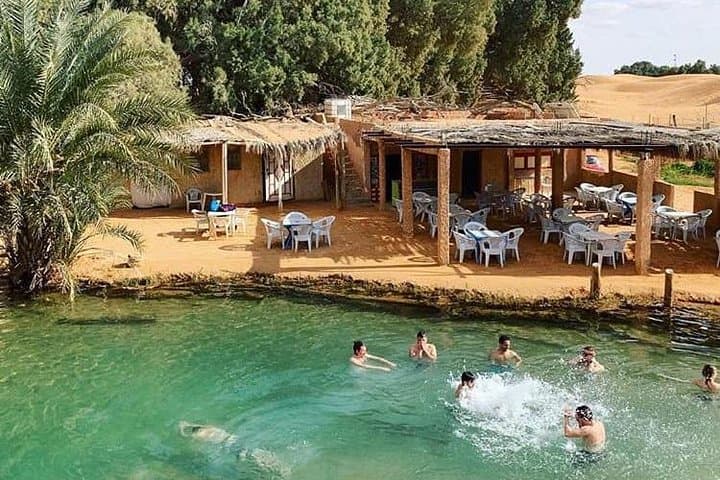


A salt-bleached road slides away from Djerba as the Mediterranean recedes and the land flattens into the pale pulse of the southern Tunisian desert. By midday the road gives way to tracks and the dunes take over—gold ridges that dare you to read their shifting lines. At the heart of that expanse sits Ksar Ghilane: a pocket of palm shade, a steaming spring and the scattered ruins of a fort.
A salt-bleached road slides away from Djerba as the Mediterranean recedes and the land flattens into the pale pulse of the southern Tunisian desert. By midday the road gives way to tracks and the dunes take over—gold ridges that dare you to read their shifting lines. At the heart of that expanse sits Ksar Ghilane: a pocket of palm shade, a steaming spring and the scattered ruins of a fort.
Geology here is plain and direct: wind-sculpted sand over a limestone underlayer, with groundwater forced to the surface by deep faults and, famously, an accidental drill that revealed a hot, sulfur-rich spring. History threads through the place in caravan routes, ksour (collective grain storehouses) and the low stone fortifications used to control trade and later occupied during World War II. Culturally, visitors meet Berber families whose livelihoods still follow seasonal patterns—date palms, small-scale grazing and guiding visitors.
Practical guidance: this is a full-day excursion (roughly 11–12 hours from Djerba), often including a hot-spring dip, short camel rides or quad-bike options, and a countryside lunch. Expect long drives on rough tracks, strong sun and temperature swings; bring layered clothing, sun protection and plenty of water. Respect local customs—ask before photographing people—and use established paths to protect sparse desert vegetation. The oasis rewards patient observation: birds on the pool’s edge, the warm steam against cool desert air and ruined walls that hold stories of trade caravans and wartime patrols. A day here is sensory and straightforward: hot water, cool shade, and the slow geometry of sand.