THE ADVENTURE COLLECTIVE® · Independent discovery and booking for outdoor travel

Walk Kyoto with a government-licensed English-speaking guide who customizes a full-day route of temples, markets, and historic districts. Pick 4–5 sites and let a local expert thread them into a single practical, crowd-smart itinerary.
Walk Kyoto with a government-licensed English-speaking guide who customizes a full-day route of temples, markets, and historic districts. Pick 4–5 sites and let a local expert thread them into a single practical, crowd-smart itinerary.
You step off the train and the city changes pitch: narrow lanes hum with market voices, temple roofs lean against a low mountain line, and the Kamogawa River dares you to slow down and watch life pass. This full-day private walk moves through those shifting scenes—shrines with vermilion gates, wooden tea houses in Gion, and quiet temple gardens whose stone arrangements reward the patient eye.
Verified experiences and guided adventures in the surrounding area.
Operated by Japan Guide Agency · Kyoto, Kyoto Prefecture
You step off the train and the city changes pitch: narrow lanes hum with market voices, temple roofs lean against a low mountain line, and the Kamogawa River dares you to slow down and watch life pass. This full-day private walk moves through those shifting scenes—shrines with vermilion gates, wooden tea houses in Gion, and quiet temple gardens whose stone arrangements reward the patient eye.
Kyoto was Japan’s capital for over a millennium, and its streets keep that continuity. The city sits in a basin ringed by low mountains, a geography that concentrated culture and courtly arts here. Guides licensed by the national government translate not just facts but ritual—why foxes stand guard at Fushimi Inari, how Zen gardens shaped Japanese aesthetics, and how merchant neighborhoods like Nishiki Market fed urban life.
Choose four to five stops—Kiyomizu-dera, Nijo Castle, Arashiyama’s bamboo groves, or hidden tea houses—and your guide will plot an efficient loop that balances sky-facing temple views with alleyside discoveries. Expect 6–10 km of walking across stone, pavement, and stairs; pacing is gentle but continuous.
Practical notes: start early to avoid crowds at major shrines, carry cash for small vendors, and wear soles with good grip for temple steps. Respect shrine etiquette—bow, remove hats, and keep voices low in temple halls. If you travel between late March and November, book farther ahead; fall foliage and cherry blossom seasons fill Kyoto fast. Your guide handles logistics and context—bring curiosity, comfortable shoes, and a charged phone for photos and transit cards.
Meeting occurs at a designated point in Osaka (confirmed after booking) and the tour runs as a full-day loop in Kyoto; exact start/stop points are coordinated with your guide.
Entrance fees and meals are typically not included—your guide can advise costs and handle reservations if requested in advance.
Many central streets and some temple approaches are wheelchair accessible, but specific sites have steps; inform the guide of mobility needs to plan an appropriate route.
Fully customizable within the eight-hour day—select 3–5 preferred sites and the licensed guide will create a practical route based on interests and mobility.
Japan Guide Agency operates guided outdoor trips and adventures with an emphasis on safety, stewardship, and memorable experiences.
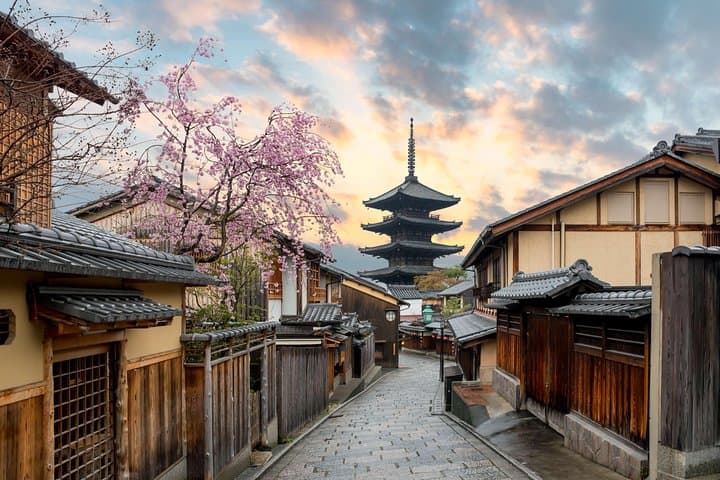
You step off the train and the city changes pitch: narrow lanes hum with market voices, temple roofs lean against a low mountain line, and the Kamogawa River dares you to slow down and watch life pass. This full-day private walk moves through those shifting scenes—shrines with vermilion gates, wooden tea houses in Gion, and quiet temple gardens whose stone arrangements reward the patient eye.
You step off the train and the city changes pitch: narrow lanes hum with market voices, temple roofs lean against a low mountain line, and the Kamogawa River dares you to slow down and watch life pass. This full-day private walk moves through those shifting scenes—shrines with vermilion gates, wooden tea houses in Gion, and quiet temple gardens whose stone arrangements reward the patient eye.
Kyoto was Japan’s capital for over a millennium, and its streets keep that continuity. The city sits in a basin ringed by low mountains, a geography that concentrated culture and courtly arts here. Guides licensed by the national government translate not just facts but ritual—why foxes stand guard at Fushimi Inari, how Zen gardens shaped Japanese aesthetics, and how merchant neighborhoods like Nishiki Market fed urban life.
Choose four to five stops—Kiyomizu-dera, Nijo Castle, Arashiyama’s bamboo groves, or hidden tea houses—and your guide will plot an efficient loop that balances sky-facing temple views with alleyside discoveries. Expect 6–10 km of walking across stone, pavement, and stairs; pacing is gentle but continuous.
Practical notes: start early to avoid crowds at major shrines, carry cash for small vendors, and wear soles with good grip for temple steps. Respect shrine etiquette—bow, remove hats, and keep voices low in temple halls. If you travel between late March and November, book farther ahead; fall foliage and cherry blossom seasons fill Kyoto fast. Your guide handles logistics and context—bring curiosity, comfortable shoes, and a charged phone for photos and transit cards.