THE ADVENTURE COLLECTIVE® · Independent discovery and booking for outdoor travel

A day-hike outside Ushuaia that earns its colors: the Laguna Esmeralda trail threads beaver-altered rivers, peat bogs and lenga forest before revealing a jewel-green lagoon with the Albino Glacier on the horizon. Expect mud, quick-changing weather and a rewarding summit lunch when conditions allow.
A day-hike outside Ushuaia that earns its colors: the Laguna Esmeralda trail threads beaver-altered rivers, peat bogs and lenga forest before revealing a jewel-green lagoon with the Albino Glacier on the horizon. Expect mud, quick-changing weather and a rewarding summit lunch when conditions allow.
The road from Ushuaia loosens its grip on civilization after about 17 kilometers: pavement gives way to a narrow parking lot and a gate where the forest breathes in a cooler key. You step off the transfer and the trail immediately ducks beneath lenga and ñire, their trunks leaning like quiet travelers. The track threads a low valley, skirts a busy beaver dam that chest-puffs at the river, and soon opens onto a peat bog where the ground seems to test every step you take.
Verified experiences and guided adventures in the surrounding area.
Operated by Arpon Trekking · Ushuaia, Tierra del Fuego
The road from Ushuaia loosens its grip on civilization after about 17 kilometers: pavement gives way to a narrow parking lot and a gate where the forest breathes in a cooler key. You step off the transfer and the trail immediately ducks beneath lenga and ñire, their trunks leaning like quiet travelers. The track threads a low valley, skirts a busy beaver dam that chest-puffs at the river, and soon opens onto a peat bog where the ground seems to test every step you take.
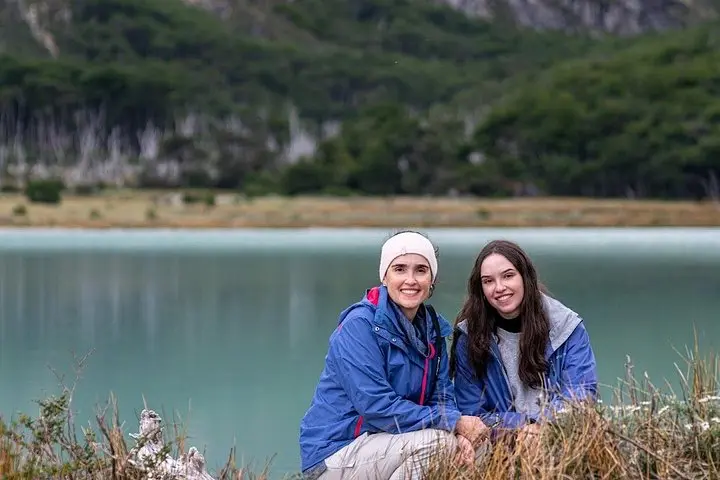
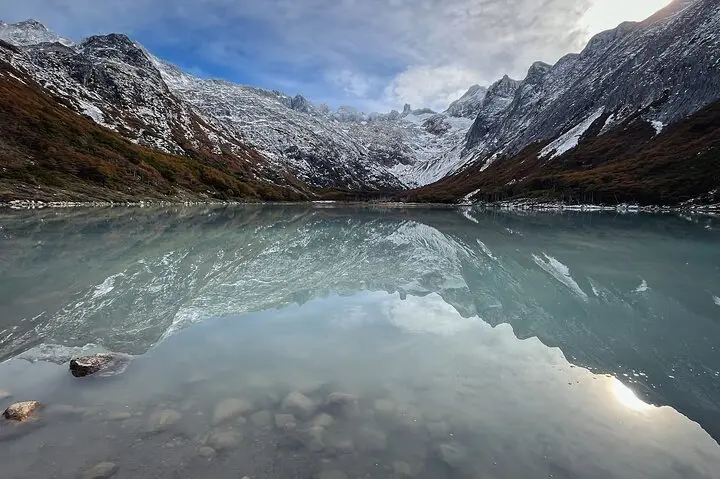
This is the Esmeralda River’s lower theater. The trail follows its curve, sometimes climbing, sometimes compressing into boardwalks and roots. After roughly two hours of walking—through mossy ribs of forest and occasional muddy stretches—the trees part and the lagoon appears: a shallow bowl of startling green-blue framed by moraine and the pale angles of the Albino Glacier beyond. In summer, the color feels to glow from within; in winter the surface seals into glass and the rim becomes a quiet, white hush.
Geologically the lagoon is a glacial cirque—water collected at the glacier’s toe, filtered by mineral-rich moraine and the peatland that drains toward it. Culturally, this corridor sits on the edge of Lands once traversed by the Kawésqar and Selk’nam peoples; today it’s a popular day trek from Ushuaia that exposes both the rawness of subantarctic landscapes and the human impacts—introduced beavers have reshaped rivers and peat around here.
Expect a solid day out: guides typically allow 5–6 hours total, with two hours uphill to the lagoon and a return along the same track. The path is roughly 9 km round-trip with about 250–350 m of elevation gain—moderate but deceptively tiring where the bog holds your boots. Weather flips quickly; the guides require proper mountain clothing and offer rentals if you arrive underprepared.
Practical edge: wear waterproof boots and gaiters, bring layered insulation, and pack at least 1.5 liters of water plus high-energy snacks. Trekking poles make the peat sections easier and help on the final climb to the viewpoint above the lagoon. If conditions allow, guides set up lunch by the water with a view of the glacier; if not, shelter in the tree line and wait for a break in the wind.
Leave no trace: stick to the trail to protect fragile bog and slow erosion. The best light for photos is late morning through golden hour; aim for the lagoon’s eastern shore to catch the glacier backlit in summer. The hike is an immediate, tactile way to feel Tierra del Fuego’s weather—unpredictable, brisk, and refusing to be ignored.
Expect about 2 hours to reach the lagoon from the trailhead and roughly 2 hours to return; total outing is 5–6 hours including transfers and breaks.
It’s suitable for regular walkers with moderate fitness, but muddy sections and the final climb require steady footing—guided groups are capped to maintain pace and safety.
Yes—organizers note mountain clothing is necessary and offer rental options if you arrive without adequate gear.
Policies vary; due to fragile bog and variable conditions, check with the operator—children should be steady hikers and supervised at all times.
Look for beaver activity along rivers and occasional sightings of Fuegian foxes and native birds in the forest canopy.
Layer clothing, carry a waterproof shell, bring extra warm layers in a pack, and confirm pickup times the day before in case of schedule adjustments.
Arpon Trekking operates guided outdoor trips and adventures with an emphasis on safety, stewardship, and memorable experiences.
The road from Ushuaia loosens its grip on civilization after about 17 kilometers: pavement gives way to a narrow parking lot and a gate where the forest breathes in a cooler key. You step off the transfer and the trail immediately ducks beneath lenga and ñire, their trunks leaning like quiet travelers. The track threads a low valley, skirts a busy beaver dam that chest-puffs at the river, and soon opens onto a peat bog where the ground seems to test every step you take.
The road from Ushuaia loosens its grip on civilization after about 17 kilometers: pavement gives way to a narrow parking lot and a gate where the forest breathes in a cooler key. You step off the transfer and the trail immediately ducks beneath lenga and ñire, their trunks leaning like quiet travelers. The track threads a low valley, skirts a busy beaver dam that chest-puffs at the river, and soon opens onto a peat bog where the ground seems to test every step you take.
This is the Esmeralda River’s lower theater. The trail follows its curve, sometimes climbing, sometimes compressing into boardwalks and roots. After roughly two hours of walking—through mossy ribs of forest and occasional muddy stretches—the trees part and the lagoon appears: a shallow bowl of startling green-blue framed by moraine and the pale angles of the Albino Glacier beyond. In summer, the color feels to glow from within; in winter the surface seals into glass and the rim becomes a quiet, white hush.
Geologically the lagoon is a glacial cirque—water collected at the glacier’s toe, filtered by mineral-rich moraine and the peatland that drains toward it. Culturally, this corridor sits on the edge of Lands once traversed by the Kawésqar and Selk’nam peoples; today it’s a popular day trek from Ushuaia that exposes both the rawness of subantarctic landscapes and the human impacts—introduced beavers have reshaped rivers and peat around here.
Expect a solid day out: guides typically allow 5–6 hours total, with two hours uphill to the lagoon and a return along the same track. The path is roughly 9 km round-trip with about 250–350 m of elevation gain—moderate but deceptively tiring where the bog holds your boots. Weather flips quickly; the guides require proper mountain clothing and offer rentals if you arrive underprepared.
Practical edge: wear waterproof boots and gaiters, bring layered insulation, and pack at least 1.5 liters of water plus high-energy snacks. Trekking poles make the peat sections easier and help on the final climb to the viewpoint above the lagoon. If conditions allow, guides set up lunch by the water with a view of the glacier; if not, shelter in the tree line and wait for a break in the wind.
Leave no trace: stick to the trail to protect fragile bog and slow erosion. The best light for photos is late morning through golden hour; aim for the lagoon’s eastern shore to catch the glacier backlit in summer. The hike is an immediate, tactile way to feel Tierra del Fuego’s weather—unpredictable, brisk, and refusing to be ignored.