THE ADVENTURE COLLECTIVE® · Independent discovery and booking for outdoor travel

Walk the Larano Trail from Machico to Porto da Cruz — an exposed, seaside levada route that alternates ocean panoramas with wind-shaped Laurisilva. This guided, moderate trek covers roughly 11 km and finishes in a village framed by vineyards and the iconic Penha d’Águia rock.
Walk the Larano Trail from Machico to Porto da Cruz — an exposed, seaside levada route that alternates ocean panoramas with wind-shaped Laurisilva. This guided, moderate trek covers roughly 11 km and finishes in a village framed by vineyards and the iconic Penha d’Águia rock.
You set off above Machico before the day crowds arrive, the Atlantic on one side daring you to look down, the laurel-clad slopes rising like a wind-sculpted wall on the other. A narrow levada leads you out of the valley; footsteps quietly measure the trail’s rhythm as seabirds wheel and call.
Verified experiences and guided adventures in the surrounding area.
Operated by Madeira Narrow Trails · Porto da Cruz, Madeira
You set off above Machico before the day crowds arrive, the Atlantic on one side daring you to look down, the laurel-clad slopes rising like a wind-sculpted wall on the other. A narrow levada leads you out of the valley; footsteps quietly measure the trail’s rhythm as seabirds wheel and call.
The Larano route traces Madeira’s dual identity: engineered levadas built to move water across volcanic rock, and the wild Laurisilva—an ancient laurel forest protected as UNESCO heritage—that clings to steep gullies. Geology here is recent and raw: basalt cliffs weathered by Atlantic spray and cliffs cut by old lava flows, with the dramatic Penha d’Águia rock standing as a coastal landmark and a cultural reference for local fishermen.
Expect roughly 11 km (about 6.8 miles) of walking and around 300 m (≈1,000 ft) of cumulative gain spread over exposed ridgelines and sheltered valley steps. The guide steadies pace through narrow sections; the most technical demand is sure-footedness rather than sustained climbing.
Practical notes: start early to avoid afternoon winds, carry 2–3 liters of water, and wear sturdy footwear with good grip. Layers are key—sun at the coast shifts quickly to cool, damp air beneath the laurel canopy. Finish in Porto da Cruz where vineyards, a rocky shoreline and the Penha d’Águia provide a rewarding endpoint and options for a café or bus back to Funchal. Stick to the marked route to protect fragile vegetation and minimize erosion; the trail is both an exhilarating coastal traverse and a lesson in island hydrology and human engineering.
The guided route is about 11 km (6.8 miles) with roughly 300 m (≈1,000 ft) of cumulative ascent spread across multiple undulations rather than long climbs.
No — the trail includes narrow, exposed sections and uneven ground; it’s not recommended for those with vertigo or significant mobility limitations.
Porto da Cruz has regular (but sometimes infrequent) regional buses to Machico and Funchal; many guided tours also include transfer options—confirm with the operator before booking.
Madeira’s east coast is mild year-round. Mornings are calmer; afternoons can be windier. Spring to fall offer the most stable conditions, but layers and waterproofs are advised any season.
Madeira Narrow Trails operates guided outdoor trips and adventures with an emphasis on safety, stewardship, and memorable experiences.
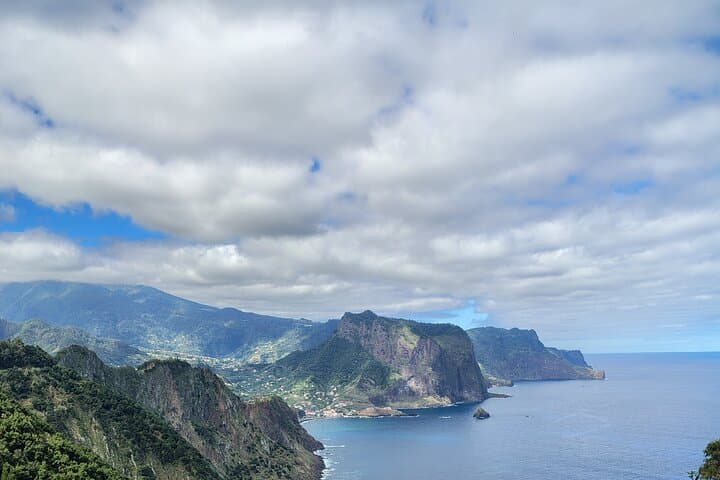


You set off above Machico before the day crowds arrive, the Atlantic on one side daring you to look down, the laurel-clad slopes rising like a wind-sculpted wall on the other. A narrow levada leads you out of the valley; footsteps quietly measure the trail’s rhythm as seabirds wheel and call.
You set off above Machico before the day crowds arrive, the Atlantic on one side daring you to look down, the laurel-clad slopes rising like a wind-sculpted wall on the other. A narrow levada leads you out of the valley; footsteps quietly measure the trail’s rhythm as seabirds wheel and call.
The Larano route traces Madeira’s dual identity: engineered levadas built to move water across volcanic rock, and the wild Laurisilva—an ancient laurel forest protected as UNESCO heritage—that clings to steep gullies. Geology here is recent and raw: basalt cliffs weathered by Atlantic spray and cliffs cut by old lava flows, with the dramatic Penha d’Águia rock standing as a coastal landmark and a cultural reference for local fishermen.
Expect roughly 11 km (about 6.8 miles) of walking and around 300 m (≈1,000 ft) of cumulative gain spread over exposed ridgelines and sheltered valley steps. The guide steadies pace through narrow sections; the most technical demand is sure-footedness rather than sustained climbing.
Practical notes: start early to avoid afternoon winds, carry 2–3 liters of water, and wear sturdy footwear with good grip. Layers are key—sun at the coast shifts quickly to cool, damp air beneath the laurel canopy. Finish in Porto da Cruz where vineyards, a rocky shoreline and the Penha d’Águia provide a rewarding endpoint and options for a café or bus back to Funchal. Stick to the marked route to protect fragile vegetation and minimize erosion; the trail is both an exhilarating coastal traverse and a lesson in island hydrology and human engineering.