THE ADVENTURE COLLECTIVE® · Independent discovery and booking for outdoor travel
Climb Lion's Head at dawn or dusk for dramatic city-and-sea views from a tight, well-used circular trail. This guided hike offers small groups, optional hotel pick-up, and those iconic chain-and-ladder sections that make the summit feel earned.
Climb Lion's Head at dawn or dusk for dramatic city-and-sea views from a tight, well-used circular trail. This guided hike offers small groups, optional hotel pick-up, and those iconic chain-and-ladder sections that make the summit feel earned.
Before the city wakes, a thin ribbon of light slides over the Atlantic and the slopes of Table Mountain; the silhouette that stops most travelers in their tracks is Lion's Head. On this guided sunrise and sunset hike the mountain feels like a living map—craggy rock faces, short grassy benches, and a path that climbs in steady pulses until the city and sea unfold beneath you.
Verified experiences and guided adventures in the surrounding area.
Operated by Kayu Adventures · Cape Town, Western Cape
Before the city wakes, a thin ribbon of light slides over the Atlantic and the slopes of Table Mountain; the silhouette that stops most travelers in their tracks is Lion's Head. On this guided sunrise and sunset hike the mountain feels like a living map—craggy rock faces, short grassy benches, and a path that climbs in steady pulses until the city and sea unfold beneath you.
The route is the popular circular trail that loops to the summit and back. Geologically, Lion's Head is part of Cape Fold Belt sandstone; its walls are hard and exfoliating, worn into ribs and ledges that catch wind and sun. Culturally, the peak has been used as a lookout for centuries—signal fires on nearby Signal Hill were a method of coastal communication long before motor traffic filled the roads below. Today locals treat the peak as a daily ritual: runners on steep switchbacks, photographers on pre-dawn ridgelines, and guides reading the wind for safe passage.
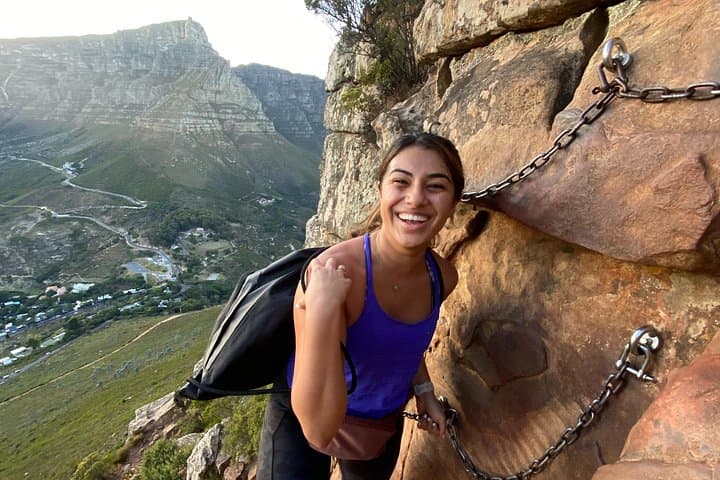
Expect a hike of roughly 5 km round-trip with about 300–350 m of elevation gain to the 669 m summit. Terrain alternates between well-trodden dirt, exposed slabs, and the short chain-and-ladder sections that give the route its character; those metal rungs are more about balance than climbing technique but require caution in wet conditions. The circular nature of the trail keeps the route moving and provides changing viewpoints of Camps Bay, Clifton, and the Atlantic seaboard.
Practicalities are straightforward. The operator meets at the boom and signpost to the hike; hotel pick-up is available across the city. Guides supply water, tea for morning departures, light snacks, and—if needed—headlamps for the pre-sunrise approach. Groups are kept small (up to 10), which makes for room on the summit and solid attention from the guide.
Timing is critical: sunrise hikes mean pre-dawn starts and headlamps; sunset walks require attention to return times—mountain wind can rise quickly and visibility drops fast once the sun sets. Fitness needs are moderate: no technical climbing is required, but you should be comfortable on uneven ground and short exposed sections.
Leave no trace is taken seriously here—fynbos is fragile and fires can be devastating. Stay on the marked path, carry out any trash, and listen to your guide about exposed ledges.
For travelers who want a compact Cape Town experience—a 360-degree view, a lesson in local geology and history, and the adrenaline of a ridge with real exposure—this Lions Head loop delivers. Bring a camera, solid trail shoes, and a respect for wind and edge; the mountain will return the favor with one of the sharpest urban summits on the planet.
The guided loop typically takes 3–4 hours round-trip, including time at viewpoints; the trail itself is about 5 km with ~300–350 m elevation gain.
Yes—no technical climbing is required, but hikers should be comfortable on uneven terrain and short exposed sections with chains.
Yes—hotel pick-up across central Cape Town is offered; confirm your pickup point when booking.
Bring a headlamp, warm layers, windproof jacket, sturdy shoes, sun protection, and water; guide-provided tea is common for morning departures.
Policies vary—small children and dogs are generally discouraged due to exposed sections and chains; check with the operator before booking.
The operator cancels in high winds or heavy rain for safety and will offer a full refund if canceled at least 24 hours before departure per their policy.
Kayu Adventures operates guided outdoor trips and adventures with an emphasis on safety, stewardship, and memorable experiences.



Before the city wakes, a thin ribbon of light slides over the Atlantic and the slopes of Table Mountain; the silhouette that stops most travelers in their tracks is Lion's Head. On this guided sunrise and sunset hike the mountain feels like a living map—craggy rock faces, short grassy benches, and a path that climbs in steady pulses until the city and sea unfold beneath you.
Before the city wakes, a thin ribbon of light slides over the Atlantic and the slopes of Table Mountain; the silhouette that stops most travelers in their tracks is Lion's Head. On this guided sunrise and sunset hike the mountain feels like a living map—craggy rock faces, short grassy benches, and a path that climbs in steady pulses until the city and sea unfold beneath you.
The route is the popular circular trail that loops to the summit and back. Geologically, Lion's Head is part of Cape Fold Belt sandstone; its walls are hard and exfoliating, worn into ribs and ledges that catch wind and sun. Culturally, the peak has been used as a lookout for centuries—signal fires on nearby Signal Hill were a method of coastal communication long before motor traffic filled the roads below. Today locals treat the peak as a daily ritual: runners on steep switchbacks, photographers on pre-dawn ridgelines, and guides reading the wind for safe passage.
Expect a hike of roughly 5 km round-trip with about 300–350 m of elevation gain to the 669 m summit. Terrain alternates between well-trodden dirt, exposed slabs, and the short chain-and-ladder sections that give the route its character; those metal rungs are more about balance than climbing technique but require caution in wet conditions. The circular nature of the trail keeps the route moving and provides changing viewpoints of Camps Bay, Clifton, and the Atlantic seaboard.
Practicalities are straightforward. The operator meets at the boom and signpost to the hike; hotel pick-up is available across the city. Guides supply water, tea for morning departures, light snacks, and—if needed—headlamps for the pre-sunrise approach. Groups are kept small (up to 10), which makes for room on the summit and solid attention from the guide.
Timing is critical: sunrise hikes mean pre-dawn starts and headlamps; sunset walks require attention to return times—mountain wind can rise quickly and visibility drops fast once the sun sets. Fitness needs are moderate: no technical climbing is required, but you should be comfortable on uneven ground and short exposed sections.
Leave no trace is taken seriously here—fynbos is fragile and fires can be devastating. Stay on the marked path, carry out any trash, and listen to your guide about exposed ledges.
For travelers who want a compact Cape Town experience—a 360-degree view, a lesson in local geology and history, and the adrenaline of a ridge with real exposure—this Lions Head loop delivers. Bring a camera, solid trail shoes, and a respect for wind and edge; the mountain will return the favor with one of the sharpest urban summits on the planet.
