THE ADVENTURE COLLECTIVE® · Independent discovery and booking for outdoor travel

A full-day from Aurangabad, Lonar Crater Lake is a rare basalt-impact crater where geology and legend meet. Explore steep basalt rims, ancient temples, and migratory birds while learning why scientists compare parts of the lake to Martian conditions.
A full-day from Aurangabad, Lonar Crater Lake is a rare basalt-impact crater where geology and legend meet. Explore steep basalt rims, ancient temples, and migratory birds while learning why scientists compare parts of the lake to Martian conditions.
The visitor steps off the road and into a bowl of wind-and-time—Lonar Crater's rim folds away and the lake below shimmers an almost unreal green. Basalt cliffs, scored by ancient lava flows, lean inward as if listening; the water answers with a surface that changes with light, at times glassy, at times rippled by migratory birds.
Verified experiences and guided adventures in the surrounding area.
Operated by 5 Senses Walks · Lonar, Maharashtra
The visitor steps off the road and into a bowl of wind-and-time—Lonar Crater's rim folds away and the lake below shimmers an almost unreal green. Basalt cliffs, scored by ancient lava flows, lean inward as if listening; the water answers with a surface that changes with light, at times glassy, at times rippled by migratory birds.
Formed roughly 50,000 years ago when a meteor struck the Deccan Traps, Lonar is one of the world’s few hypervelocity impact craters in basalt. Archaeological fragments and Hindu temples—most notably the 6th–12th century Daitya Sudan temple—mark centuries of human reverence and local myth about Lord Vishnu and the demon Lonasura.
Geology and legend sit side by side: the crater’s steep rim exposes columnar basalts and weathered scoria, while saline-alkaline pools and microbial mats give the lake its distinctive color and scientific interest. Local villages maintain simple dhabas and a handful of craftsmen selling pottery and snacks; guides usually explain both the rock record and the temple iconography.
Practically, this is a full-day outing from Aurangabad—expect long drives on rural roads, short steep descents to rim viewpoints, and uneven basalt walking surfaces. Bring sturdy shoes, sun protection, and water; avoid swimming—algae and high alkalinity make the water hazardous. Best visited in the cooler months for birdwatching and comfortable hiking. Whether one comes for science, mythology, or sheer place-based curiosity, Lonar rewards patience with close-up geology, quiet temples, and a landscape that feels, in equal parts, ancient and otherworldly.
About 140–160 km depending on route, typically 2.5–3 hours each way by car.
No—high alkalinity and delicate microbial mats make swimming unsafe and discouraged.
There is a nominal entrance fee for the crater area; guided day trips from Aurangabad commonly include transport and a guide.
October to March offers cooler temperatures and peak migratory bird activity, making it the most comfortable period for walking and wildlife viewing.
5 Senses Walks operates guided outdoor trips and adventures with an emphasis on safety, stewardship, and memorable experiences.
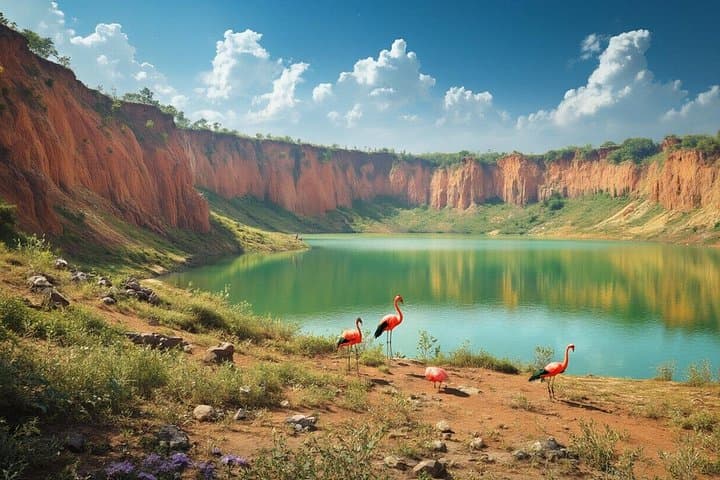


The visitor steps off the road and into a bowl of wind-and-time—Lonar Crater's rim folds away and the lake below shimmers an almost unreal green. Basalt cliffs, scored by ancient lava flows, lean inward as if listening; the water answers with a surface that changes with light, at times glassy, at times rippled by migratory birds.
The visitor steps off the road and into a bowl of wind-and-time—Lonar Crater's rim folds away and the lake below shimmers an almost unreal green. Basalt cliffs, scored by ancient lava flows, lean inward as if listening; the water answers with a surface that changes with light, at times glassy, at times rippled by migratory birds.
Formed roughly 50,000 years ago when a meteor struck the Deccan Traps, Lonar is one of the world’s few hypervelocity impact craters in basalt. Archaeological fragments and Hindu temples—most notably the 6th–12th century Daitya Sudan temple—mark centuries of human reverence and local myth about Lord Vishnu and the demon Lonasura.
Geology and legend sit side by side: the crater’s steep rim exposes columnar basalts and weathered scoria, while saline-alkaline pools and microbial mats give the lake its distinctive color and scientific interest. Local villages maintain simple dhabas and a handful of craftsmen selling pottery and snacks; guides usually explain both the rock record and the temple iconography.
Practically, this is a full-day outing from Aurangabad—expect long drives on rural roads, short steep descents to rim viewpoints, and uneven basalt walking surfaces. Bring sturdy shoes, sun protection, and water; avoid swimming—algae and high alkalinity make the water hazardous. Best visited in the cooler months for birdwatching and comfortable hiking. Whether one comes for science, mythology, or sheer place-based curiosity, Lonar rewards patience with close-up geology, quiet temples, and a landscape that feels, in equal parts, ancient and otherworldly.