THE ADVENTURE COLLECTIVE® · Independent discovery and booking for outdoor travel

Grab a paddle and meet the Madawaska: a compact, rolling whitewater run that mixes surfable waves and quick eddies. This two-hour guided trip near Barry’s Bay is instruction-forward, hands-on, and designed for active groups ready to get wet.
Grab a paddle and meet the Madawaska: a compact, rolling whitewater run that mixes surfable waves and quick eddies. This two-hour guided trip near Barry’s Bay is instruction-forward, hands-on, and designed for active groups ready to get wet.
A cool wind off the river sharpens the senses as a seven-person raft tips into the current. The Madawaska doesn’t ask politely — it dares you to match rhythm with its waves. Guides run through strokes on shore, then the raft slips into Staircase, a short sequence of ledges where eddies cradle the boat one moment and a rolling wave sends everyone paddling the next.
Verified experiences and guided adventures in the surrounding area.
Operated by Madawaska Kanu Centre · Barry's Bay, Ontario
A cool wind off the river sharpens the senses as a seven-person raft tips into the current. The Madawaska doesn’t ask politely — it dares you to match rhythm with its waves. Guides run through strokes on shore, then the raft slips into Staircase, a short sequence of ledges where eddies cradle the boat one moment and a rolling wave sends everyone paddling the next.
Geology here is readable in the rocks: Precambrian bedrock and glacial till shape tight channels and fast-flowing drops. The Madawaska has long been a corridor for people — Indigenous canoes, then voyageurs and log drivers — each leaving traces in place names and old portages. Locally, small cafés roast coffee for rafters and anglers alike, and the river’s working-class history still shows in timber and towns along its banks.
Expect five kilometres of moving water across roughly two hours: paddling-heavy stretches, surfable waves like Claudia’s Roller, and quieter eddies for a breath. Guides teach scouting and moving-water safety so the group practices strokes before the first rapid; swimming is possible and part of the trip’s rhythm, so flotation is non-negotiable.
Practical points: wear secure water footwear and quick-dry layers, stash a small dry bag for keys and phone, and plan for getting wet. Morning runs are cooler with firmer flows; afternoons bring warmer air and fuller sun. The Riverside Café near takeout is convenient for a hot sandwich and coffee after the trip. Follow guide instructions, respect minimum weight limits, and leave no trace along riverbanks.
No — the operator provides lifejackets and guides manage group safety, but you should be comfortable in moving water as swims can happen.
Lifejacket, helmet and paddle are provided and a certified raft guide leads the group and gives instruction.
Yes — expect to be splashed and potentially swim; wear quick-dry clothing and secure footwear.
All sales are final; trips may be canceled for bad weather or insufficient participants per operator policy.
Madawaska Kanu Centre operates guided outdoor trips and adventures with an emphasis on safety, stewardship, and memorable experiences.
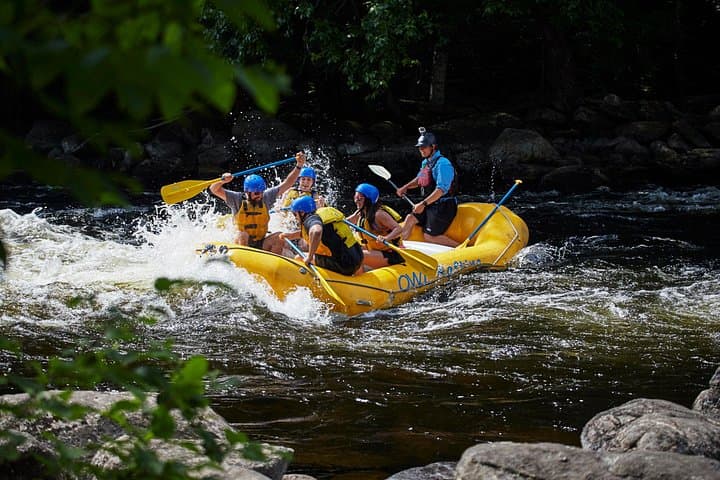

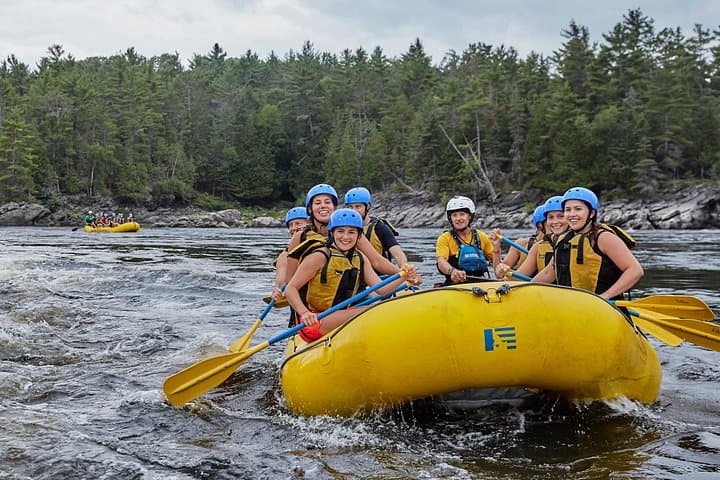

A cool wind off the river sharpens the senses as a seven-person raft tips into the current. The Madawaska doesn’t ask politely — it dares you to match rhythm with its waves. Guides run through strokes on shore, then the raft slips into Staircase, a short sequence of ledges where eddies cradle the boat one moment and a rolling wave sends everyone paddling the next.
A cool wind off the river sharpens the senses as a seven-person raft tips into the current. The Madawaska doesn’t ask politely — it dares you to match rhythm with its waves. Guides run through strokes on shore, then the raft slips into Staircase, a short sequence of ledges where eddies cradle the boat one moment and a rolling wave sends everyone paddling the next.
Geology here is readable in the rocks: Precambrian bedrock and glacial till shape tight channels and fast-flowing drops. The Madawaska has long been a corridor for people — Indigenous canoes, then voyageurs and log drivers — each leaving traces in place names and old portages. Locally, small cafés roast coffee for rafters and anglers alike, and the river’s working-class history still shows in timber and towns along its banks.
Expect five kilometres of moving water across roughly two hours: paddling-heavy stretches, surfable waves like Claudia’s Roller, and quieter eddies for a breath. Guides teach scouting and moving-water safety so the group practices strokes before the first rapid; swimming is possible and part of the trip’s rhythm, so flotation is non-negotiable.
Practical points: wear secure water footwear and quick-dry layers, stash a small dry bag for keys and phone, and plan for getting wet. Morning runs are cooler with firmer flows; afternoons bring warmer air and fuller sun. The Riverside Café near takeout is convenient for a hot sandwich and coffee after the trip. Follow guide instructions, respect minimum weight limits, and leave no trace along riverbanks.