THE ADVENTURE COLLECTIVE® · Independent discovery and booking for outdoor travel

Turn Mantua's streets into a puzzle: this self-guided scavenger hunt uses your phone to lead you through Gonzaga palaces, market alleys and lakeside quays. Solve riddles, snap creative photos and learn local history at your own pace.
Turn Mantua's streets into a puzzle: this self-guided scavenger hunt uses your phone to lead you through Gonzaga palaces, market alleys and lakeside quays. Solve riddles, snap creative photos and learn local history at your own pace.
You step off the square into a honeycomb of lanes, the app's map pulsing on your screen as the city's stones seem to watch. Mantua's low-slung roofs and the slow ribbon of the Mincio make navigation feel like reading a living map; the scavenger hunt nudges you toward Castello di San Giorgio, Casa di Rigoletto and the Pescherie di Giulio Romano with riddles that turn monuments into clues.
Verified experiences and guided adventures in the surrounding area.
Operated by Explorial · Mantua, Lombardy
You step off the square into a honeycomb of lanes, the app's map pulsing on your screen as the city's stones seem to watch. Mantua's low-slung roofs and the slow ribbon of the Mincio make navigation feel like reading a living map; the scavenger hunt nudges you toward Castello di San Giorgio, Casa di Rigoletto and the Pescherie di Giulio Romano with riddles that turn monuments into clues.
This is a Renaissance city shaped by the Gonzaga dynasty and rebuilt by architects such as Giulio Romano; its piazzas and palaces reflect sixteenth-century ambition while the three lakes carved by the Mincio still control the city's pulse. Geology here is quiet—river meanders and reclaimed marsh formed the islands you walk across—while the culture still centers on tight-knit neighborhoods, daily markets and centuries of opera and court life.
The experience blends curiosity and local detail: solve questions hidden on plaques, take creative photo tasks, and learn brief historical notes tied to each stop. Terrain is urban and mainly flat—paved streets and cobblestones—so it's accessible to most walkers, though some alleyways have steps.
Practical notes: buy the ticket, get an access code, download the app, and start at the indicated meeting point. Expect 1–2 hours at an easy pace; go early or late to avoid midday heat and to catch softer light on the façades. Carry a charged phone, wear comfortable shoes for cobbles, and respect historic sites by not climbing barriers. The route is self-paced—ideal for solo explorers, families, or small private groups wanting a playful, independent look at Mantua.
The route typically takes 1–2 hours at a relaxed pace, but the experience is self‑paced so you can take longer if you wish.
No—this is fully self‑guided. After purchase you receive an access code to use in the app and follow the map and clues independently.
The experience is offered in English and Italian; the app content and riddles will appear in the chosen language.
Much of the tour is on paved streets, but some sections include cobblestones and narrow alleys that can be challenging for wheelchairs or strollers.
Explorial operates guided outdoor trips and adventures with an emphasis on safety, stewardship, and memorable experiences.
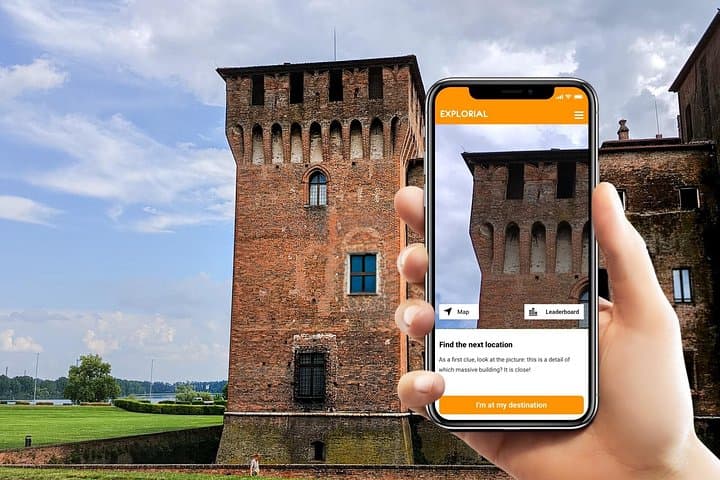



You step off the square into a honeycomb of lanes, the app's map pulsing on your screen as the city's stones seem to watch. Mantua's low-slung roofs and the slow ribbon of the Mincio make navigation feel like reading a living map; the scavenger hunt nudges you toward Castello di San Giorgio, Casa di Rigoletto and the Pescherie di Giulio Romano with riddles that turn monuments into clues.
You step off the square into a honeycomb of lanes, the app's map pulsing on your screen as the city's stones seem to watch. Mantua's low-slung roofs and the slow ribbon of the Mincio make navigation feel like reading a living map; the scavenger hunt nudges you toward Castello di San Giorgio, Casa di Rigoletto and the Pescherie di Giulio Romano with riddles that turn monuments into clues.
This is a Renaissance city shaped by the Gonzaga dynasty and rebuilt by architects such as Giulio Romano; its piazzas and palaces reflect sixteenth-century ambition while the three lakes carved by the Mincio still control the city's pulse. Geology here is quiet—river meanders and reclaimed marsh formed the islands you walk across—while the culture still centers on tight-knit neighborhoods, daily markets and centuries of opera and court life.
The experience blends curiosity and local detail: solve questions hidden on plaques, take creative photo tasks, and learn brief historical notes tied to each stop. Terrain is urban and mainly flat—paved streets and cobblestones—so it's accessible to most walkers, though some alleyways have steps.
Practical notes: buy the ticket, get an access code, download the app, and start at the indicated meeting point. Expect 1–2 hours at an easy pace; go early or late to avoid midday heat and to catch softer light on the façades. Carry a charged phone, wear comfortable shoes for cobbles, and respect historic sites by not climbing barriers. The route is self-paced—ideal for solo explorers, families, or small private groups wanting a playful, independent look at Mantua.