THE ADVENTURE COLLECTIVE® · Independent discovery and booking for outdoor travel

Escape San José for a day on Costa Rica’s Central Pacific: a guided trip to Manuel Antonio National Park that combines wildlife-rich rainforest hikes with warm Pacific beaches and coastal viewpoints. This full-day tour times visits to avoid the worst crowds and includes breakfast, lunch and park entry.
Escape San José for a day on Costa Rica’s Central Pacific: a guided trip to Manuel Antonio National Park that combines wildlife-rich rainforest hikes with warm Pacific beaches and coastal viewpoints. This full-day tour times visits to avoid the worst crowds and includes breakfast, lunch and park entry.
Morning light hits the Pacific and the road unwinds toward Quepos — palms lean like watchful hosts as the van climbs coastal hills. By the time you reach Manuel Antonio National Park the air is humid, birdcalls register as punctuation, and the trailhead feels like a threshold between city rhythms and rainforest time.
Verified experiences and guided adventures in the surrounding area.
Operated by Go Tours Costa Rica · Quepos, Puntarenas
Morning light hits the Pacific and the road unwinds toward Quepos — palms lean like watchful hosts as the van climbs coastal hills. By the time you reach Manuel Antonio National Park the air is humid, birdcalls register as punctuation, and the trailhead feels like a threshold between city rhythms and rainforest time.
Established in 1972, Manuel Antonio protects a compact stretch of Pacific rainforest and coastal terrace carved from volcanic soils and marine sediments. The park’s steep ridges and sandy coves concentrate wildlife: howler and white-faced monkeys, sleepy two-toed sloths, and bright toucans make the short trails feel alive. Nearby Quepos grew from a fishing village into the region’s gateway, and local culture still centers on seafood, fruit stands, and tour guides who read the forest like a living map.
Expect easy, well-marked trails (about an hour for the main loop) with roots and occasional rock steps, interspersed with lookout points and beaches framed by rocky headlands. Wildlife encounters are best early; the tour times here are arranged to skirt heavy crowds and midday heat. National Park rules prohibit single-use plastic water bottles and feeding animals — both help preserve fragile coastal ecosystems.
Practical tips: wear closed-toe shoes for slipping roots, bring a reusable water bottle and insect repellent, and pack a swim change. If you’re timing matters, sunrise departures from San José give the clearest wildlife windows and the calmest beach swims. Respect wildlife distances; a patient pause often rewards you with a sloth or squirrel monkey moving through the canopy.
The main loop and lookout hikes included on this tour take roughly one hour of guided walking, plus free time on the beaches for swimming or independent trails.
Yes — this tour includes the national park entrance fee, as noted in the itinerary and inclusions.
No — park authorities prohibit single-use plastic bottles; bring a reusable bottle to refill at permitted locations.
Default pickup is 6:00 a.m., but the operator confirms exact time and meeting point after booking; vehicles wait a maximum of 10 minutes.
Go Tours Costa Rica operates guided outdoor trips and adventures with an emphasis on safety, stewardship, and memorable experiences.
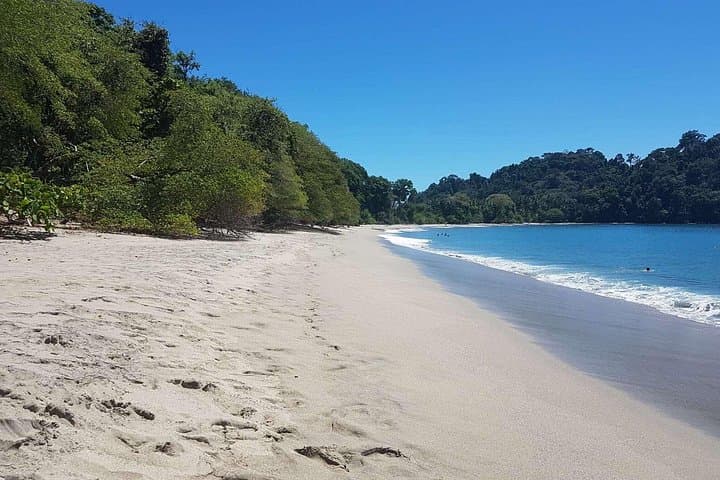


Morning light hits the Pacific and the road unwinds toward Quepos — palms lean like watchful hosts as the van climbs coastal hills. By the time you reach Manuel Antonio National Park the air is humid, birdcalls register as punctuation, and the trailhead feels like a threshold between city rhythms and rainforest time.
Morning light hits the Pacific and the road unwinds toward Quepos — palms lean like watchful hosts as the van climbs coastal hills. By the time you reach Manuel Antonio National Park the air is humid, birdcalls register as punctuation, and the trailhead feels like a threshold between city rhythms and rainforest time.
Established in 1972, Manuel Antonio protects a compact stretch of Pacific rainforest and coastal terrace carved from volcanic soils and marine sediments. The park’s steep ridges and sandy coves concentrate wildlife: howler and white-faced monkeys, sleepy two-toed sloths, and bright toucans make the short trails feel alive. Nearby Quepos grew from a fishing village into the region’s gateway, and local culture still centers on seafood, fruit stands, and tour guides who read the forest like a living map.
Expect easy, well-marked trails (about an hour for the main loop) with roots and occasional rock steps, interspersed with lookout points and beaches framed by rocky headlands. Wildlife encounters are best early; the tour times here are arranged to skirt heavy crowds and midday heat. National Park rules prohibit single-use plastic water bottles and feeding animals — both help preserve fragile coastal ecosystems.
Practical tips: wear closed-toe shoes for slipping roots, bring a reusable water bottle and insect repellent, and pack a swim change. If you’re timing matters, sunrise departures from San José give the clearest wildlife windows and the calmest beach swims. Respect wildlife distances; a patient pause often rewards you with a sloth or squirrel monkey moving through the canopy.