THE ADVENTURE COLLECTIVE® · Independent discovery and booking for outdoor travel

A single-day hike along Kilimanjaro’s Marangu Route takes you from misty rainforest to the dramatic rim of Maundi Crater. It’s a manageable, scenic way to experience Kilimanjaro’s lower slopes — perfect for travelers short on time or testing their altitude tolerance.
A single-day hike along Kilimanjaro’s Marangu Route takes you from misty rainforest to the dramatic rim of Maundi Crater. It’s a manageable, scenic way to experience Kilimanjaro’s lower slopes — perfect for travelers short on time or testing their altitude tolerance.
You stand at Marangu Gate before dawn, the park sign damp with mist and the slope of Kilimanjaro rising like a slow-moving cloud mass to the northwest. The trail slips immediately into moss-dark forest; ferns brush your calves and the air is thick with birdsong and the nervous chitter of monkeys. For the next several hours the mountain feels less like an objective and more like a living neighbor, the path winding through zones of tropical green that occasionally open to a raw, rocky skyline where Kibo’s snowfields sit high above.
Verified experiences and guided adventures in the surrounding area.
Operated by Kiota Adventures & Safaris · Moshi, Kilimanjaro Region
You stand at Marangu Gate before dawn, the park sign damp with mist and the slope of Kilimanjaro rising like a slow-moving cloud mass to the northwest. The trail slips immediately into moss-dark forest; ferns brush your calves and the air is thick with birdsong and the nervous chitter of monkeys. For the next several hours the mountain feels less like an objective and more like a living neighbor, the path winding through zones of tropical green that occasionally open to a raw, rocky skyline where Kibo’s snowfields sit high above.
The Marangu Route is the oldest and most established approach on Kilimanjaro — often called the ‘Coca-Cola’ route for its gentle grades and hut-based stops on multi-day climbs. This day hike borrows the lower sections of that classic path: rainforest, heath, and the sweeping rim around Maundi Crater. Geologically, you’re walking on volcanic shoulders of Kibo and Mawenzi; the crater and surrounding moraines are reminders of eruptions and glacial sculpting that shaped East Africa’s roof.
Culturally the approach skirts Chagga farmland and compact villages perched on fertile slopes. The Chagga have farmed these volcanic soils for generations; on a clear day your guide can point out terraced plots and coffee bushes that feed Moshi below. Guides and porters remain central to park access — they know safe lines through sudden cloud and where wildlife sightings concentrate.
For practical planning: the full program runs most of the day, including transfers to and from Moshi or nearby lodges. Expect roughly 6–8 hours of walking and 700–900 meters of cumulative elevation gain depending on chosen turnaround points. Trails are well-maintained but can be slick after rains; sections climb steadily but never require technical gear. The hike’s reward is proximity to Kibo’s high ridgelines and the crater viewpoint, with panoramic views back toward the plains and, on good days, across to Mount Meru.
Bring layered clothing for dramatic shifts in temperature, waterproof footwear for muddy sections, and at least 2–3 liters of water. Start early to avoid afternoon clouds and to get the clearest light for photos. Respect park rules: stay on marked trails, carry out trash, and follow your guide’s directions for wildlife encounters. If you’re acclimatizing for a longer summit attempt, this hike is an effective, scenic way to test elevation response without the commitment of a multi-day trek.
On balance, the Marangu Route day hike delivers a concentrated dose of Kilimanjaro — forest, culture, volcanic terrain, and sweeping viewpoints — packaged to be accessible for fit day-trippers and useful for climbers checking their altitude legs.
No — this is a day hike on the lower Marangu Route that reaches Maundi Crater and viewpoints; it does not summit Kilimanjaro.
Expect roughly 10–16 km round-trip depending on the exact turnaround point, with about 700–900 meters cumulative elevation gain.
Yes — park regulations require guides and park entry permits; the tour includes a professional mountain guide and fees.
Trails are well-maintained but can be muddy, steep in sections, and include roots and rock steps; no technical climbing required.
The offering includes bottled water and lunch as stated in the itinerary; bring extra snacks if you need more energy between meals.
The hike is suitable for a wide range of ages if participants are reasonably fit; consult the operator if there are cardio concerns or mobility limits.
Kiota Adventures & Safaris operates guided outdoor trips and adventures with an emphasis on safety, stewardship, and memorable experiences.


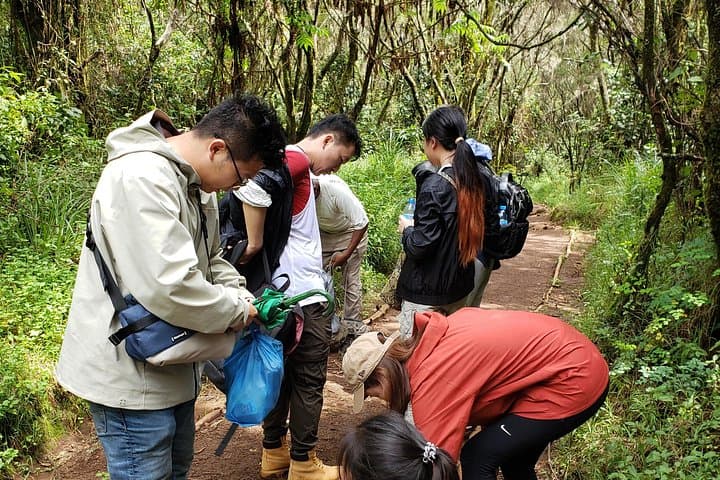

You stand at Marangu Gate before dawn, the park sign damp with mist and the slope of Kilimanjaro rising like a slow-moving cloud mass to the northwest. The trail slips immediately into moss-dark forest; ferns brush your calves and the air is thick with birdsong and the nervous chitter of monkeys. For the next several hours the mountain feels less like an objective and more like a living neighbor, the path winding through zones of tropical green that occasionally open to a raw, rocky skyline where Kibo’s snowfields sit high above.
You stand at Marangu Gate before dawn, the park sign damp with mist and the slope of Kilimanjaro rising like a slow-moving cloud mass to the northwest. The trail slips immediately into moss-dark forest; ferns brush your calves and the air is thick with birdsong and the nervous chitter of monkeys. For the next several hours the mountain feels less like an objective and more like a living neighbor, the path winding through zones of tropical green that occasionally open to a raw, rocky skyline where Kibo’s snowfields sit high above.
The Marangu Route is the oldest and most established approach on Kilimanjaro — often called the ‘Coca-Cola’ route for its gentle grades and hut-based stops on multi-day climbs. This day hike borrows the lower sections of that classic path: rainforest, heath, and the sweeping rim around Maundi Crater. Geologically, you’re walking on volcanic shoulders of Kibo and Mawenzi; the crater and surrounding moraines are reminders of eruptions and glacial sculpting that shaped East Africa’s roof.
Culturally the approach skirts Chagga farmland and compact villages perched on fertile slopes. The Chagga have farmed these volcanic soils for generations; on a clear day your guide can point out terraced plots and coffee bushes that feed Moshi below. Guides and porters remain central to park access — they know safe lines through sudden cloud and where wildlife sightings concentrate.
For practical planning: the full program runs most of the day, including transfers to and from Moshi or nearby lodges. Expect roughly 6–8 hours of walking and 700–900 meters of cumulative elevation gain depending on chosen turnaround points. Trails are well-maintained but can be slick after rains; sections climb steadily but never require technical gear. The hike’s reward is proximity to Kibo’s high ridgelines and the crater viewpoint, with panoramic views back toward the plains and, on good days, across to Mount Meru.
Bring layered clothing for dramatic shifts in temperature, waterproof footwear for muddy sections, and at least 2–3 liters of water. Start early to avoid afternoon clouds and to get the clearest light for photos. Respect park rules: stay on marked trails, carry out trash, and follow your guide’s directions for wildlife encounters. If you’re acclimatizing for a longer summit attempt, this hike is an effective, scenic way to test elevation response without the commitment of a multi-day trek.
On balance, the Marangu Route day hike delivers a concentrated dose of Kilimanjaro — forest, culture, volcanic terrain, and sweeping viewpoints — packaged to be accessible for fit day-trippers and useful for climbers checking their altitude legs.