THE ADVENTURE COLLECTIVE® · Independent discovery and booking for outdoor travel

Ride private bike-only trails from Chincheros to Moray and Maras in a single day, sampling Incan agricultural terraces and pre-Incan salt pans. This high-altitude Sacred Valley loop blends cultural stops with long, scenic riding and van support when you need it.
Ride private bike-only trails from Chincheros to Moray and Maras in a single day, sampling Incan agricultural terraces and pre-Incan salt pans. This high-altitude Sacred Valley loop blends cultural stops with long, scenic riding and van support when you need it.
You start before the sun warms the high valley, pedals turning on cool, thin air as the Andes open ahead. The trail out of Chincheros slips along river valleys and terraces, the landscape alternately pushing and easing your pace—glaciers loom in the distance while local fields hold crops that still follow ancient patterns.
Verified experiences and guided adventures in the surrounding area.
Operated by Cultural Immersion Travel Peru E.I.R.L. · Cusco, Cusco Region
You start before the sun warms the high valley, pedals turning on cool, thin air as the Andes open ahead. The trail out of Chincheros slips along river valleys and terraces, the landscape alternately pushing and easing your pace—glaciers loom in the distance while local fields hold crops that still follow ancient patterns.
Moray’s concentric terraces appear like an amphitheater carved into the earth: an Incan agricultural laboratory where microclimates were engineered to test crops at different temperatures. Nearby, Maras keeps a different kind of history—salt pans cut into the hillside since pre-Incan times, their stepped pools glittering bright against rust-red soil.
The ride itself uses primarily bike-only trails that are mostly flat but cover long distances at altitude; a support van follows the group and can assist if you need a break. Expect rocky, dusty singletrack, paved stretches through villages, and short climbs that feel harder because of the elevation.
Practical notes: you’ll need strong aerobic fitness for sustained riding at 3,000–3,700 m (9,800–12,100 ft). Bring sun protection, layered clothing for wind and temperature swings, and a hydration system. Guides supply bikes, helmets, lunch, and transport back to Cusco, but basic bike-repair know-how helps. Time your visit for the dry months (May–September) for firmer trails and clearer views. Ride with respect—these are living communities with deep traditions; slow down in towns and tip locally when services are good.
You should have solid endurance cycling experience—rides are long and at high altitude; the van is available if you need to skip sections.
Yes; the tour includes a mountain bike and helmet, plus a support van and guide.
Riding takes place roughly between 3,000–3,700 meters (9,800–12,100 ft), which can intensify effort and require acclimatization.
Site visits are included in the itinerary, but check with the operator if any site entrance fees are charged separately.
Cultural Immersion Travel Peru E.I.R.L. operates guided outdoor trips and adventures with an emphasis on safety, stewardship, and memorable experiences.


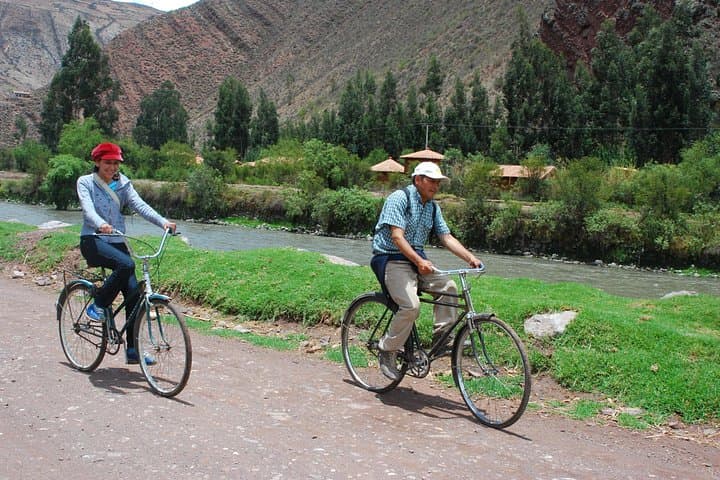

You start before the sun warms the high valley, pedals turning on cool, thin air as the Andes open ahead. The trail out of Chincheros slips along river valleys and terraces, the landscape alternately pushing and easing your pace—glaciers loom in the distance while local fields hold crops that still follow ancient patterns.
You start before the sun warms the high valley, pedals turning on cool, thin air as the Andes open ahead. The trail out of Chincheros slips along river valleys and terraces, the landscape alternately pushing and easing your pace—glaciers loom in the distance while local fields hold crops that still follow ancient patterns.
Moray’s concentric terraces appear like an amphitheater carved into the earth: an Incan agricultural laboratory where microclimates were engineered to test crops at different temperatures. Nearby, Maras keeps a different kind of history—salt pans cut into the hillside since pre-Incan times, their stepped pools glittering bright against rust-red soil.
The ride itself uses primarily bike-only trails that are mostly flat but cover long distances at altitude; a support van follows the group and can assist if you need a break. Expect rocky, dusty singletrack, paved stretches through villages, and short climbs that feel harder because of the elevation.
Practical notes: you’ll need strong aerobic fitness for sustained riding at 3,000–3,700 m (9,800–12,100 ft). Bring sun protection, layered clothing for wind and temperature swings, and a hydration system. Guides supply bikes, helmets, lunch, and transport back to Cusco, but basic bike-repair know-how helps. Time your visit for the dry months (May–September) for firmer trails and clearer views. Ride with respect—these are living communities with deep traditions; slow down in towns and tip locally when services are good.