THE ADVENTURE COLLECTIVE® · Independent discovery and booking for outdoor travel

Explore coastal karst and a lantern-lit UNESCO town in one day. This small-group tour from Da Nang pairs limestone caves and pagodas at the Marble Mountains with a sunset stroll along Hoi An’s Thu Bon River.
Explore coastal karst and a lantern-lit UNESCO town in one day. This small-group tour from Da Nang pairs limestone caves and pagodas at the Marble Mountains with a sunset stroll along Hoi An’s Thu Bon River.
You step out of the mini-bus as late afternoon light softens the limestone faces of the Marble Mountains. Wind threads through open cave mouths while the town horns from the coast remind you this is a working landscape, not just a postcard. Later, lanterns on the Thu Bon River begin to flicker, and Hoi An’s streets become a river of amber reflection.
Verified experiences and guided adventures in the surrounding area.
You step out of the mini-bus as late afternoon light softens the limestone faces of the Marble Mountains. Wind threads through open cave mouths while the town horns from the coast remind you this is a working landscape, not just a postcard. Later, lanterns on the Thu Bon River begin to flicker, and Hoi An’s streets become a river of amber reflection.
The Marble Mountains are a compact karst cluster of five limestone hills—formed over millions of years as seabeds rose and fractured. Within their stone are Buddhist shrines, Cham-era carvings and steep staircases that cut through grottoes. Hoi An’s Old Town, a UNESCO World Heritage Site, preserves merchant houses and Japanese bridgework from the 16th–18th centuries; its culture is shaped by trading routes that once linked Southeast Asia to China and Japan.
Expect roughly 6–7 hours of activity, including short hikes, steep stone steps (elevation gain at Marble Mountains is modest—around 80–150 m depending on route) and walking on uneven pavement in Hoi An. Practicalities: wear sturdy walking shoes, carry sun protection and 1–1.5 liters of water, and bring a compact flashlight for dim cave passages. Modest clothing is required for temple visits.
Timing matters—arrive Marble Mountains in late afternoon light for dramatic shadows; plan to be riverside in Hoi An before full sunset to watch lanterns and the reflective glow. Guides add historical context and route choices, but be prepared for narrow steps and crowds at popular viewpoints.
The tour runs about 6–7 hours total (the operator lists 390 minutes), typically departing Da Nang in the afternoon and returning the same evening.
Yes; expect several flights of steep stone steps and switchbacks to reach viewpoints and cave entrances—about 80–150 m of elevation gain on common routes.
Hoi An’s flat streets are family-friendly, but Marble Mountains’ stairs can be challenging for very young children or those with limited mobility; consider mobility and footwear.
Most small-group tours include guide services and coordinate site access, but confirm whether entrance fees are covered at booking.
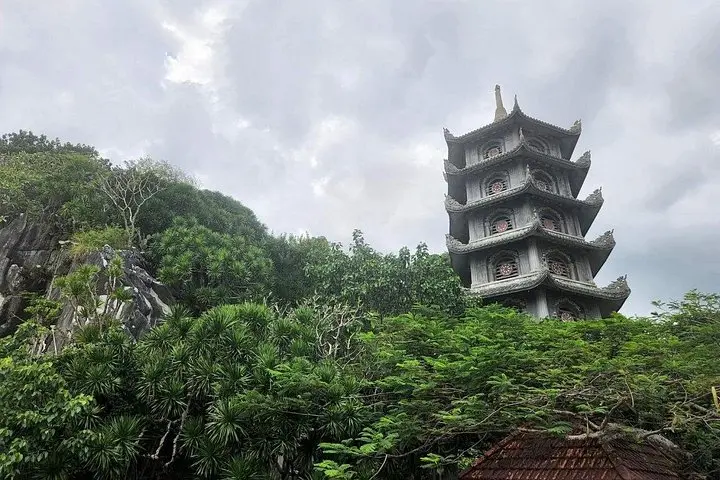
You step out of the mini-bus as late afternoon light softens the limestone faces of the Marble Mountains. Wind threads through open cave mouths while the town horns from the coast remind you this is a working landscape, not just a postcard. Later, lanterns on the Thu Bon River begin to flicker, and Hoi An’s streets become a river of amber reflection.
You step out of the mini-bus as late afternoon light softens the limestone faces of the Marble Mountains. Wind threads through open cave mouths while the town horns from the coast remind you this is a working landscape, not just a postcard. Later, lanterns on the Thu Bon River begin to flicker, and Hoi An’s streets become a river of amber reflection.
The Marble Mountains are a compact karst cluster of five limestone hills—formed over millions of years as seabeds rose and fractured. Within their stone are Buddhist shrines, Cham-era carvings and steep staircases that cut through grottoes. Hoi An’s Old Town, a UNESCO World Heritage Site, preserves merchant houses and Japanese bridgework from the 16th–18th centuries; its culture is shaped by trading routes that once linked Southeast Asia to China and Japan.
Expect roughly 6–7 hours of activity, including short hikes, steep stone steps (elevation gain at Marble Mountains is modest—around 80–150 m depending on route) and walking on uneven pavement in Hoi An. Practicalities: wear sturdy walking shoes, carry sun protection and 1–1.5 liters of water, and bring a compact flashlight for dim cave passages. Modest clothing is required for temple visits.
Timing matters—arrive Marble Mountains in late afternoon light for dramatic shadows; plan to be riverside in Hoi An before full sunset to watch lanterns and the reflective glow. Guides add historical context and route choices, but be prepared for narrow steps and crowds at popular viewpoints.