THE ADVENTURE COLLECTIVE® · Independent discovery and booking for outdoor travel

A high-altitude trek from Leh that follows the Markha River through farmland, remote Ladakhi villages and up to the Kongmaru La pass. Expect long days, stark geology, and close encounters with pastoral mountain life.
A high-altitude trek from Leh that follows the Markha River through farmland, remote Ladakhi villages and up to the Kongmaru La pass. Expect long days, stark geology, and close encounters with pastoral mountain life.
Dawn in the Markha Valley arrives as a cold, brittle light that strips the stars from the high ridges and reveals prayer flags flapping like bright punctuation across stone walls. The trail slips away from Leh’s dust into a carved river corridor: pasture, barley fields, then the exposed scree and moraine that signal real altitude.
Verified experiences and guided adventures in the surrounding area.
Operated by E Ladakh Tourism · Leh, Ladakh
Dawn in the Markha Valley arrives as a cold, brittle light that strips the stars from the high ridges and reveals prayer flags flapping like bright punctuation across stone walls. The trail slips away from Leh’s dust into a carved river corridor: pasture, barley fields, then the exposed scree and moraine that signal real altitude.
This route threads through centuries-old Ladakhi villages where whitewashed gompas guard fields irrigated by ancient channels. Geologically the valley is a cross-section of trans-Himalayan terrain—sandstone canyons, glaciated cirques around Kang Yangtse, and the stony passes like Kongmaru La (5,265 m) that frame views of Nun-Kun to the south and the Tibetan ranges to the north.
Culturally the trek reveals pastoral rhythms: nomadic yak herders, stacked stone shelters, and mani walls carved with mantras. Wildlife—snow leopard territory at higher elevations, and blue sheep on the slopes—reminds trekkers this is a working landscape, not a playground.
Practical guidance is plain: acclimatize in Leh (3,500 m) for at least 48 hours, carry layers for intense sun and thin nights, and plan for long walking days of mixed terrain—riverbed, scree, and steep ascents. Camps at Nimaling offer one of the most rewarding high-altitude bivouacs, but strong winds can arrive without warning.
Expect 6–8 days on trail depending on pace and route, and prepare for variable weather between June and September. Hydration, slow-paced ascent, and a reliable sleeping bag matter more than speed; navigation is straightforward on marked trails but a local guide adds safety and cultural insight. The Markha Valley is straightforward to attempt, but it insists on respect for altitude and the fragile mountain environment.
June to September offers the most stable weather, open passes and flowing water; early season may have residual snow and late season brings cold and fewer services.
Indian nationals generally do not need special permits inside Ladakh beyond ID; foreign nationals should check local rules and often register with local authorities or obtain permits from Leh.
Kongmaru La is a high, exposed pass at 5,265 m—physically demanding due to altitude and loose terrain; take it slow and consider a guide if unfamiliar with high passes.
The route commonly uses tented camps at Nimaling and other nights; services vary by operator—confirm sleeping bag inclusion and meal arrangements when booking.
E Ladakh Tourism operates guided outdoor trips and adventures with an emphasis on safety, stewardship, and memorable experiences.
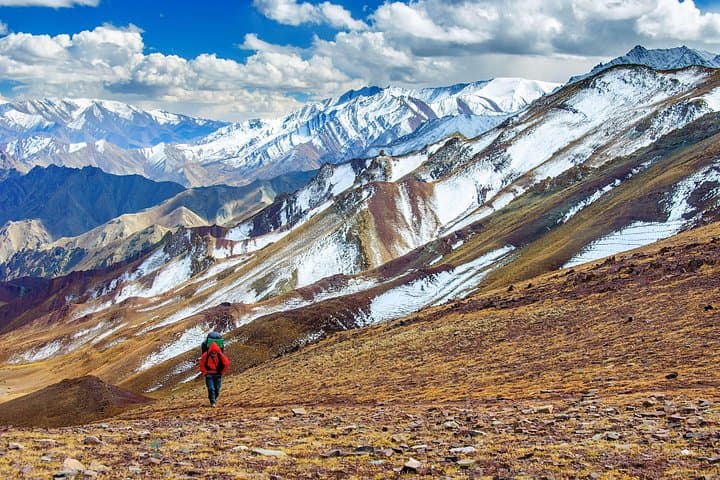


Dawn in the Markha Valley arrives as a cold, brittle light that strips the stars from the high ridges and reveals prayer flags flapping like bright punctuation across stone walls. The trail slips away from Leh’s dust into a carved river corridor: pasture, barley fields, then the exposed scree and moraine that signal real altitude.
Dawn in the Markha Valley arrives as a cold, brittle light that strips the stars from the high ridges and reveals prayer flags flapping like bright punctuation across stone walls. The trail slips away from Leh’s dust into a carved river corridor: pasture, barley fields, then the exposed scree and moraine that signal real altitude.
This route threads through centuries-old Ladakhi villages where whitewashed gompas guard fields irrigated by ancient channels. Geologically the valley is a cross-section of trans-Himalayan terrain—sandstone canyons, glaciated cirques around Kang Yangtse, and the stony passes like Kongmaru La (5,265 m) that frame views of Nun-Kun to the south and the Tibetan ranges to the north.
Culturally the trek reveals pastoral rhythms: nomadic yak herders, stacked stone shelters, and mani walls carved with mantras. Wildlife—snow leopard territory at higher elevations, and blue sheep on the slopes—reminds trekkers this is a working landscape, not a playground.
Practical guidance is plain: acclimatize in Leh (3,500 m) for at least 48 hours, carry layers for intense sun and thin nights, and plan for long walking days of mixed terrain—riverbed, scree, and steep ascents. Camps at Nimaling offer one of the most rewarding high-altitude bivouacs, but strong winds can arrive without warning.
Expect 6–8 days on trail depending on pace and route, and prepare for variable weather between June and September. Hydration, slow-paced ascent, and a reliable sleeping bag matter more than speed; navigation is straightforward on marked trails but a local guide adds safety and cultural insight. The Markha Valley is straightforward to attempt, but it insists on respect for altitude and the fragile mountain environment.