THE ADVENTURE COLLECTIVE® · Independent discovery and booking for outdoor travel

Cross the High Atlas, stand at Ait Ben Haddou, and ride camels into the ochre sea of Erg Chebbi on this compact three-day Marrakech-to-Fes Sahara tour. Expect long drives, dramatic gorges, and dune camping timed for sunset and sunrise.
Cross the High Atlas, stand at Ait Ben Haddou, and ride camels into the ochre sea of Erg Chebbi on this compact three-day Marrakech-to-Fes Sahara tour. Expect long drives, dramatic gorges, and dune camping timed for sunset and sunrise.
Dawn spills gold across Erg Chebbi as a line of camels jigsaws the dune ridge and the first light picks out Ait Ben Haddou’s clay-red walls far behind. You feel the scale of the Sahara the moment the tar highway runs out and the landscape opens to wind-sculpted sand and broad, empty sky.
Verified experiences and guided adventures in the surrounding area.
Dawn spills gold across Erg Chebbi as a line of camels jigsaws the dune ridge and the first light picks out Ait Ben Haddou’s clay-red walls far behind. You feel the scale of the Sahara the moment the tar highway runs out and the landscape opens to wind-sculpted sand and broad, empty sky.
This three-day route follows ancient caravan corridors and modern mountain passes: Marrakech over the Tizi n’Tichka (about 2,260 m), through the fortified ksar of Ait Ben Haddou, down the Dades Valley’s folded sandstone, and finally into the Merzouga dunes. Geology here reads as chapters — High Atlas metamorphosed rock, river-cut gorges, then the sweeping erg where grains of Sahara have migrated for millennia.
The region is predominantly Amazigh (Berber). Villages offer mint tea and tajine; camps range from basic nomad tents to luxury bivouacs that use local crews and traditional building techniques. Wildlife is sparse but adapted — nocturnal foxes and desert birds that appear around watering points.
Practical notes: the full drive covers roughly 550–650 km over three days with long transfer stretches (expect multiple 4–8 hour driving segments). Camel treks across dunes are typically 2–5 km; walking on sand is slower and requires sturdy footwear. Bring layered clothing for hot days and cold desert nights, sun protection, a refillable water bottle, and earplugs for camp nights. If you plan optional quad-biking or sandboarding, check equipment, insurance, and local safety briefings.
This trip balances road travel and desert immersion — timing your arrival at the dunes for sunset and sunrise is the simplest way to make every mile count.
Camel transfers across the dunes are usually 2–5 km and last 45–90 minutes; most operators let guests walk portions or skip the camel and walk instead.
Options range from basic nomad-style tents to luxury bivouacs with beds and private facilities; confirm the camp category when booking.
Families and older travelers do the route regularly, but be prepared for long vehicle transfers and uneven terrain; discuss any mobility concerns with the operator before booking.
Expect multiple long transfers totaling roughly 550–650 km over three days, with several 4–8 hour driving segments including mountain passes and valley roads.
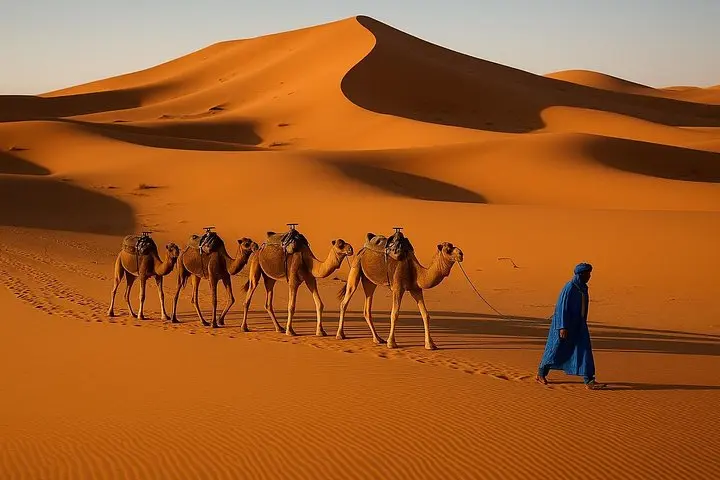
Dawn spills gold across Erg Chebbi as a line of camels jigsaws the dune ridge and the first light picks out Ait Ben Haddou’s clay-red walls far behind. You feel the scale of the Sahara the moment the tar highway runs out and the landscape opens to wind-sculpted sand and broad, empty sky.
Dawn spills gold across Erg Chebbi as a line of camels jigsaws the dune ridge and the first light picks out Ait Ben Haddou’s clay-red walls far behind. You feel the scale of the Sahara the moment the tar highway runs out and the landscape opens to wind-sculpted sand and broad, empty sky.
This three-day route follows ancient caravan corridors and modern mountain passes: Marrakech over the Tizi n’Tichka (about 2,260 m), through the fortified ksar of Ait Ben Haddou, down the Dades Valley’s folded sandstone, and finally into the Merzouga dunes. Geology here reads as chapters — High Atlas metamorphosed rock, river-cut gorges, then the sweeping erg where grains of Sahara have migrated for millennia.
The region is predominantly Amazigh (Berber). Villages offer mint tea and tajine; camps range from basic nomad tents to luxury bivouacs that use local crews and traditional building techniques. Wildlife is sparse but adapted — nocturnal foxes and desert birds that appear around watering points.
Practical notes: the full drive covers roughly 550–650 km over three days with long transfer stretches (expect multiple 4–8 hour driving segments). Camel treks across dunes are typically 2–5 km; walking on sand is slower and requires sturdy footwear. Bring layered clothing for hot days and cold desert nights, sun protection, a refillable water bottle, and earplugs for camp nights. If you plan optional quad-biking or sandboarding, check equipment, insurance, and local safety briefings.
This trip balances road travel and desert immersion — timing your arrival at the dunes for sunset and sunrise is the simplest way to make every mile count.