THE ADVENTURE COLLECTIVE® · Independent discovery and booking for outdoor travel

Cross the High Atlas, explore Aït Ben Haddou and ride camels into Erg Chebbi on a focused three-day loop from Marrakech. Spend a night in a traditional Berber camp under vast desert skies and return through rose-scented valleys and cinematic kasbahs.
Cross the High Atlas, explore Aït Ben Haddou and ride camels into Erg Chebbi on a focused three-day loop from Marrakech. Spend a night in a traditional Berber camp under vast desert skies and return through rose-scented valleys and cinematic kasbahs.
The minibus pulls out of Marrakech before dawn and the High Atlas unfolds like a changing coastline: rock, snow-streaked passes and then the ochre terraces that signal a long descent toward the desert.
Verified experiences and guided adventures in the surrounding area.
Operated by Morocco Tourism Travel · Merzouga, Drâa-Tafilalet
The minibus pulls out of Marrakech before dawn and the High Atlas unfolds like a changing coastline: rock, snow-streaked passes and then the ochre terraces that signal a long descent toward the desert.
On day one the road climbs Tizi n’Tichka (2,260 m) and unwinds past Aït Ben Haddou, a centuries-old ksar whose sunbaked walls have framed Hollywood epics and Berber trade routes. Geology here traces the push of the African plate; river-cut gorges and fossil-strewn plains appear as you move east toward the Dades and Todra canyons.
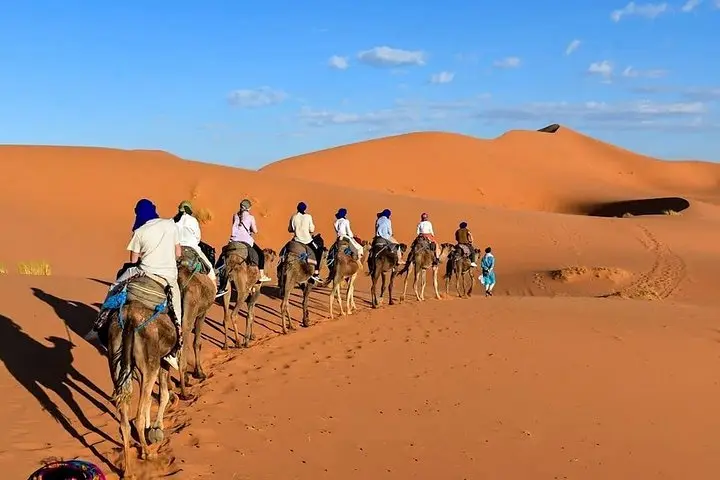
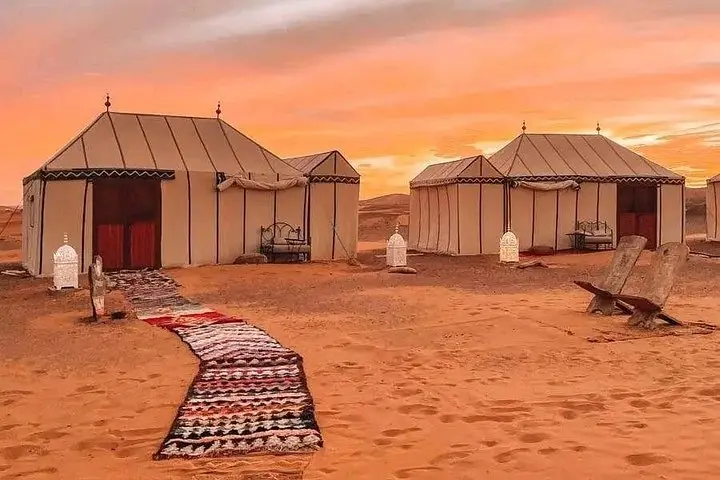
By day two the landscape shifts again—river oases and palm grooves give way to gravel plains and then the orange crests of Erg Chebbi. Travelers mount camels at sunset; the caravan's slow sway and the dune’s ridgeline create a clean horizon where stars seem to gather intentionally. Overnight, a Berber camp offers mattresses, dinner by a low fire and live music that carries across the open sand.
The final day returns through Rose Valley and Ouarzazate, where kasbahs and film studios punctuate the route back over the Atlas.
Practical guidance: pack layers for cold desert nights, bring at least 2 liters of water per person for day rides, sun protection and sturdy shoes for canyon walks. Expect long stretches in a climate-controlled vehicle, light walking in gorges, a 1–2 hour camel transfer and tented accommodation with basic facilities. Ideal for travelers seeking a compact, immersive Sahara experience without technical requirements.
Camel transfers into Erg Chebbi are typically 1–2 hours depending on the camp location and the caravan pace.
Most traditional camps offer mattresses and shared or basic ensuite facilities; private tent upgrades may be available on request.
Yes—children can join, but expect long vehicle transfers; infants may need to sit on laps during transport.
The tour involves vehicle travel, short walks, and camel mounting; those with significant mobility limitations should consult the operator before booking.
Morocco Tourism Travel operates guided outdoor trips and adventures with an emphasis on safety, stewardship, and memorable experiences.
The minibus pulls out of Marrakech before dawn and the High Atlas unfolds like a changing coastline: rock, snow-streaked passes and then the ochre terraces that signal a long descent toward the desert.
The minibus pulls out of Marrakech before dawn and the High Atlas unfolds like a changing coastline: rock, snow-streaked passes and then the ochre terraces that signal a long descent toward the desert.
On day one the road climbs Tizi n’Tichka (2,260 m) and unwinds past Aït Ben Haddou, a centuries-old ksar whose sunbaked walls have framed Hollywood epics and Berber trade routes. Geology here traces the push of the African plate; river-cut gorges and fossil-strewn plains appear as you move east toward the Dades and Todra canyons.
By day two the landscape shifts again—river oases and palm grooves give way to gravel plains and then the orange crests of Erg Chebbi. Travelers mount camels at sunset; the caravan's slow sway and the dune’s ridgeline create a clean horizon where stars seem to gather intentionally. Overnight, a Berber camp offers mattresses, dinner by a low fire and live music that carries across the open sand.
The final day returns through Rose Valley and Ouarzazate, where kasbahs and film studios punctuate the route back over the Atlas.
Practical guidance: pack layers for cold desert nights, bring at least 2 liters of water per person for day rides, sun protection and sturdy shoes for canyon walks. Expect long stretches in a climate-controlled vehicle, light walking in gorges, a 1–2 hour camel transfer and tented accommodation with basic facilities. Ideal for travelers seeking a compact, immersive Sahara experience without technical requirements.